
English is full of words that look almost identical but spark endless debates among writers and grammar enthusiasts. One of the most common examples is orientated vs oriented. If you’ve ever wondered whether one is more correct than the other, you’re definitely not alone.
The good news is that both words are accepted in modern English. However, they are not used equally everywhere. Regional preferences, writing style, and context all influence which version sounds more natural.
In this guide, we’ll explore the meanings, grammar, regional usage, examples, and subtle differences between these two commonly debated words.
Orientated vs Oriented Meaning
At their core, both words mean the same thing.
They describe:
- Being aligned toward something
- Being familiar with a subject or environment
- Focusing on a goal, direction, or category
Examples:
- customer-oriented business
- career-orientated training
In both cases, the meaning stays essentially the same.
Understanding the shared meaning helps simplify the entire orientated vs oriented debate.
Is Orientated vs Oriented a Real Grammar Issue?
Technically, no. Both forms are recognized by dictionaries and grammar guides.
However:
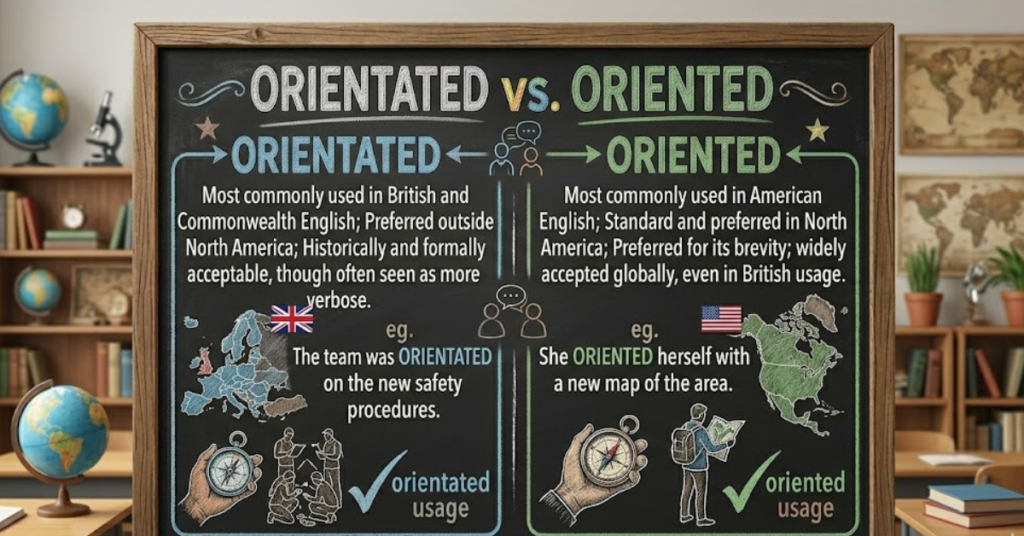
- “Oriented” is generally more common worldwide.
- “Orientated” appears more frequently in British English and some international varieties.
So the issue is less about correctness and more about style and regional preference.
What Does “Oriented” Mean?
“Oriented” is the shorter and more widely accepted form.
It commonly appears in:
- American English
- Business writing
- Academic writing
- Professional communication
Examples of Oriented
- The company is customer-oriented.
- She is career-oriented.
- The training program is results-oriented.
- We quickly became oriented to the new environment.
The word often describes focus, direction, or adaptation.
What Does “Orientated” Mean?
“Orientated” carries the same meaning but uses a slightly longer form.
Examples of Orientated
- The school is community-orientated.
- He became orientated after reading the guide.
- Their approach is family-orientated.
Although less common globally, the word is still grammatically acceptable.
This is why discussions about orientated vs oriented meaning often conclude that the difference is stylistic rather than semantic.
Orientated vs Oriented UK Usage
Regional differences play a major role in word preference.
In the United Kingdom
“Orientated” appears more frequently in:
- British business writing
- UK job descriptions
- Educational content
- Everyday speech
However, “oriented” is also understood and widely accepted in the UK.
This explains why many people search for orientated vs oriented uk comparisons.
Orientated vs Oriented in American English
In the United States, “oriented” strongly dominates.
You’ll commonly see:
- goal-oriented
- customer-oriented
- detail-oriented
The longer form “orientated” sounds less natural to many American speakers, even though it is technically correct.
Orientated vs Oriented Canada Usage
Canadian English often blends British and American influences.
As a result:
- “Oriented” is generally more common.
- “Orientated” still appears occasionally, especially in formal or British-influenced writing.
That’s why discussions about orientated vs oriented canada often show mixed preferences.
Family Orientated vs Oriented
One of the most searched examples involves family-related descriptions.
Both Are Correct
- family-oriented
- family-orientated
However, “family-oriented” is significantly more common in global English usage.
Businesses, schools, and organizations often prefer the shorter form because it sounds cleaner and more modern.
This explains the popularity of searches for family orientated vs oriented.
Why “Oriented” Became More Popular
Several factors contributed to the rise of “oriented”:
- Shorter spelling
- Simpler pronunciation
- Stronger use in American English
- Influence from global business writing
- Preference in media and corporate communication
Over time, the shorter form became dominant in many industries.
Are Both Words Grammatically Correct?
Yes. Both are grammatically acceptable.
Grammar experts generally agree that:
- “Oriented” is more common and modern.
- “Orientated” is more traditional and regionally preferred in some areas.
So if you’re asking:
- “Is orientated vs oriented correct?”
The answer is that both are correct.
Common Phrases Using Oriented
Here are some phrases that commonly use “oriented”:
- customer-oriented
- goal-oriented
- career-oriented
- team-oriented
- detail-oriented
- service-oriented
These expressions appear frequently in resumes, job descriptions, and professional communication.
Common Phrases Using Orientated
Although less common globally, these phrases still appear:
- family-orientated
- community-orientated
- business-orientated
- child-orientated
These are especially common in British-influenced writing.
Define Orientated vs Oriented Simply
If you want a quick explanation:
Oriented
Directed toward a purpose, goal, or activity.
Orientated
A variation of “oriented” with the same meaning.
This simple explanation covers the basic orientated vs oriented definition clearly.
Pronunciation Differences
Pronunciation can vary slightly depending on accent.
Oriented
Often pronounced:
- OR-ee-en-tid
Orientated
Often pronounced:
- OR-ee-en-tay-tid
The longer pronunciation is one reason some speakers prefer the shorter form.
Which Version Should You Use?
The best choice depends on your audience.
Use “Oriented” If:
- Writing for an international audience
- Using American English
- Creating professional or business content
- Wanting the more modern standard
Use “Orientated” If:
- Writing in British English
- Matching regional style preferences
- Following local organizational standards
Consistency matters more than the specific choice.
Common Mistakes to Avoid
Mistake 1: Thinking One Is Wrong
Both forms are acceptable.
Mistake 2: Mixing Styles
Choose one version and stay consistent throughout your writing.
Mistake 3: Assuming They Have Different Meanings
They do not. The meaning remains essentially the same.
Examples in Real Sentences
Sentences with “Oriented”
- Our company is customer-oriented.
- She is highly career-oriented.
- The workshop is skill-oriented.
Sentences with “Orientated”
- The clinic offers family-orientated services.
- Their teaching style is student-orientated.
- The business remains community-orientated.
These examples show how interchangeable the words often are.
Why Writers Prefer “Oriented”
Many editors and businesses prefer “oriented” because it:
- Looks cleaner
- Reads faster
- Sounds more modern
- Matches international standards
That’s why the shorter form dominates online content and corporate communication.
FAQs About Orientated vs Oriented
What is the difference between orientated and oriented?
There is no major difference in meaning. The distinction is mainly regional and stylistic.
Is “orientated” grammatically correct?
Yes. “Orientated” is a valid English word.
Which is more common: orientated or oriented?
Is “family orientated” correct?
Yes, but “family-oriented” is more common globally.
Why do British speakers use “orientated”?
British English tends to preserve some longer word forms that American English simplified over time.
Should I use orientated or oriented on a resume?
“Oriented” is usually the safer and more widely accepted choice in professional settings.
Do the words have different meanings?
No. Both words mean directed toward or focused on something.
Conclusion
Understanding orientated vs oriented becomes much easier once you realize the two words share the same meaning. The real difference comes down to regional preference, writing style, and audience expectations.
“Oriented” is more common in American English, business communication, and international writing, while “orientated” appears more frequently in British English and certain regional contexts.
In most situations, readers will understand either version correctly.The key is consistency. Choose the form that best matches your audience and writing style, then use it consistently throughout your content.
As with many English language debates, clarity and readability matter far more than strict preference.