
English has plenty of confusing word pairs, but few are as easy to mix up as grisly vs grizzly. They sound almost identical when spoken, yet their meanings are completely different. One describes something horrifying, while the other usually refers to a large bear.
Because the words are pronounced similarly, many writers accidentally use the wrong one in articles, stories, social media posts, and even news headlines. The good news is that the distinction is actually simple once you understand what each word means.
In this guide, you’ll learn the definitions, pronunciation, usage rules, memory tricks, and common mistakes associated with these commonly confused words.
What Does “Grisly” Mean?
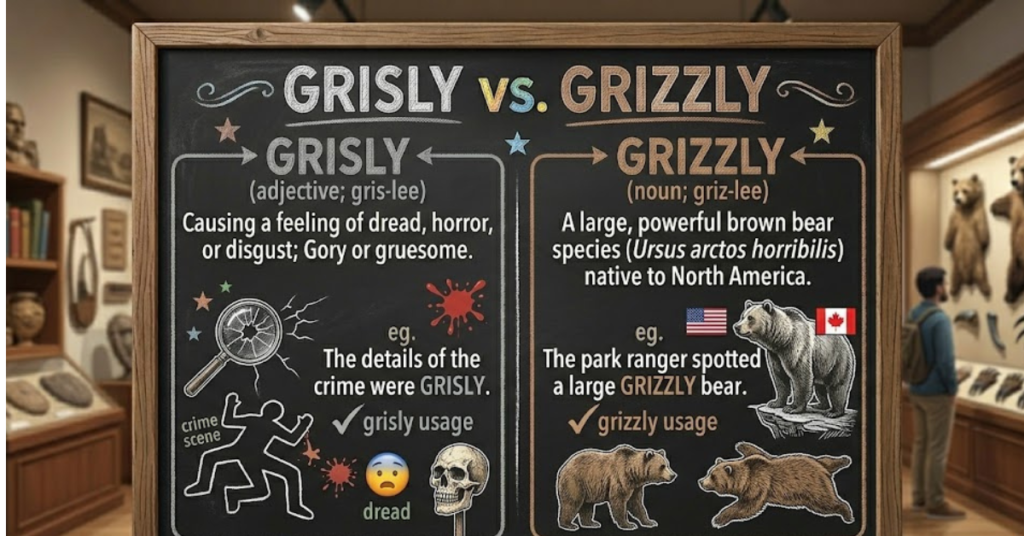
“Grisly” is an adjective used to describe something horrifying, gruesome, or shocking.
It often appears in:
- Crime reports
- Horror stories
- News articles
- Dramatic descriptions
Examples of Grisly
- The detective described the scene as grisly.
- The movie included several grisly details.
- They uncovered a grisly discovery in the abandoned house.
The word creates a strong image of something disturbing or unpleasant.
What Does “Grizzly” Mean?
“Grizzly” most commonly refers to the large North American bear species known as the grizzly bear.
It can also describe something grayish or rough in appearance.
Examples of Grizzly
- We spotted a grizzly in the forest.
- The hikers stayed alert for grizzly bears.
- His grizzly beard made him look older.
In most modern usage, “grizzly” is strongly associated with bears.
Grisly vs Grizzly Meaning Explained
The easiest way to remember the difference is this:
- Grisly = gruesome or horrifying
- Grizzly = bear or grayish appearance
Although the words sound alike, they belong to completely different categories of meaning.
One describes fear or horror.
The other describes an animal.
Why People Confuse Grisly and Grizzly
There are several reasons these words get mixed up so often:
- They sound very similar.
- Both contain nearly identical spelling.
- Many people hear the words more often than they read them.
- Autocorrect and fast typing can create mistakes.
Because “grizzly” is more familiar to many people due to the animal reference, it often replaces “grisly” accidentally in writing.
How to Remember the Difference
A simple memory trick can help you avoid mistakes.
Grisly = Gross
Both words start with “gr.”
If something is grisly, it’s disturbing or gruesome.
Grizzly = Bear
The extra “zz” can remind you of the larger, heavier spelling associated with a giant bear.
These small mental connections make the distinction much easier to remember.
Grisly in Everyday Writing
The word “grisly” usually appears in serious or dramatic contexts.
Common Situations
- Crime reporting
- Horror novels
- True crime podcasts
- Historical tragedies
Example Sentences
- The article described the grisly accident in detail.
- Police investigated the grisly murder scene.
- The documentary covered several grisly events from history.
Because the word carries strong emotional weight, writers often use it carefully.
Grizzly in Everyday Writing
“Grizzly” appears most often in wildlife discussions and nature topics.
Common Situations
- National parks
- Wildlife documentaries
- Camping advice
- Outdoor safety guides
Example Sentences
- The ranger warned campers about grizzly activity.
- A grizzly crossed the hiking trail.
- Photographers waited hours to capture the grizzly on camera.
The word can also describe someone with rough or gray features.
Example:
- He had a grizzly old beard.
Common Mistakes to Avoid
Here are some errors people frequently make.
Incorrect:
- The police uncovered a grizzly crime scene.
Correct:
- The police uncovered a grisly crime scene.
Because the sentence describes something horrifying, “grisly” is correct.
Incorrect:
- We saw a grisly bear near the river.
Correct:
- We saw a grizzly bear near the river.
Because the sentence refers to the animal, “grizzly” is correct.
Are Grisly and Grizzly Pronounced the Same?
They are very close in pronunciation, especially in casual speech.
Grisly
Usually pronounced:
- GRIZ-lee
Grizzly
Usually pronounced:
- GRIZ-lee
In many accents, they sound nearly identical. That’s why spelling and context become so important in writing.
The Origin of the Word “Grisly”
“Grisly” comes from older English roots connected to fear and horror.
Historically, the word described:
- Terror
- Dread
- Fearsome situations
Over time, it evolved into the modern meaning associated with gruesome or shocking events.
The Origin of “Grizzly Bear”
The term “grizzly” originally referred to the bear’s gray-tipped fur.
The famous Grizzly Bear gets its name from its grizzled appearance rather than from anything frightening.
Ironically, many people incorrectly assume the word “grizzly” means scary because grizzly bears are powerful animals.
Why Correct Usage Matters
Confusing these words can completely change sentence meaning.
For example:
- “Grisly bear” sounds like a horrifying bear.
- “Grizzly crime scene” accidentally suggests a bear-related crime scene.
Small spelling errors can create awkward or unintentionally funny sentences.
Correct word choice improves:
- Professional writing
- Academic work
- Storytelling clarity
- Reader understanding
Grisly vs Grizzly in Media and Pop Culture
These words appear frequently in:
- News headlines
- Crime dramas
- Wildlife documentaries
- Horror fiction
- Adventure stories
Because both words create vivid imagery, writers often rely on them for emotional impact.
However, using the wrong one can weaken credibility or confuse readers.
Simple Practice Exercises
Try these quick exercises.
Fill in the Blank
- Rangers warned visitors about the _____ bear nearby.
- The detective described the scene as _____.
- Campers stored food safely to avoid attracting a _____.
- The movie contained several _____ moments.
Answers
- grizzly
- grisly
- grizzly
- grisly
Practice helps reinforce the difference naturally.
Quick Comparison Tips
Here’s a fast way to choose correctly:
Use “Grisly” When Talking About:
- Horror
- Violence
- Disturbing scenes
- Shocking details
Use “Grizzly” When Talking About:
- Bears
- Wildlife
- Gray or rough appearance
This simple distinction solves most confusion instantly.
FAQs About Grisly vs Grizzly
What is the difference between grisly and grizzly?
“Grisly” means horrifying or gruesome, while “grizzly” usually refers to a type of bear.
Is a grizzly bear spelled with “grisly”?
No. The correct spelling is “grizzly bear.”
Why do people confuse grisly and grizzly?
The words sound almost identical and have very similar spelling.
What does grisly mean in a sentence?
It describes something shocking, horrifying, or disturbing.
Example:
- The report included grisly details.
Can grizzly describe a person?
Yes. It can describe someone with gray, rough, or shaggy features.
Are grisly and grizzly homophones?
They are near-homophones because they sound extremely similar in many accents.
Which word relates to horror?
“Grisly” relates to horror or gruesome situations.
Conclusion
Understanding grisly vs grizzly is easier once you focus on meaning instead of pronunciation. While the words sound almost identical, their definitions are completely different.
Remember:
- “Grisly” describes something horrifying or gruesome.
- “Grizzly” usually refers to a bear or a grayish appearance.
The best way to avoid confusion is to pay attention to context. If the sentence involves fear, violence, or disturbing imagery, “grisly” is probably correct. If it involves wildlife or bears, “grizzly” is the right choice.
With a little practice, you’ll be able to use both words confidently and avoid one of the most common spelling mix-ups in English writing.