
English often gives us multiple words that appear to mean the same thing, which can make writing surprisingly confusing. One example many people struggle with is disenroll or unenroll. Both terms are commonly used in schools, online courses, subscription systems, and training programs, but are they actually interchangeable?
If you’ve ever wondered which word is grammatically correct or more commonly accepted, you’re not alone. This guide explains the meaning of both terms, how they differ, where they’re used, and which option is generally preferred in modern English.
What Do “Disenroll” and “Unenroll” Mean?
Both “disenroll” and “unenroll” refer to removing someone from enrollment in a program, institution, course, or service.
In simple terms, they both mean:
- To cancel enrollment
- To withdraw participation
- To remove registration
- To stop being officially enrolled
Examples include:
- Leaving a school
- Canceling an online course
- Exiting a subscription-based learning platform
Although the meanings are nearly identical, usage preferences vary.
Is It Disenroll or Unenroll?
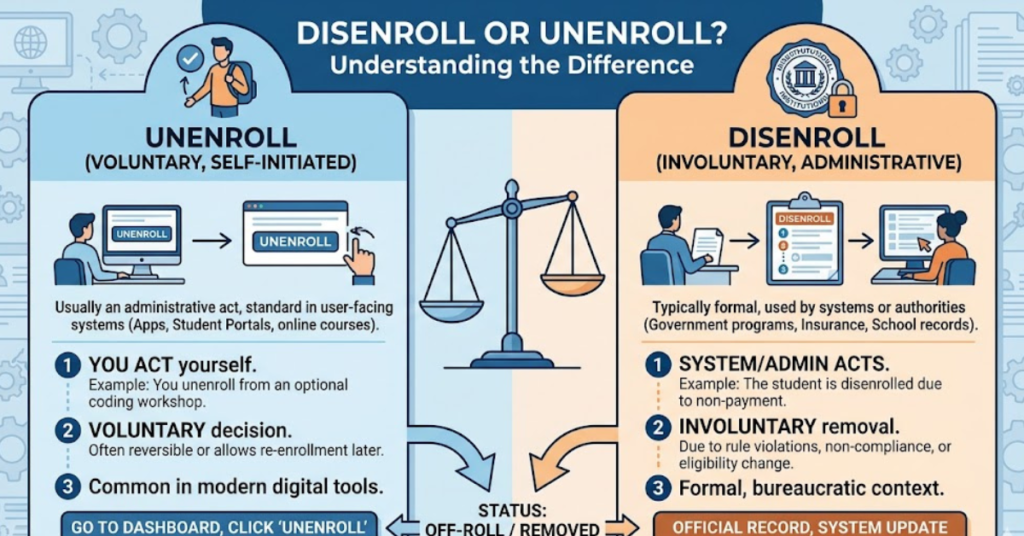
Technically, both words are considered acceptable in English. However, “unenroll” is generally more common in modern everyday usage, especially in American English.
Common Usage Trends
- “Unenroll” is often used in digital platforms and online systems.
- “Disenroll” appears more in formal or institutional settings.
Both words communicate the same action, so choosing between them often depends on context, style, and regional preference.
Understanding the Prefix Difference
The confusion becomes easier to understand when you examine the prefixes.
“Un-” Prefix
The prefix “un-” typically means:
- Reverse
- Remove
- Undo
Examples:
- Unlock
- Untie
- Uninstall
So “unenroll” literally means:
- Undo enrollment
“Dis-” Prefix
The prefix “dis-” often means:
- Opposite of
- Remove from
- Separate from
Examples:
- Disconnect
- Disapprove
- Discontinue
Therefore, “disenroll” means:
- Remove from enrollment
Both prefixes work logically with the word “enroll.”
Disenroll or Unenroll From School
The phrase disenroll or unenroll from school appears frequently because educational institutions often use both terms interchangeably.
Situations Where These Terms Are Used
Students may disenroll or unenroll when:
- Transferring schools
- Leaving a course
- Switching programs
- Homeschooling
- Withdrawing from college
Different schools may prefer one term over the other in official paperwork.
Example Sentences
- The student decided to unenroll from the program.
- Parents must submit forms to disenroll a child from school.
- She unenrolled from online classes last semester.
All of these examples are grammatically acceptable.
Which Word Sounds More Natural?
In casual modern conversation, “unenroll” often sounds more natural to many English speakers.
This is partly because:
- Online learning platforms use it frequently
- Tech systems commonly label buttons as “Unenroll”
- The “un-” prefix feels more familiar in digital language
However, “disenroll” may sound slightly more formal or administrative.
How Schools and Universities Use These Terms
Educational institutions sometimes choose terminology based on policy style.
Schools May Use “Disenroll” For:
- Official records
- Administrative procedures
- Student withdrawal documentation
Online Platforms Often Use “Unenroll” For:
- Course settings
- User dashboards
- Subscription management
Neither version is inherently wrong.
Disenroll or Unenroll Synonym Options
If you want alternatives to avoid repetition, several synonyms work depending on context.
Common Synonyms
- Withdraw
- Cancel registration
- Opt out
- Remove enrollment
- Leave a course
- Drop a class
- Terminate participation
Each option carries slightly different tones and levels of formality.
Difference Between “Drop” and “Unenroll”
People sometimes confuse “dropping” a course with unenrolling.
Dropping a Course
Usually refers to:
- Leaving an individual class
- Withdrawing before deadlines
- Adjusting schedules
Unenrolling
Usually refers to:
- Leaving an entire program
- Removing official registration
- Exiting broader participation
The exact meaning may vary by institution.
Is “Disenroll” More Formal?
In many cases, yes. “Disenroll” often appears in:
- Administrative documents
- Government systems
- Institutional policies
- Official school communication
Meanwhile, “unenroll” feels slightly more user-friendly and conversational.
Grammar and Spelling Notes
Both spellings are valid compound verbs formed from prefixes added to “enroll.”
Correct Spellings
- Unenroll
- Disenroll
Incorrect Variations
- Un-inroll
- Disinroll
- Unenrole
Using standard spelling improves clarity and professionalism.
Why People Get Confused
The confusion happens because English allows multiple negative prefixes with similar meanings.
Examples include:
- Disconnect / unplug
- Inactive / disabled
- Undo / reverse
Because both “dis-” and “un-” imply removal or reversal, both versions sound correct to many people.
Which Word Should You Use?
The best choice often depends on audience and context.
Use “Unenroll” When:
- Writing casually
- Using digital or app interfaces
- Communicating with general audiences
Use “Disenroll” When:
- Writing formally
- Referring to institutional policies
- Following official school terminology
Consistency matters more than strict preference.
FAQs
Is it disenroll or unenroll?
Both are correct, though “unenroll” is often more common in everyday usage.
What does unenroll mean?
It means to remove yourself or someone else from enrollment in a course, school, or program.
Is disenroll a real word?
Yes. “Disenroll” is a recognized English word commonly used in administrative contexts.
Which word is more common?
“Unenroll” tends to appear more frequently in modern digital platforms and casual communication.
Can schools use both terms?
Yes. Different schools and institutions may prefer different wording.
What is a synonym for unenroll?
Common synonyms include withdraw, opt out, drop, or cancel registration.
Conclusion
Understanding the difference between disenroll or unenroll is mostly about recognizing usage preferences rather than strict grammatical correctness. Both words are valid and share nearly identical meanings related to removing enrollment from a course, school, or program.
In modern everyday English, “unenroll” often sounds more natural and appears more frequently in online systems and casual communication. Meanwhile, “disenroll” tends to appear in formal educational or administrative settings.
Knowing when and how to use each term can improve your writing clarity and help you communicate more confidently in both academic and professional environments.