
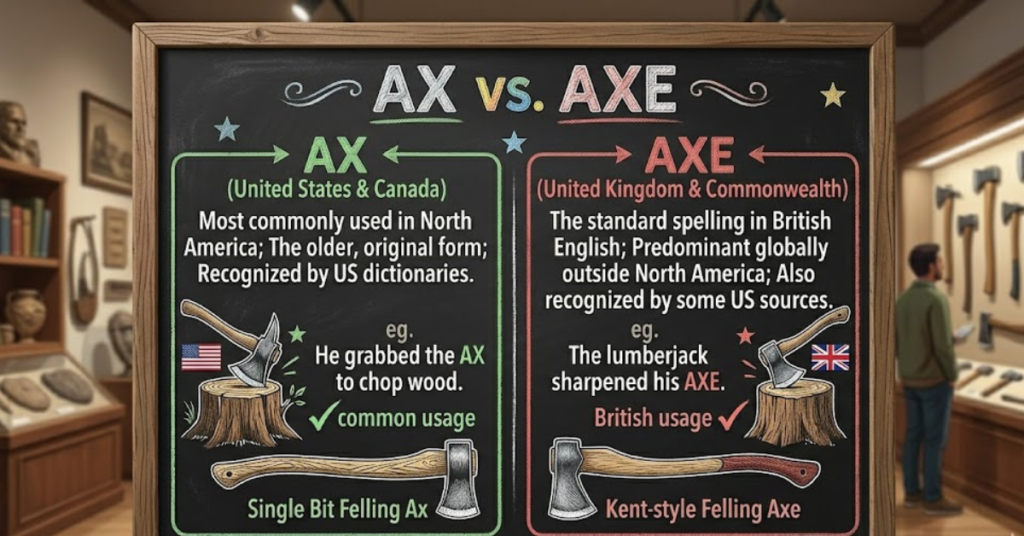

English spelling can be surprisingly confusing, especially when two words mean exactly the same thing. One classic example is ax vs axe. You’ve probably seen both spellings in books, online stores, video games, and even tech products. So which version is correct?
The short answer is that both “ax” and “axe” are acceptable spellings. The difference mostly comes down to regional preferences, writing styles, and specific industries. While one spelling is more common in American English, the other often appears in British English and modern branding.
In this guide, we’ll break down the meaning, spelling differences, grammar rules, style guide preferences, and even why the terms appear in WiFi router names.
Ax vs Axe Meaning Explained
Both “ax” and “axe” refer to the same tool:
- A cutting instrument with a sharp metal blade attached to a handle
- Commonly used for chopping wood, cutting trees, or splitting logs
Examples:
- He used an ax to split firewood.
- The firefighter carried an axe.
There is no difference in meaning between the two spellings.
Which Spelling Is Correct: Ax or Axe?
The truth is simple:
- Both spellings are correct.
- Usage depends on style and location.
“Axe” Is Traditionally More Common
Historically, “axe” has been the older and more traditional spelling in English.
“Ax” Became Popular in American English
Over time, American dictionaries and style guides accepted the shorter spelling “ax.”
Today, both versions are widely understood.
Ax vs Axe Spelling Difference
The main difference is regional and stylistic rather than grammatical.
“Axe”
Often preferred in:
- British English
- Canadian English
- General international usage
- Product branding
“Ax”
Often preferred in:
- American journalism
- AP style writing
- Newspaper headlines
- Short-form professional writing
This explains much of the confusion surrounding ax vs axe spelling.
Ax vs Axe British Usage
In British English, “axe” is generally the standard spelling.
Examples:
- The lumberjack sharpened his axe.
- The museum displayed ancient battle axes.
British publications, schools, and dictionaries typically favor the version with the “e.”
That’s why discussions about ax vs axe british usage often conclude that “axe” is more common outside the United States.
Ax vs Axe AP Style
One major reason Americans frequently see “ax” is because of AP Style.
What AP Style Recommends
The Associated Press Stylebook prefers:
- “ax” for both noun and verb forms
Examples:
- He grabbed an ax.
- The company plans to ax the project.
Because journalists and media outlets follow AP guidelines, many newspapers use the shorter spelling consistently.
This is a major factor behind searches related to ax vs axe ap style.
Why Both Spellings Exist
English spelling evolved over centuries through:
- Old English
- Germanic influences
- Regional pronunciation changes
- Publishing trends
At one point, many words had multiple accepted spellings. Over time, certain regions standardized different versions.
That’s why both “ax” and “axe” survived into modern English.
Ax vs Axe in Everyday Writing
In most situations, either spelling is acceptable as long as you stay consistent.
Good Practice
- Choose one spelling.
- Use it consistently throughout your writing.
For example:
- Don’t switch between “ax” and “axe” in the same article unless discussing the difference itself.
Consistency matters more than which spelling you choose.
Ax vs Axe WiFi: What Does It Mean?
One surprising place people encounter these terms is in networking technology.
In tech products, “AX” and “AXE” usually refer to WiFi standards rather than cutting tools.
WiFi AX
“AX” commonly refers to:
- WiFi 6 technology
- Faster wireless speeds
- Improved efficiency
- Better device handling
WiFi AXE
“AXE” usually refers to:
- WiFi 6E technology
- Access to the 6 GHz band
- Enhanced performance
- Reduced network congestion
This explains searches related to ax vs axe wifi and wifi ax vs axe.
Understanding AX vs AXE Routers
Router manufacturers often use these labels in product names.
AX Routers
Typically support:
- WiFi 6
- 2.4 GHz and 5 GHz bands
AXE Routers
Usually support:
- WiFi 6E
- 2.4 GHz, 5 GHz, and 6 GHz bands
The added “E” generally stands for “Extended” or indicates support for the newer 6 GHz spectrum.
That’s why shoppers frequently compare ax vs axe router models when buying networking equipment.
TP-Link AX vs AXE Routers
Brands like TP-Link use these labels heavily in product marketing.
TP-Link AX Models
Focus on:
- Reliable WiFi 6 performance
- Faster home networking
- Budget-friendly upgrades
TP-Link AXE Models
Usually offer:
- WiFi 6E support
- Lower latency
- Better multi-device performance
- More future-proof hardware
This is why many users search for tp link ax vs axe comparisons before purchasing routers.
Ax vs Axe in Video Games
The spelling difference also appears in gaming communities.
One popular example is the video game Animal Crossing: New Horizons.
Players often discuss:
- Stone axe
- Flimsy axe
- Golden axe
Searches like stone ax vs axe animal crossing often happen because players notice spelling differences in guides, forums, or regional versions of the game.
Ax vs Axe as a Verb
Both spellings can also function as verbs.
Examples
- The company decided to ax the project.
- The editor axed several paragraphs.
In verb form, “ax” is more common in American journalism, especially in headlines.
Which Spelling Should You Use?
The best choice depends on your audience.
Use “Ax” If:
- Writing in AP style
- Creating American news content
- Following concise editorial standards
Use “Axe” If:
- Writing for international audiences
- Following British English conventions
- Preferring traditional spelling
Neither version is wrong.
Common Expressions Using Ax or Axe
Here are some familiar phrases:
- Get the axe
- Axe murderer
- Battle axe
- Axe to grind
In idioms, spelling varies by region and publication style.
Easy Memory Trick
Here’s a simple way to remember the difference:
Axe = Traditional
The extra “e” gives it an older, classic appearance.
Ax = Shortened American Style
Shorter spelling fits modern journalistic writing.
This trick helps many writers decide which version fits their audience best.
Common Mistakes to Avoid
Mistake 1: Thinking One Is Incorrect
Both spellings are accepted in modern English.
Mistake 2: Mixing Spellings
Stay consistent throughout your writing.
Mistake 3: Confusing WiFi Terms with Grammar
AX and AXE in router names refer to networking standards, not spelling rules.
FAQs About Ax vs Axe
What is the difference between ax and axe?
There is no difference in meaning. The distinction is mainly regional and stylistic.
Is “axe” British spelling?
Yes. “Axe” is more commonly used in British English and many international publications.
Is “ax” American spelling?
Yes. American journalism and AP style often prefer “ax.”
Which spelling is more correct?
Both are correct. The best choice depends on your audience and writing style.
What does AX mean in WiFi routers?
AX usually refers to WiFi 6 technology.
What does AXE mean in routers?
AXE typically refers to WiFi 6E routers that support the 6 GHz band.
Why does AP style use “ax”?
AP style favors shorter spellings for consistency and readability.
Is there a pronunciation difference?
No. Both words are pronounced the same way.
Conclusion
Understanding ax vs axe is easier once you realize both spellings are correct. The real difference comes down to regional usage, editorial style, and context.
“Axe” is generally more traditional and common in British English, while “ax” appears frequently in American journalism and AP style. In technology, AX and AXE often describe different WiFi standards rather than spelling variations.
The most important rule is consistency. Choose the spelling that fits your audience and stick with it throughout your writing. With that simple approach, you’ll avoid confusion and communicate more clearly in both casual and professional settings.