
English has plenty of words that sound alike but mean completely different things. Few examples confuse writers more than wear vs were vs we’re vs where. These four words are pronounced similarly in many accents, yet each one serves a unique purpose in grammar and communication.
If you’ve ever stopped mid-sentence wondering whether to write “were” or “where,” you’re not alone. The confusion is incredibly common among students, native speakers, and even experienced writers.
This guide breaks everything down in a simple, conversational way. You’ll learn the meaning of each word, how to use them correctly, common mistakes to avoid, and practical examples that make the differences easy to remember.
Why Wear, Were, We’re, and Where Are So Confusing
These words are commonly confused because they are homophones or near-homophones. That means they sound almost the same when spoken aloud.
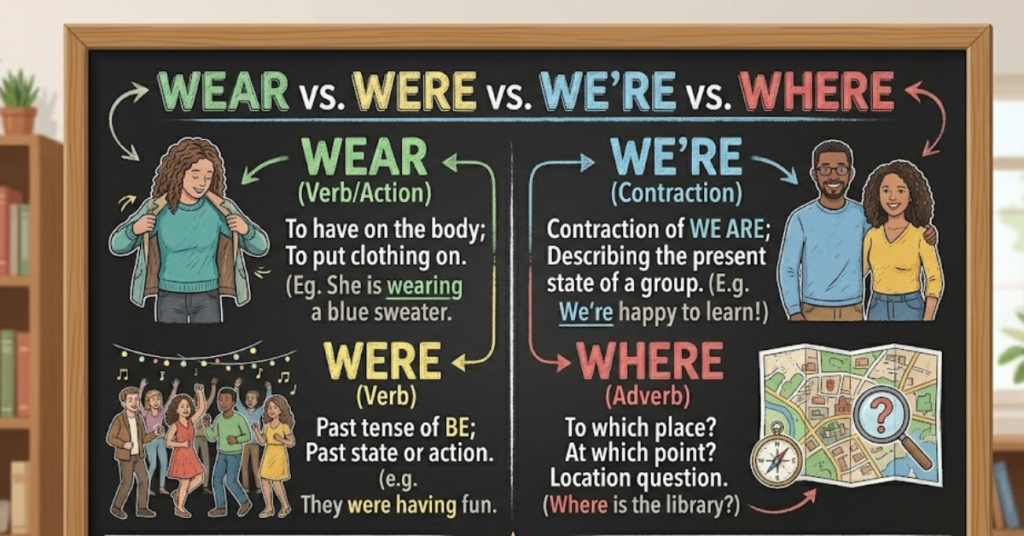
However, their meanings are completely different:
- Wear relates to clothing or physical use.
- Were is a past tense verb.
- We’re is a contraction of “we are.”
- Where refers to location or place.
Understanding context is the key to using them correctly.
What Does “Wear” Mean?
“Wear” is usually a verb connected to clothing, accessories, or physical use over time.
Examples of Wear
- I wear glasses every day.
- She likes to wear black jackets.
- You should wear comfortable shoes.
- The carpet began to wear out.
The word can also describe damage caused by repeated use.
More Ways “Wear” Is Used
- Wear and tear
- Wear a uniform
- Wear perfume
- Wear a smile
In every case, the word relates to carrying, using, or displaying something physically.
What Does “Were” Mean?
“Were” is the past tense form of the verb “to be.”
It is used with:
- You
- We
- They
- Plural subjects
Examples of Were
- We were late to the meeting.
- They were excited about the trip.
- You were right all along.
- The children were playing outside.
The word can also appear in hypothetical grammar structures:
- If I were rich, I’d travel the world.
That use belongs to the subjunctive mood in English grammar.
What Does “We’re” Mean?
“We’re” is simply a contraction of “we are.”
The apostrophe replaces the letter “a” in “are.”
Examples of We’re
- We’re going to the movies tonight.
- We’re happy to help.
- We’re learning English grammar.
- We’re not ready yet.
A quick trick:
If you can replace the word with “we are,” then “we’re” is correct.
Example
- We’re excited.
- We are excited.
Since both sentences work, “we’re” is the right choice.
What Does “Where” Mean?
“Where” refers to location, place, or direction.
It is often used in questions.
Examples of Where
- Where are my keys?
- Do you know where she lives?
- Where did you buy that shirt?
- This is the restaurant where we met.
The word helps identify places or locations in both spoken and written English.
Wear vs Were vs We’re vs Where Meaning Breakdown
Although these words sound similar, their roles are very different.
Wear
Related to clothing or usage.
Were
Past tense verb.
We’re
Short form of “we are.”
Where
Used for locations or places.
Once you connect each word to its purpose, the confusion becomes much easier to manage.
Common Sentences Using Each Word
Seeing words in context helps build confidence.
Sentences with “Wear”
- I wear a watch every day.
- She likes to wear bright colors.
Sentences with “Were”
- They were tired after work.
- We were surprised by the news.
nd=”3835″>with “We’re”
- We’re planning a vacation.
- We’re almost finished.
nd=”3917″>with “Where”
- Where is the nearest station?
- I know where he works.
Practicing these sentence patterns helps reinforce proper usage naturally.
Easy Memory Tricks for Each Word
Simple memory tools can make these words much easier to remember.
Wear = Clothing
Think:
- Wear clothes
- Wear shoes
- Wear jewelry
Were = Past
Think about past events:
- We were there yesterday.
We’re = We Are
Expand the contraction:
- We’re ready.
- We are ready.
Where = Place
Remember:
- Where asks about location.
These small connections help prevent writing mistakes.
Common Grammar Mistakes to Avoid
Here are some errors people frequently make.
Incorrect:
- Were going shopping later.
Correct:
- We’re going shopping later.
Incorrect:
- Where my jacket tomorrow.
Correct:
- Wear my jacket tomorrow.
Incorrect:
- Wear did you go?
Correct:
- Where did you go?
Incorrect:
- We where excited about the concert.
Correct:
- We were excited about the concert.
Paying attention to sentence meaning usually reveals the correct choice.
Why Pronunciation Causes Confusion
In many English accents, these words sound nearly identical.
For example:
- Were
- We’re
- Where
They may all sound like “wer.”
Because spoken English often reduces vowel sounds, listeners depend heavily on context to understand meaning.
That’s why spelling becomes especially important in writing.
Tips for Using These Words Correctly
Here are some practical strategies to improve accuracy.
1. Slow Down While Writing
Many mistakes happen because of typing too quickly.
2. Read Sentences Out Loud
Hearing the full sentence helps identify awkward grammar.
3. Replace Contractions
If “we are” works, use “we’re.”
4. Ask About Meaning
- Is this about clothing?
- A place?
- Past tense?
- A contraction?
Meaning usually points to the correct word immediately.
How These Words Appear in Everyday English
These words appear constantly in:
- Emails
- Social media posts
- School assignments
- Professional communication
- Text messages
Because they are so common, mistakes stand out quickly. Using the correct form improves clarity and professionalism.
Wear vs Were vs We’re vs Where in Casual and Formal Writing
The good news is that the meanings stay the same in both casual and professional writing.
However, contractions like “we’re” appear more frequently in informal communication.
Formal Example
- We are pleased to announce the results.
Informal Example
- We’re excited about the results.
Both are correct depending on tone and style.
Practice Exercises
Try these quick practice questions.
Fill in the Blank
- _____ are heading to the airport.
- I usually _____ sneakers to work.
- _____ did you leave your phone?
- They _____ excited about the announcement.
Answers
- We’re
- wear
- Where
- were
Simple exercises like these help build long-term grammar confidence.
Why Learning These Differences Matters
Confusing these words can:
- Change sentence meaning
- Create misunderstandings
- Make writing look careless
- Reduce professionalism
Mastering them helps improve communication in both academic and everyday settings.
Even fluent English speakers occasionally mix them up, so learning the distinction is a valuable writing skill.
FAQs About Wear vs Were vs We’re vs Where
What is the difference between wear and were?
“Wear” relates to clothing or use, while “were” is the past tense of “to be.”
When should I use “we’re”?
Use “we’re” whenever you can replace it with “we are.”
What does “where” mean?
“Where” refers to a place or location.
Why are these words confusing?
They sound very similar in pronunciation, especially in fast speech.
Is “we’re” formal or informal?
“We’re” is acceptable in most writing but appears more commonly in informal communication.
Can “were” and “where” sound the same?
Yes. In many accents, they are pronounced almost identically.
How can I remember the difference quickly?
- Wear = clothing
- Were = past tense
- We’re = we are
- Where = location
Conclusion
Understanding wear vs were vs we’re vs where becomes much easier once you focus on meaning instead of sound. While the words may be pronounced similarly, each one has a completely different grammatical role.
Remember:
- “Wear” relates to clothing or usage.
- “Were” is a past tense verb.
- “We’re” means “we are.”
- “Where” refers to place or location.
The best way to master these commonly confused words is through regular reading, writing, and practice. Over time, choosing the correct word will feel natural, helping you communicate more clearly and confidently in every situation.