
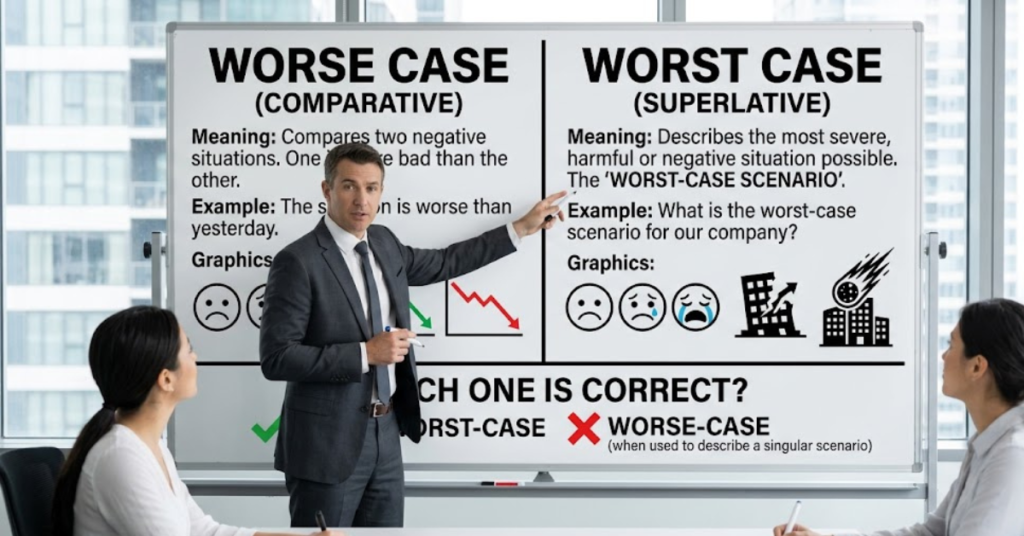

If you’ve ever paused mid-sentence wondering worse case or worst case, you’re definitely not alone. This is one of those English grammar confusions that looks small but causes a lot of uncertainty in writing.
At first glance, both versions might seem acceptable, but only one is correct in standard English. In this article, we’ll clearly break down worse case or worst case, explain why people mix them up, and show you how to use the correct form confidently in real-life writing.
Worse Case or Worst Case: What’s the Correct Phrase?
The correct expression is worst case. The phrase “worse case” is grammatically incorrect in this context.
So when people ask which is correct worse case or worst case, the answer is simple: always “worst case.”
Why “worst case” is correct
The word “worst” is the superlative form of “bad,” meaning the most extreme or serious condition. In contrast, “worse” is a comparative form, used only when comparing two things.
That’s why:
- “worst case” = most extreme scenario
- “worse case” = incorrect usage in this phrase
Understanding this difference is the key to mastering worse case or worst case grammar.
What Does “Worst Case” Mean?
The phrase worst case refers to the most unfavorable or severe possible outcome of a situation.
Example usage:
- In the worst case, the project may be delayed by two weeks.
- Let’s prepare for the worst-case scenario.
- The worst case would be a complete system failure.
This phrase is often used in planning, risk analysis, and everyday decision-making.
Worse Case or Worst Case Scenario Explained
Many people specifically search for worse case or worst case scenario, and this is where confusion increases.
The correct phrase is worst-case scenario, which refers to the most negative possible outcome that could happen.
Examples:
- The worst-case scenario is losing the entire investment.
- We planned for the worst-case scenario but hoped for the best outcome.
In this structure, “worst-case” works as a compound adjective describing the type of scenario.
Why People Confuse Worse and Worst
The confusion between worse case or worst case usually happens because of how similar the words sound and look.
Here are the main reasons:
1. Comparative vs superlative confusion
- Worse = comparison between two things
- Worst = the highest level of “bad”
2. Informal speech habits
People often say phrases quickly, which blurs the distinction.
3. Writing based on instinct
Many assume “worse” fits because it feels familiar.
4. Lack of grammar awareness
Not everyone learns adjective forms in detail early on.
Common Usage Examples
To fully understand is it worse case vs worst case scenario, here are correct examples in context:
- We should consider the worst case before making a decision.
- In the worst-case scenario, we may need backup plans.
- The worst case would involve total data loss.
- Planning for the worst case helps reduce risk.
These examples show how naturally the correct form fits into English sentences.
Simple Grammar Rule to Remember
If you ever get stuck thinking do you say worse case vs worst case, remember this:
- Use “worse” when comparing two things
- Use “worst” when talking about the most extreme situation
That single rule eliminates almost all confusion.
Worse Case vs Worst Case in Real-Life Communication
This phrase is especially common in:
- Business planning
- Project management
- Risk assessment
- Everyday decision-making
Using the correct form not only improves grammar but also makes communication clearer and more professional.
FAQs
1. Is it worse case vs worst case?
The correct phrase is “worst case,” not “worse case.”
2. What is the correct usage: worse case vs worst case scenario?
The correct form is “worst-case scenario.”
3. Why is “worse case” incorrect?
Because “worse” is comparative, while the phrase requires the superlative “worst.”
4. Can I ever use “worse case” in English?
Not in this context. It is not grammatically correct as a fixed phrase.
5. How do I remember the correct form?
Think of “worst” as the most extreme outcome possible.
Conclusion
Understanding worse case or worst case is all about knowing the difference between comparative and superlative forms. The correct expression is always “worst case,” especially when referring to extreme or unfavorable outcomes.
Once you grasp this simple rule, you’ll never hesitate again when writing worst case scenario or explaining worst case grammar in everyday communication. Keep practicing, and soon it will feel completely natural in your writing.