
It’s a classic mix-up in English: take effect or take affect—which one is actually right? If you’ve ever paused mid-sentence wondering which version to use, you’re definitely not alone.
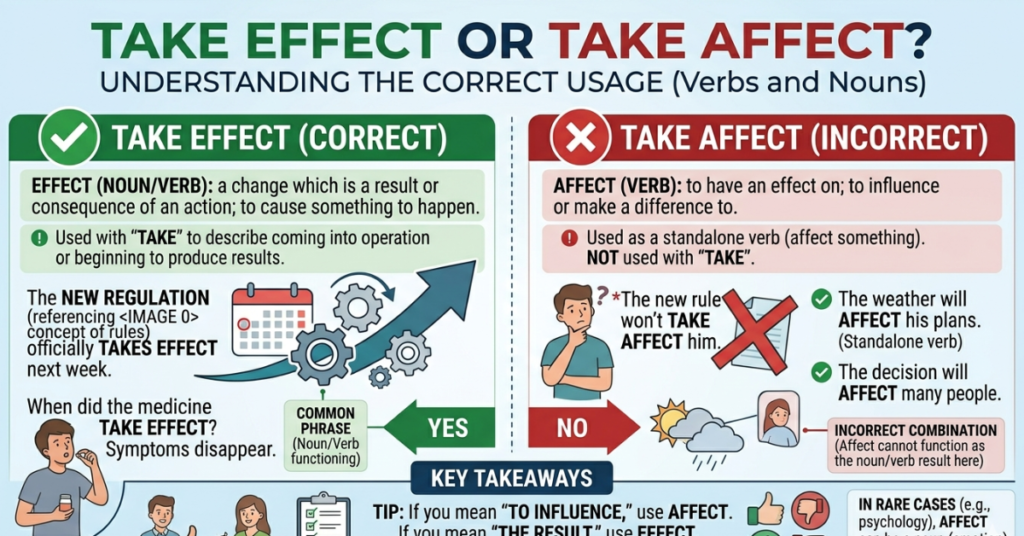
Let’s clear it up quickly: “take effect” is correct, while “take affect” is almost always incorrect. But to really understand why, we need to look at the difference between effect and affect.
Take Effect or Take Affect: Which Is Correct?
If you’re asking is it take effect or take affect, here’s the simple answer:
Correct:
- take effect
Incorrect:
- take affect
So, whenever something becomes active or starts working, you should use take effect.
What Does “Take Effect” Mean?
Understanding the meaning makes everything easier.
“Take effect” definition:
It means:
- To begin working
- To become active
- To start producing results
Examples:
- “The new law will take effect next month.”
- “The medicine should take effect within an hour.”
This phrase is commonly used in formal, professional, and everyday contexts.
Why “Take Affect” Is Incorrect
The confusion comes from mixing up two similar-sounding words: affect and effect.
The difference:
- Effect (noun) = a result or outcome
- Affect (verb) = to influence something
Why it matters:
In the phrase take effect, “effect” refers to the result becoming active—not influencing something.
That’s why take affect doesn’t make grammatical sense in standard usage.
Take Effect or Take Affect in a Sentence
Let’s look at how the correct phrase works in real sentences.
Correct examples:
- “The policy will take effect on January 1.”
- “These changes will take effect immediately.”
- “The treatment began to take effect after a few hours.”
Incorrect examples:
- “The policy will take affect tomorrow.”
So for searches like take effect or take affect in a sentence, always stick with take effect.
Common Usage in Everyday Language
You’ll often see this phrase in specific situations:
1. Laws and rules:
- “The new regulation will take effect soon.”
2. Medicine:
- “Wait for the painkiller to take effect.”
3. Changes or decisions:
- “The update will take effect overnight.”
It’s a versatile phrase used across many contexts.
Easy Trick to Remember
Here’s a quick memory tip:
Effect = End result
If something is starting to work → it’s becoming the result → take effect
If you can replace the phrase with “start working,” then take effect is the correct choice.
Will Take Effect or Take Affect?
Another common search is will take effect or take affect.
Correct:
- “The changes will take effect tomorrow.”
Incorrect:
- “The changes will take affect tomorrow.”
Again, the rule stays the same regardless of tense.
Common Mistakes to Avoid
Mistakes:
- to take affect
- will take affect
- take affect immediately
Correct versions:
- to take effect
- will take effect
- take effect immediately
Keeping this consistent will instantly improve your writing clarity.
Quick Grammar Breakdown
Let’s simplify it one more time:
- Effect = result → used in the phrase
- Affect = influence → not used here
So:
- take effect
- take affect
FAQs About Take Effect or Take Affect
1. Is it take effect or take affect?
The correct phrase is take effect.
2. What does “take effect” mean?
It means something begins working or becomes active.
3. Is “take affect” ever correct?
No, it’s considered incorrect in standard English.
4. How do I remember the difference?
Think: “effect = result,” so when something starts working, it takes effect.
5. Can I use “take effect” in formal writing?
Yes, it’s widely used in both formal and informal contexts.
Final Thoughts: Keep It Clear and Correct
So, take effect or take affect—what’s the final answer? It’s always “take effect.” Once you understand the difference between affect and effect, the confusion disappears.
It may seem like a small detail, but using the correct phrase makes your writing more polished and professional. The next time you write it, you’ll know exactly which one to choose—no second guessing needed.
Want to improve your grammar even further? Keep practicing these common word pairs—they’re the building blocks of clear, confident communication.