
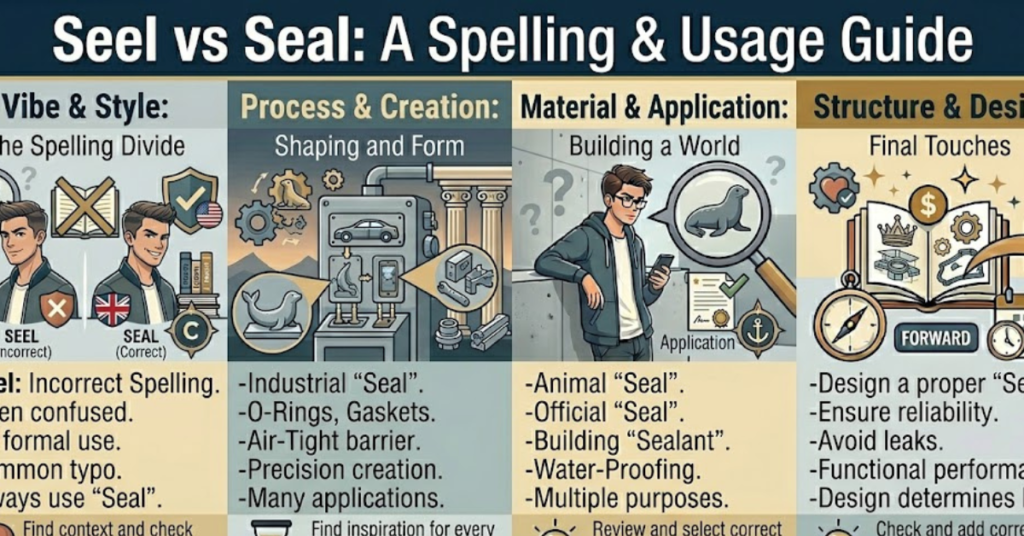

English can be tricky, especially when two words look similar but behave very differently. If you’ve come across seel vs seal, you might be wondering whether they mean the same thing—or if one is simply a misspelling of the other.
The truth is, both words exist, but they’re used in completely different contexts. In this guide, we’ll break down the seel vs seal meaning, explain their differences, and show you exactly when (and if) you should use each one.
Seel vs Seal: Quick Overview
Let’s start with the basics.
- Seal is a common word with multiple meanings and everyday usage
- Seel is rare, outdated, and used in very specific contexts
Understanding the seel vs seal difference comes down to frequency and practicality. In most modern writing, “seal” is almost always the correct choice.
What Does “Seal” Mean?
“Seal” is a versatile word used as both a noun and a verb.
As a Noun
- A marine animal
- A stamp or emblem used for authentication
- A tight closure (like a seal on a bottle)
As a Verb
- To close something tightly
- To finalize or confirm something
Examples
- Please seal the envelope before sending it
- The deal was sealed yesterday
- The jar has a tight seal
As you can see, “seal” is widely used in daily conversation and writing.
What Does “Seel” Mean?
“Seel” is much less common and often unfamiliar to most people.
Traditional Meaning
Historically, “seel” meant:
- To sew or close something, especially the eyes of a bird (in falconry)
- To blind or obscure vision
Example
- The falconer would seel the bird’s eyes temporarily
This usage is now considered archaic and rarely appears outside historical or literary contexts.
Seel vs Seal Meaning: Key Differences
To clearly understand seel vs seal meaning, here are the main distinctions:
- Seal is modern, widely used, and has multiple meanings
- Seel is outdated and limited to historical references
- “Seal” applies to everyday language; “seel” does not
In practical terms, you’ll almost always want to use “seal.”
When Should You Use “Seal”?
Use “seal” in nearly all modern situations.
Common Uses
- Closing envelopes or containers
- Confirming agreements or deals
- Describing waterproof or airtight closures
- Referring to the animal
Tip
If your sentence sounds natural in everyday conversation, “seal” is likely the correct word.
When (If Ever) Should You Use “Seel”?
There are very few situations where “seel” is appropriate.
Limited Use Cases
- Historical writing
- Literary or poetic contexts
- Specialized references to falconry
For general writing, emails, or social media, avoid using “seel.”
Common Mistakes to Avoid
Many people confuse these two words or assume one is a typo.
Watch Out For
- Using “seel” when you mean “seal”
- Assuming both words are interchangeable
- Overcomplicating simple sentences
If you’re unsure, choosing “seal” is almost always the safe option.
Simple Trick to Remember the Difference
Here’s an easy way to keep it straight:
- Seal = common, everyday word
- Seel = rare, historical word
If you’ve never heard the word before, it’s probably not the one you need.
FAQs
What is the main difference between seel vs seal?
“Seal” is commonly used in modern English, while “seel” is rare and outdated.
Is “seel” a correct word?
Yes, but it’s archaic and not used in everyday language.
Can I use “seel” instead of “seal”?
No, they are not interchangeable in modern usage.
Why do people confuse seel and seal?
Because they look and sound similar, but their meanings are very different.
Which word should I use in normal writing?
You should use “seal” in almost all cases.
Conclusion
Understanding seel vs seal doesn’t have to be complicated. While both words exist, only one truly belongs in modern English. “Seal” is the practical, widely accepted choice for everyday communication, while “seel” remains a historical term with limited use.
The key takeaway is simple: stick with “seal” unless you’re writing about something very specific or historical. With that clarity, you’ll never second-guess your word choice again.