
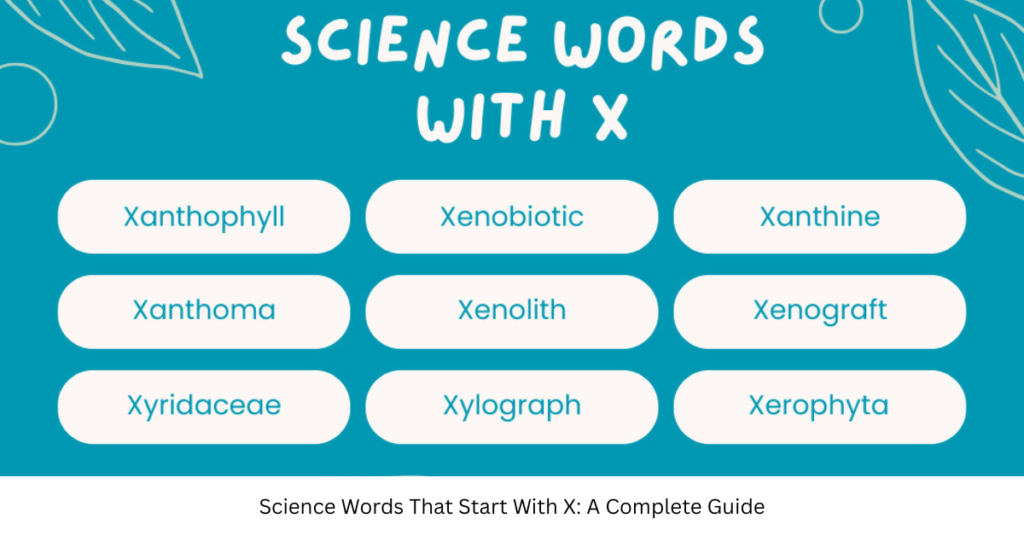

Ever tried thinking of science words that start with X and found yourself stuck after one or two? You’re not alone. The letter “X” is one of the least common starting letters in scientific vocabulary, yet it hides some fascinating and important terms used across biology, physics, chemistry, and medicine.
In this article, we’ll explore a curated list of these rare but meaningful terms, explain them in simple language, and show how they’re used in real-world science. Whether you’re a student, writer, or just curious, this guide will make these tricky words easy to understand.
Why Are “X” Science Words So Rare?
Before diving into the list, it helps to understand why “X” is uncommon in science terminology:
- Many scientific words are derived from Greek or Latin.
- The letter “X” often appears within words, not at the beginning.
- When used at the start, it usually represents a sound like “Z” or “Ex.”
Despite this, there are still several important terms worth learning.
Common Science Words That Start With X
1. Xylem (Biology)
Definition:
A type of plant tissue responsible for transporting water and nutrients from roots to leaves.
Why it matters:
Without xylem, plants wouldn’t be able to survive or grow properly.
2. Xenon (Chemistry)
Definition:
A colorless, odorless noble gas found in Earth’s atmosphere.
Uses:
- Lighting (flash lamps)
- Medical imaging
- Space propulsion
3. Xerophyte (Biology)
Definition:
A plant adapted to survive in dry environments.
Examples:
- Cactus
- Aloe vera
Key trait:
They store water efficiently and reduce water loss.
4. X-ray (Physics/Medicine)
Definition:
A type of electromagnetic radiation used to see inside objects, especially the human body.
Applications:
- Medical diagnosis
- Airport security
- Material analysis
5. Xenobiology (Advanced Science)
Definition:
The study of artificial or extraterrestrial life forms.
Interesting fact:
It’s a growing field in synthetic biology and space exploration.
6. Xanthophyll (Biology/Chemistry)
Definition:
A yellow pigment found in plants, important for photosynthesis.
Where it’s found:
- Leaves
- Fruits
- Algae
7. Xeric (Ecology)
Definition:
Describes an environment that is very dry with little moisture.
Example:
Deserts are xeric ecosystems.
8. Xylem Sap (Plant Science)
Definition:
The liquid transported through xylem, consisting of water and dissolved minerals.
Lesser-Known “X” Scientific Terms
Here are a few more advanced or less common terms:
- Xenogenesis – Generation of offspring different from parents
- Xenolith – A rock fragment embedded in another rock
- Xiphoid Process – A small bone at the bottom of the sternum
- Xenotransplantation – Transplanting organs between species
How to Remember These Words Easily
Learning uncommon terms becomes easier with simple techniques:
Try These Tips:
- Group by subject (biology, physics, etc.)
- Use flashcards
- Relate to real-world examples
- Practice using them in sentences
Importance of Learning Rare Science Terms
Understanding rare scientific vocabulary can:
- Improve academic performance
- Enhance writing and communication
- Help in competitive exams
- Build stronger subject knowledge
Even uncommon terms like these can give you an edge.
FAQs About Science Words That Start With X
1. What is the most common science word starting with X?
The most widely known is X-ray, especially in medical and physics contexts.
2. Are there many scientific terms that start with X?
No, they are relatively rare compared to other letters, but still important.
3. What does “xeno” mean in science?
“Xeno” means foreign or strange, commonly used in biology and medicine.
4. Is xenon dangerous?
Xenon is generally safe in small amounts and is used in controlled environments like medical procedures.
5. Why should I learn these uncommon terms?
They expand your vocabulary and deepen your understanding of scientific concepts.
Conclusion
Although limited in number, science words that start with X are far from insignificant. From plant biology terms like xylem to advanced concepts like xenobiology, these words play important roles across scientific disciplines.
By learning and understanding them, you not only boost your vocabulary but also gain deeper insights into how science explains the world around us. If you found this helpful, consider exploring more scientific vocabulary—you never know what fascinating terms you’ll discover next.