
English is full of words that look or sound similar but carry completely different meanings, and one confusing pair is retract vs redact. At first glance, they may seem related because both involve some kind of “removal” or “undoing,” but in reality, they are used in very different contexts.
The focus keyword retract vs redact often confuses students, writers, and professionals working with legal, journalistic, or formal documents. In this guide, we’ll break down the meaning of each word, explore real-life examples, explain grammar usage, and help you clearly understand when to use each term without hesitation.
What Does Retract Mean?
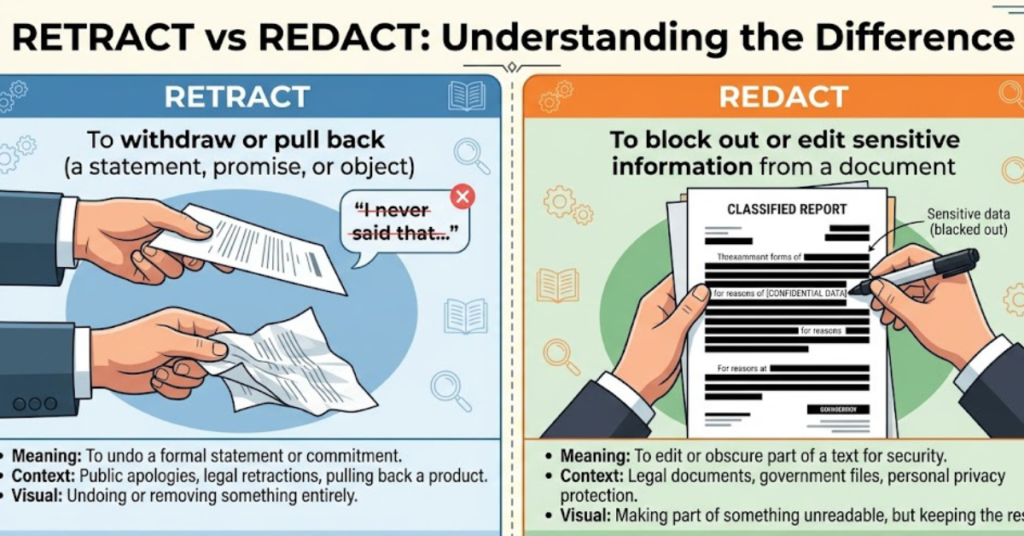
Retract is a verb that means to take back, withdraw, or pull something back.
Meaning of Retract
Retract generally means:
- To take back a statement or claim
- To withdraw something previously said or done
- To physically pull something back
Common Uses of Retract
Retract is often used in:
- Statements or apologies
- Scientific or official corrections
- Physical movement descriptions
Examples of Retract
- The company retracted its earlier statement.
- He retracted his accusation after reviewing the facts.
- The cat retracted its claws.
In all cases, retract involves reversing or withdrawing something.
What Does Redact Mean?
Redact is a verb used mainly in legal, governmental, and editorial contexts. It means to edit or censor parts of a document before publishing or releasing it.
Meaning of Redact
Redact means:
- To remove sensitive or confidential information
- To edit text for privacy or security reasons
- To black out or censor parts of a document
Common Uses of Redact
Redact is often used in:
- Legal documents
- Government reports
- Classified information
- News reporting
Examples of Redact
- The government redacted personal details from the report.
- Names were redacted for privacy reasons.
- Sensitive sections of the document were redacted before release.
Unlike retract, redact is about editing content, not taking back statements.
Retract vs Redact Meaning Explained
The confusion between retract vs redact meaning comes from their similar spelling and formal tone, but their functions are very different.
Retract Meaning
- To take back or withdraw something
- Used for statements, claims, or physical actions
Redact Meaning
- To edit or censor information
- Used for documents, reports, or sensitive data
Simple comparison:
- Retract = take back
- Redact = remove or edit information
Retract vs Redact Examples
Understanding examples side by side makes the difference clearer.
Correct Use of Retract
- She retracted her statement after realizing the mistake.
- The newspaper retracted the incorrect report.
- He retracted his offer.
Correct Use of Redact
- The document was redacted before public release.
- Officials redacted classified information.
- The report was partially redacted for security reasons.
Even though both involve “removal,” the purpose is different.
Retract vs Redact Grammar Usage
Both words are verbs, but they are used in different grammatical contexts.
Retract as a Verb
Retract is used when:
- Undoing statements or claims
- Physically pulling something back
Examples:
- The witness retracted his statement.
- The snake retracted its fangs.
Redact as a Verb
Redact is used when:
- Editing written material
- Removing sensitive content
Examples:
- The editor redacted personal information.
- Authorities redacted confidential sections.
Key Differences Between Retract vs Redact
Here’s a simple breakdown of the retract vs redact difference:
1. Purpose
- Retract: To take back something said or done
- Redact: To remove or hide information in documents
2. Context
- Retract: Speech, statements, actions
- Redact: Documents, reports, legal texts
3. Usage Field
- Retract: General English, communication, science
- Redact: Legal, journalism, government work
Why People Confuse Retract and Redact
There are several reasons for the confusion:
Similar Spelling
Both words look almost identical, differing by only one letter.
Formal Tone
Both are used in formal writing, which increases confusion.
Overlapping Idea of Removal
Both involve some form of “taking away,” but in different ways.
Easy Way to Remember the Difference
A simple memory trick can help:
Retract = Take Back
- Think “retract your words”
Redact = Edit Out
- Think “redact confidential information”
This association makes the distinction easier to remember.
Retract vs Redact in Real-Life Usage
Retract in Daily Life
- News corrections
- Apologies or statements
- Scientific updates
Redact in Professional Use
- Government reports
- Legal documents
- Privacy protection in journalism
The contexts rarely overlap, which helps clarify usage.
FAQs
What is the difference between retract vs redact?
Retract means to take back or withdraw something, while redact means to edit or remove sensitive information from a document.
Is retract the same as redact?
No, they are completely different words with different meanings and usage contexts.
What does retract mean in English?
Retract means to take back a statement, claim, or physical action.
What does redact mean in documents?
Redact means to remove or hide confidential or sensitive information from documents.
Are retract and redact verbs?
Yes, both are verbs but used in different contexts.
Why do people confuse retract and redact?
They look similar in spelling and are both used in formal writing, which causes confusion.
Conclusion
Understanding retract vs redact is important for clear and accurate communication, especially in professional writing. While retract means to take back a statement or action, redact refers to editing or censoring sensitive information in documents.
Although they look similar, their meanings and uses are completely different. Recognizing this distinction helps improve grammar accuracy and ensures your writing remains clear, precise, and professional.
If you continue exploring commonly confused English words, you’ll build stronger language skills and avoid frequent writing mistakes in both academic and real-world communication.