
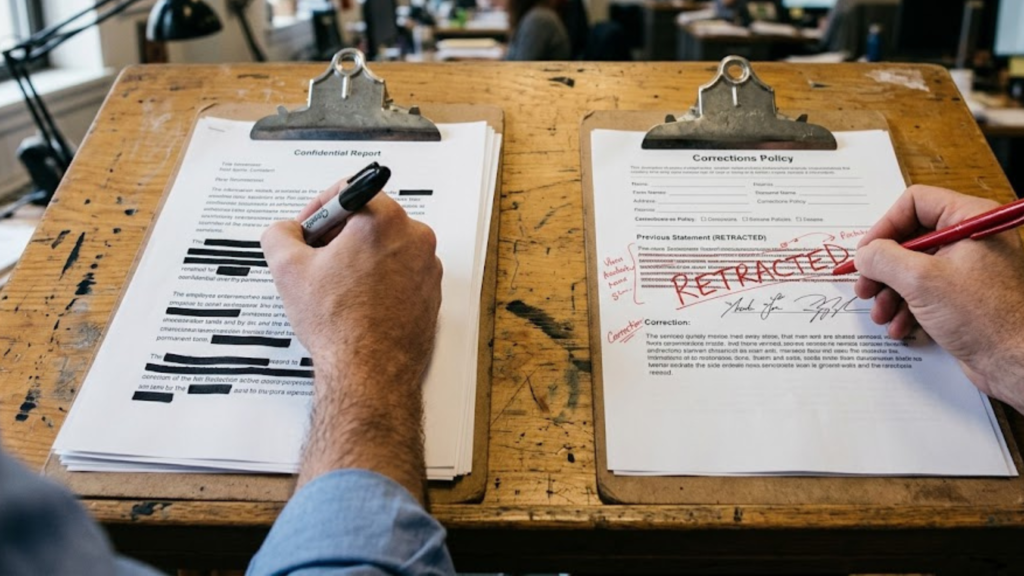

English has plenty of words that sound similar but carry completely different meanings. One pair that often confuses writers, students, and professionals is redact vs retract. At first glance, the words look related because they share similar spelling patterns, but they are used in very different situations.
Understanding the difference matters, especially in legal writing, journalism, publishing, and professional communication. Using the wrong word can completely change the meaning of a sentence.
In this guide, you’ll learn what each word means, how they differ, when to use them, and practical examples that make the distinction easy to remember.
Redact vs Retract: The Main Difference
The easiest way to separate the two words is this:
- Redact means to edit, censor, or remove sensitive information.
- Retract means to withdraw, take back, or reverse a statement.
Although both involve removing something in a way, the context is completely different.
What Does “Redact” Mean?
The word “redact” is commonly used in legal, government, business, and publishing contexts.
Definition of Redact
To redact means:
- To remove confidential information
- To censor sensitive content
- To edit text before publication
Usually, redaction happens to protect privacy or classified information.
Common Examples of Redaction
Examples include:
- Hiding personal data in legal documents
- Blacking out names in police reports
- Removing financial information from records
Sentence examples:
- The lawyer redacted the client’s address.
- Sensitive information was redacted from the file.
- The agency redacted classified sections of the report.
What Does “Retract” Mean?
“Retract” has a very different meaning. It refers to taking back something that was previously said, published, or claimed.
Definition of Retract
To retract means:
- To withdraw a statement
- To admit something was incorrect
- To reverse a claim or accusation
This word often appears in journalism, academic publishing, politics, and public communication.
Common Examples of Retraction
Examples include:
- A newspaper retracting a false story
- A person retracting a statement
- A scientist retracting flawed research
Sentence examples:
- The company retracted its earlier announcement.
- He refused to retract his comments.
- The journal retracted the article due to errors.
Why People Confuse Redact and Retract
The confusion happens because both words:
- Begin with “re”
- Relate to removing something
- Often appear in professional settings
However, the action itself is different.
Redact = Remove Information
You remove parts of content while keeping the document itself.
Retract = Take Back Entire Statement
You withdraw the claim, statement, or publication altogether.
Redact vs Retract in Legal Contexts
Legal documents frequently use both words, which increases confusion.
When Lawyers Use “Redact”
Lawyers redact information to protect:
- Personal identities
- Medical records
- Financial details
- Confidential evidence
Example:
- The court ordered the document to be redacted before release.
When Lawyers Use “Retract”
Someone may retract:
- A testimony
- A statement
- A public accusation
Example:
- The witness later retracted his statement.
Redact vs Retract in Journalism
Media organizations commonly deal with both actions.
Redaction in Journalism
Journalists may redact:
- Names of minors
- Classified details
- Private information
Retraction in Journalism
News outlets retract stories when:
- Facts are incorrect
- Information cannot be verified
- Ethical violations occur
Example:
- The newspaper issued a formal retraction.
Simple Trick to Remember the Difference
Memory tricks can make these words much easier to distinguish.
Think of “Redact” as Editing
“Redact” relates to editing or blocking out text.
You can picture:
- Black bars over information
Think of “Retract” as Taking Back
“Retract” relates to reversing or withdrawing something already said.
You can picture:
- Pulling words back
Common Mistakes People Make
Using “Retract” for Hidden Information
Incorrect:
- The agency retracted personal information from the file.
Correct:
- The agency redacted personal information from the file.
Using “Redact” for Withdrawn Statements
Incorrect:
- The author redacted his earlier claim.
Correct:
- The author retracted his earlier claim.
How These Words Are Used Professionally
In Business
Companies redact confidential data and retract inaccurate announcements.
In Academia
Researchers may retract studies containing serious mistakes.
In Government
Government agencies often redact classified documents before public release.
Similar Words Related to Redact and Retract
Understanding related vocabulary can help reinforce the distinction.
Words Similar to Redact
- Edit
- Censor
- Black out
- Remove information
Words Similar to Retract
- Withdraw
- Reverse
- Recant
- Take back
Why Correct Usage Matters
Choosing the wrong word can create confusion or even legal misunderstandings.
For example:
- Redacting a document protects information.
- Retracting a statement changes a public position.
In professional communication, precision matters. Using accurate language improves clarity, credibility, and trust.
FAQs
What is the difference between redact and retract?
“Redact” means removing or hiding sensitive information, while “retract” means taking back a statement or claim.
Can you redact a statement?
You can redact parts of a statement by hiding information, but you retract the statement if you withdraw it completely.
What does redact mean legally?
In legal contexts, redact means removing confidential or sensitive details from documents before sharing them publicly.
What does retract mean in journalism?
In journalism, retract means formally withdrawing a published statement or article because it was incorrect or misleading.
Is retract the same as apologize?
Not exactly. Retracting means taking back a statement, while apologizing expresses regret.
What is a redacted document?
A redacted document contains information that has been hidden, removed, or blacked out for privacy or security reasons.
Conclusion
The confusion around redact vs retract is understandable because the words sound similar and often appear in professional settings. However, their meanings are very different.
Remember the key distinction:
- Redact = remove sensitive information
- Retract = take back a statement or claim
Once you connect “redact” with editing and “retract” with withdrawal, using the correct word becomes much easier. Mastering these subtle language differences can improve your writing, sharpen communication skills, and help you sound more confident in professional and everyday conversations.