
SIf you’ve ever paused while writing and wondered which word to use, you’re not alone. These two English words often confuse learners because they look similar and sound almost identical.
The confusion usually happens because both appear in everyday writing—but they play very different grammatical roles. Once you understand how each word works, the mistake becomes easy to avoid.
In this guide, you’ll learn their meanings, differences, usage rules, and simple tricks to use them correctly.
Meaning of Passed and Past
Passed
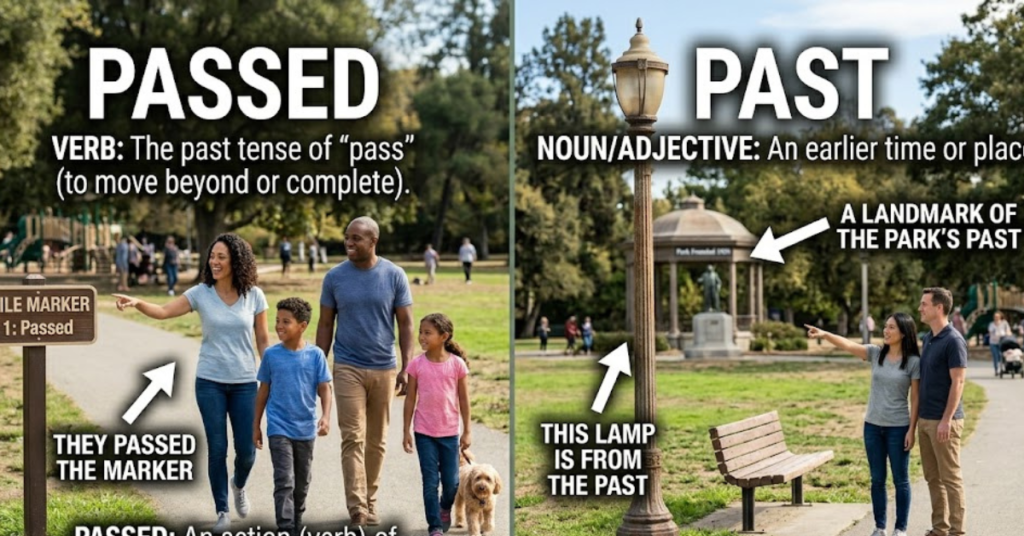
“Passed” is the past tense of the verb “pass.”
It describes an action that has already happened.
It can mean:
- Moving by something
- Going beyond something
- Succeeding in something
Examples:
- He passed the exam.
- The car passed me on the road.
Past
“Past” refers to time or position.
It does not describe an action.
It can be used as:
- A noun (time before now)
- A preposition (direction or position)
- An adjective or adverb
Examples:
- In the past, life was simpler.
- Walk past the store.
Simple Difference Between Them
The easiest way to understand the distinction:
- One describes an action
- The other describes time or position
Quick rule:
- Passed = something happened
- Past = something related to time or location
When to Use Each One
Use “Passed” for:
- Completed actions
- Movement or transition
- Exams or tests
- Time moving forward
Examples:
- She passed the test.
- The deadline has passed.
Use “Past” for:
- Time periods
- Directions or positions
- Something already finished in history
Examples:
- We talked about it in the past.
- He walked past the building.
Common Confusion in Sentences
A frequent mistake is mixing direction words.
Correct:
- I walked past the shop.
Incorrect:
- I walked passed the shop.
Why?
Because “past” shows location or direction, not action.
“Passed Away” vs “Past Away”
Another common confusion:
Correct:
- Passed away
Incorrect:
- Past away
Meaning:
A respectful phrase used when someone dies.
Example:
- Her grandfather passed away last year.
Get Past vs Passed
Correct:
- Get past your fear
Incorrect:
- Get passed your fear
Here, “past” means overcoming or moving beyond something.
Look Past vs Passed
Correct:
- Look past your mistakes
Incorrect:
- Look passed your mistakes
“Past” here means beyond or ignoring something.
Time Usage Difference
- “Passed” refers to time moving forward
- “Past” refers to history or earlier periods
Examples:
- Time has passed quickly.
- In the past, things were different.
Simple Grammar Breakdown
- Pass = present form
- Passed = completed action
- Past = time or position concept
Examples:
- I pass the park daily.
- I passed the park yesterday.
- The park is in my past route.
Common Mistakes
People often:
- Use the wrong form for direction
- Confuse time and action
- Treat both words as interchangeable
Understanding context solves most of these issues.
Quick Practice
Fill in the blanks:
- The train ___ quickly.
- In the ___, people wrote letters.
- He ___ the finish line first.
- Walk ___ the store.
Answers:
- Passed
- Past
- Passed
- Past
FAQs
What is the main difference?
One is a verb (action), the other relates to time or position.
When should I use “passed”?
When describing an action like moving, succeeding, or completing something.
Should I use “past”?
When talking about time, history, or direction.
Is “walked passed” correct?
No, the correct form is “walked past.”
How can I remember easily?
Think: passed = action, past = time or place.
Conclusion
The confusion disappears once you separate action from time or position. One word always describes something happening, while the other describes time or location.
To summarize:
- Passed = action or completion
- Past = time or position
With practice, choosing the right word becomes natural and automatic.