
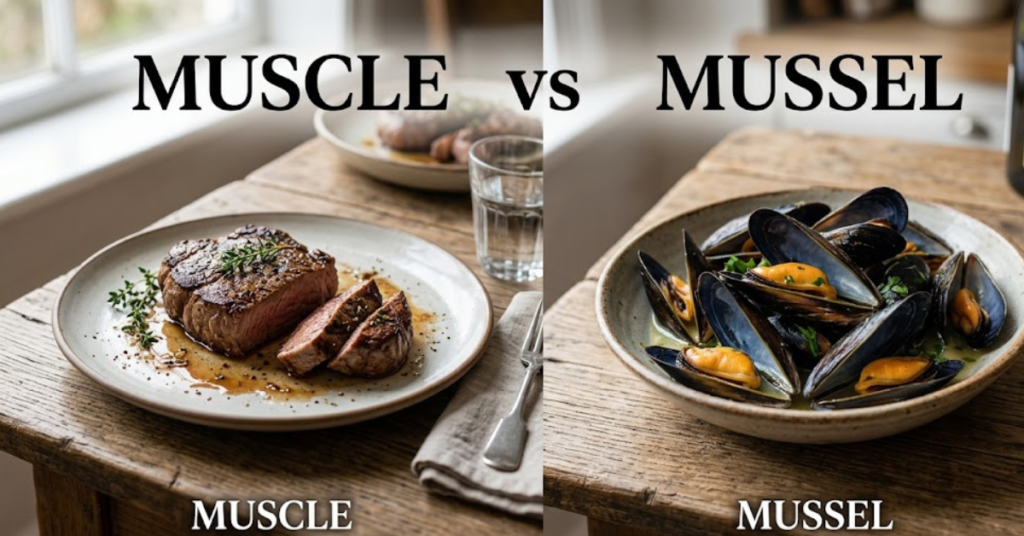

Have you ever seen the words muscle and mussel and wondered whether they’re related? You’re not alone. These two words sound remarkably similar, yet they have completely different meanings. One refers to a vital part of the human body, while the other is a popular seafood delicacy found in oceans and rivers.
The confusion surrounding Muscle vs Mussel is common among English learners, students, and even native speakers. Since they’re pronounced almost identically, it’s easy to mix them up in writing. In this guide, we’ll break down their meanings, pronunciation, spelling, origins, and usage so you’ll never confuse them again.
Muscle vs Mussel: What’s the Difference?
At first glance, the words look similar, but they belong to entirely different categories.
| Word | Meaning | Category |
| Muscle | A tissue in the body that helps movement and strength | Anatomy |
| Mussel | A shellfish that lives in freshwater or saltwater | Seafood/Marine Life |
Muscle Definition
A muscle is a soft tissue in the body that contracts and relaxes to create movement. Humans have more than 600 muscles that help with everything from walking and lifting to breathing and blinking.
Examples:
- I pulled a muscle while exercising.
- Building muscle requires regular strength training.
- The heart is a powerful muscle.
Mussel Definition
A mussel is a type of edible shellfish with two hinged shells. Mussels are commonly found attached to rocks, docks, and other underwater surfaces.
Examples:
- We ordered steamed mussels for dinner.
- Mussels are rich in protein and minerals.
- The fisherman collected fresh mussels from the shore.
Muscle vs Mussel Pronunciation
One reason people confuse these words is that their pronunciation is almost identical.
How to Pronounce Muscle
Muscle: /ˈmʌs.əl/
Sounds like:
MUH-suhl
Interestingly, the “c” in muscle is silent.
How to Pronounce Mussel
Mussel: /ˈmʌs.əl/
Sounds like:
MUH-suhl
As you can see, both words share the same pronunciation in standard English.
Why Are They Pronounced the Same?
English contains many homophones—words that sound alike but have different meanings and spellings. Muscle and mussel are considered near-perfect homophones, which explains why people often confuse them when writing.
How to Spell Muscles Correctly
Many people search for how to spell muscles because the silent “c” can make the word tricky.
Singular Form
- Muscle
Plural Form
- Muscles
Common Misspellings
Avoid these incorrect versions:
- Musscle
- Muscel
- Musle
- Musclese
Easy Trick to Remember
Think of the word muscular.
Since muscular contains the same root, remembering “muscular” can help you correctly spell “muscle.”
Why Are Mussels Called Mussels?
A common question is: Why are mussels called mussels?
The word mussel comes from the Old English word muscle, which itself was derived from Latin musculus. Historically, several shellfish species shared similar names across European languages.
Over centuries, English spelling evolved and separated the two words:
- Muscle became associated with body tissue.
- Mussel became the standard spelling for the shellfish.
Although they now have distinct meanings, they share fascinating linguistic roots dating back hundreds of years.
The Origins of Muscle and Mussel
Understanding their history makes the distinction easier.
Origin of Muscle
The word muscle comes from the Latin word musculus, meaning “little mouse.”
Ancient Romans thought contracting muscles looked like tiny mice moving beneath the skin.
Origin of Mussel
Mussel originated from Germanic and Old English words used to describe shellfish. Over time, spelling changes helped distinguish the shellfish from the anatomical term.
Muscle vs Mussel: Examples in Everyday Sentences
Seeing the words in context helps reinforce the difference.
Muscle Examples
- She gained muscle after months of training.
- A muscle injury can take weeks to heal.
- Strong muscles support healthy posture.
Mussel Examples
- The chef prepared garlic butter mussels.
- Mussels filter water as they feed.
- Fresh mussels should have tightly closed shells.
Quick Memory Tricks for Muscle vs Mussel
Need a fast way to remember the difference?
Remember Muscle
- Contains “cle” at the end.
- Associated with strength and exercise.
- Think of the word “muscular.”
Remember Mussel
- Contains “ssel” at the end.
- Associated with seafood and oceans.
- Think of the shell in a mussel.
Common Mistakes People Make
Here are some examples of incorrect and correct usage.
Incorrect
I strained a mussel at the gym.
Correct
I strained a muscle at the gym.
Incorrect
We ate steamed muscles for dinner.
Correct
We ate steamed mussels for dinner.
While the mistakes are understandable due to identical pronunciation, choosing the correct spelling depends entirely on context.
Muscle vs Mussel in Biology
The words also appear in different scientific fields.
Muscle in Biology
Muscles belong to the muscular system and are classified into:
- Skeletal muscles
- Smooth muscles
- Cardiac muscles
Mussel in Marine Biology
Mussels are aquatic mollusks belonging to the family of bivalve shellfish. They play important ecological roles by filtering water and providing habitat for other organisms.
Muscle vs Mussel: Side-by-Side Comparison
| Feature | Muscle | Mussel |
| Meaning | Body tissue used for movement | Edible shellfish |
| Pronunciation | MUH-suhl | MUH-suhl |
| Category | Anatomy | Marine life |
| Plural | Muscles | Mussels |
| Related To | Fitness, health, biology | Seafood, oceans, rivers |
| Common Context | Exercise, medicine | Cooking, fishing |
Why This Confusion Happens So Often
Several factors contribute to the confusion:
- Identical pronunciation
- Similar spelling
- Shared linguistic history
- English homophone rules
Because both words appear frequently in everyday conversation, many writers accidentally choose the wrong spelling when typing quickly.
FAQs About Muscle vs Mussel
Is muscle pronounced the same as mussel?
Yes. In standard English, both words are pronounced /ˈmʌs.əl/ and sound like “MUH-suhl.”
What is the difference between muscle and mussel?
A muscle is body tissue that helps movement, while a mussel is a type of shellfish commonly eaten as seafood.
How do you spell muscles?
The correct spelling is muscles. The singular form is muscle.
Why is the “c” silent in muscle?
The silent “c” comes from the word’s Latin origin. English retained the spelling while simplifying the pronunciation over time.
Why are mussels called mussels?
The name evolved from older Germanic and English words for shellfish and eventually became distinct from the anatomical term muscle.
Are muscle and mussel homophones?
Yes. People consider them homophones because they share the same pronunciation but have different meanings and spellings.
Which word should I use when talking about exercise?
Use muscle when discussing fitness, strength, anatomy, or physical movement.
Which word should I use when talking about seafood?
Use mussel when referring to the edible shellfish.
Conclusion
Understanding Muscle vs Mussel is easier once you know their meanings and contexts. A muscle is a body tissue responsible for movement and strength, while a mussel is a shellfish commonly enjoyed as seafood. Although their pronunciation is nearly identical, their spellings and definitions are entirely different.
If you frequently struggle with muscle vs mussel pronunciation, remember that context is the key. Think fitness and anatomy for muscle, and seafood and marine life for mussel. By keeping these simple distinctions in mind, you’ll avoid one of English’s most common spelling mix-ups and communicate with greater confidence.