
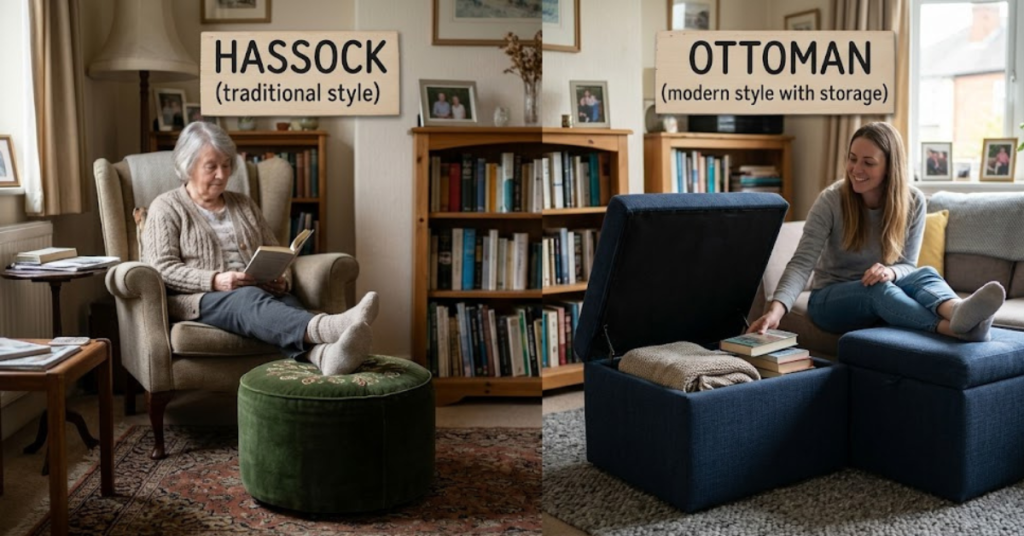

If you’ve ever shopped for home furniture, you’ve probably come across the confusion of hassock vs ottoman. At first glance, they look almost identical—soft, cushioned pieces used for seating or resting your feet—but there are subtle differences that set them apart.
In this guide on hassock vs ottoman, we’ll break down what each piece of furniture actually is, how they’re used in modern homes, and why the terms often get mixed up. By the end, you’ll be able to confidently tell the difference and choose the right one for your space.
What Is a Hassock vs Ottoman?
To understand what is a hassock vs ottoman, it helps to look at their basic definitions.
Hassock
A hassock is typically:
- A soft, padded cushion
- Used mainly as a footrest or low seat
- Often round or cylindrical in shape
- Usually has no storage or frame
Hassocks are simple and lightweight, designed for comfort rather than structure.
Ottoman
An ottoman is:
- A cushioned furniture piece with a solid frame
- Often rectangular, square, or round
- Sometimes includes storage inside
- Can be used as seating, a table, or footrest
Ottomans are more versatile and structured compared to hassocks.
Hassock vs Ottoman Difference Explained
The main hassock vs ottoman difference comes down to structure, function, and design.
Structure
- Hassock: Soft, unstructured, cushion-like
- Ottoman: Built on a solid frame
Function
- Hassock: Primarily for resting feet or casual seating
- Ottoman: Multi-purpose (seat, table, storage)
Design
- Hassock: Minimalist and lightweight
- Ottoman: More decorative and functional
In simple terms, hassocks are soft comfort pieces, while ottomans are functional furniture units.
Hassock vs Ottoman vs Footstool Comparison
Many people also search for hassock vs ottoman vs footstool because these terms overlap.
Footstool
A footstool is:
- A small raised platform
- Usually has legs
- Designed strictly for foot support
Comparison Summary
- Hassock: Soft cushion, no legs
- Ottoman: Structured, often multifunctional
- Footstool: Raised with legs, simple design
All three serve similar purposes but differ in structure and design complexity.
Hassock vs Ottoman Furniture in Modern Homes
When looking at hassock vs ottoman furniture, modern interior design trends show both pieces being used differently.
Hassocks in Interior Design
- Used in casual living spaces
- Common in meditation or relaxation areas
- Often chosen for minimalist homes
Ottomans in Interior Design
- Popular in living rooms and lounges
- Used for storage and seating
- Often paired with sofas or armchairs
Ottomans are more common in modern furniture sets, while hassocks are more niche and traditional.
What Is a Hassock vs Ottoman Used For?
To understand what is a hassock vs ottoman, it helps to look at practical use cases.
Hassock Uses
- Footrest while sitting
- Floor seating in casual settings
- Lightweight decorative piece
Ottoman Uses
- Extra seating for guests
- Coffee table alternative
- Storage for blankets or items
- Stylish living room centerpiece
Ottomans clearly offer more versatility in everyday use.
Materials Used in Hassocks and Ottomans
Both pieces can be made from a variety of materials, but their construction differs.
Hassock Materials
- Foam padding
- Fabric or leather covering
- Lightweight filling
Ottoman Materials
- Wooden or metal frame
- Upholstered cushioning
- Fabric, leather, or synthetic covers
- Optional storage compartments
This difference explains why ottomans tend to be heavier and more durable.
Hassock vs Ottoman Design Evolution
Historically, hassocks were simple religious or home items used for kneeling or resting feet during prayer. Over time, they became more decorative.
Ottomans, on the other hand, evolved from large upholstered furniture pieces used in Ottoman-era homes and European salons. Today, they are widely used in modern interior design for both style and function.
This historical difference still influences hassock vs ottoman difference today.
Which One Should You Choose?
Choosing between them depends on your needs.
Choose a Hassock If You Want:
- A soft, lightweight footrest
- Minimalist design
- Simple comfort piece
Choose an Ottoman If You Want:
- Storage functionality
- Extra seating
- A decorative furniture piece
- Multi-purpose use
In most modern homes, ottomans are more practical, but hassocks still appeal to simplicity lovers.
Common Misconceptions
People often assume:
- Hassocks and ottomans are the same thing
- All footrests are interchangeable
- Ottoman always means storage furniture
In reality, each has its own purpose and structure, even though they overlap in function.
FAQs
What is a hassock or ottoman?
A hassock is a soft cushion used mainly as a footrest, while an ottoman is a structured, multifunctional furniture piece.
What is the difference between hassock or ottoman?
Hassocks are soft and simple, while ottomans are framed, often larger, and may include storage.
Is a hassock the same as a footstool?
No. A footstool usually has legs, while a hassock is a cushion placed directly on the floor.
Can an ottoman be used as a seat?
Yes, most ottomans are designed to function as extra seating.
Which is better, hassock or ottoman?
It depends on your needs—hassocks are simple and soft, while ottomans are more versatile and functional.
Conclusion
Understanding hassock vs ottoman comes down to structure, function, and design. Hassocks are soft, lightweight cushions meant for basic comfort, while ottomans are structured furniture pieces that can serve multiple roles in a home.
If you’re choosing between them, think about how you plan to use the space. For simplicity and relaxation, a hassock works well. For versatility and storage, an ottoman is the better option.
By knowing the difference, you can make smarter furniture choices that fit your style, comfort, and everyday needs.