
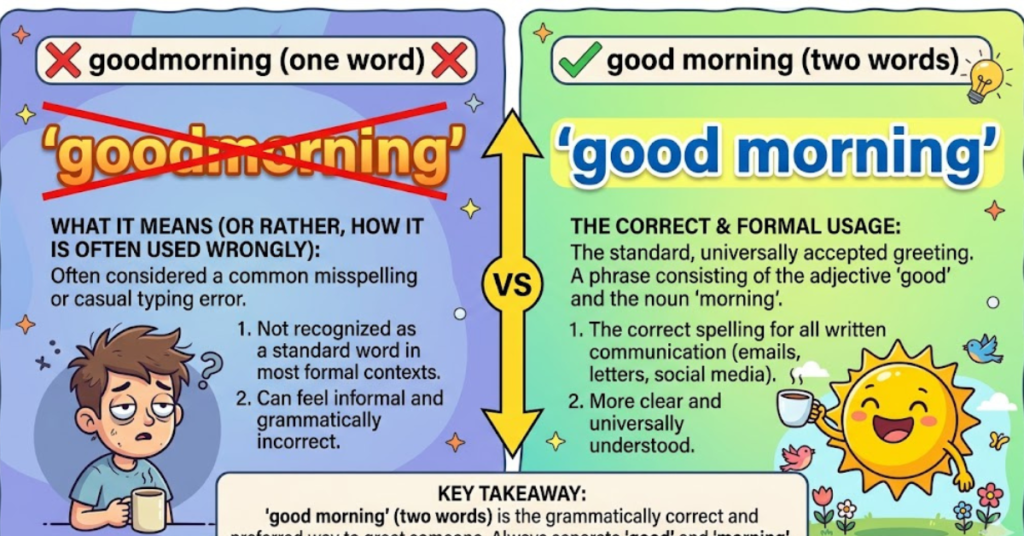

If you’ve ever typed a friendly greeting and paused to wonder whether it should be “goodmorning” or “good morning,” you’re definitely not alone. The confusion around goodmorning vs good morning is extremely common, especially in texting, social media posts, and casual writing.
At first glance, both versions look acceptable. After all, people type quickly and often merge words in informal conversations. But when it comes to proper English grammar, only one version is considered correct in standard writing.
In this guide, we’ll break down goodmorning vs good morning, explain the grammar rule behind it, show real examples, and help you remember the correct form easily.
Goodmorning vs Good Morning: The Correct Answer
The correct and standard form is:
- Good morning (two words)
“Goodmorning” as one word is not considered standard English. It may appear in informal texting or usernames, but it is grammatically incorrect in formal writing.
So when people ask goodmorning vs good morning, the answer is simple: always use “good morning” in proper communication.
Why “Good Morning” Is Written as Two Words
English greetings like “good morning” follow a simple structure:
- “Good” = adjective
- “Morning” = noun
When an adjective describes a noun, they are usually written as separate words.
Example:
- Good morning
- Good afternoon
- Good evening
This pattern is consistent in standard English grammar.
Is “Goodmorning” Ever Correct?
Technically, “goodmorning” is not standard English, but it does appear in informal settings.
You might see it used in:
- Text messages
- Social media captions
- Usernames or handles
- Casual chats
However, even in these cases, it is still considered a stylistic shortcut rather than correct grammar.
So in the discussion of goodmorning vs good morning, only “good morning” is grammatically accepted.
Goodmorning vs Good Morning in Texting
In texting culture, spelling rules are often relaxed. That’s why many people type “goodmorning” as one word.
Example in casual texting:
- Goodmorning! Hope you slept well.
Even though it is widely understood, it is still not correct in formal English usage.
Correct version:
- Good morning! Hope you slept well.
So when considering goodmorning vs good morning, texting habits do not change grammar rules.
Goodmorning vs Good Morning in Professional Writing
In professional communication, grammar accuracy matters a lot. That includes:
- Emails
- Business messages
- Academic writing
- Formal greetings
Correct usage:
- Good morning, Mr. Smith.
- Good morning everyone.
Incorrect usage:
- Goodmorning, Mr. Smith.
Using the correct form improves clarity and professionalism.
Why People Confuse Goodmorning and Good Morning
The confusion happens for a few simple reasons:
1. Fast typing habits
People often merge words when typing quickly on phones.
2. Social media influence
Platforms like Instagram and WhatsApp encourage informal writing styles.
3. Visual similarity
Since both words are commonly used together, they appear as a single idea.
4. Lack of grammar awareness
Many users never learn that greetings follow adjective + noun structure.
Goodmorning vs Good Morning in Digital Communication
Even though grammar rules remain the same, digital communication has influenced how people write.
Informal platforms:
- Goodmorning is often accepted
- Grammar is flexible
- Speed matters more than correctness
Formal platforms:
- Always use good morning
- Correct grammar is expected
- Clarity is important
So context matters, but grammar rules do not change.
Easy Way to Remember the Correct Form
Here’s a simple trick:
Think of “good” as a description
- Good morning = a morning that is good
Since you would not normally combine adjectives and nouns into one word, keep them separate.
Other examples:
- Good night
- Good luck
- Good day
All follow the same structure.
Common Mistakes People Make
Mistake 1: Writing it as one word
Incorrect:
- Goodmorning everyone
Correct:
- Good morning everyone
Mistake 2: Overusing informal spelling in professional writing
Even if texting allows shortcuts, formal writing does not.
Mistake 3: Assuming both are grammatically equal
Only “good morning” is correct in standard English.
Why Correct Spelling Matters
Using proper grammar improves:
- Communication clarity
- Professional image
- Writing credibility
- Academic accuracy
- Reader trust
Even small details like greetings can impact how your writing is perceived.
FAQs
Is it goodmorning or good morning?
The correct form is “good morning.” “Goodmorning” is informal and not standard English.
Why do people write goodmorning as one word?
People often type quickly in texts and social media, which leads to merging words.
Is goodmorning acceptable in texting?
It is commonly used in informal texting, but it is not grammatically correct.
Can I use goodmorning in formal emails?
No, you should always use “good morning” in formal or professional communication.
What is the difference between goodmorning vs good morning?
“Good morning” is correct grammar, while “goodmorning” is an informal, incorrect merged form.
Conclusion
Understanding goodmorning vs good morning is simple once you know the basic grammar rule. “Good morning” is the correct and standard form because it follows the natural structure of English adjectives and nouns. “Goodmorning,” while common in texting and casual communication, is not considered grammatically correct.
Whether you are writing emails, messages, or professional documents, using “good morning” ensures clarity, correctness, and a more polished tone. Small details like this may seem minor, but they make a big difference in how your writing is received.