
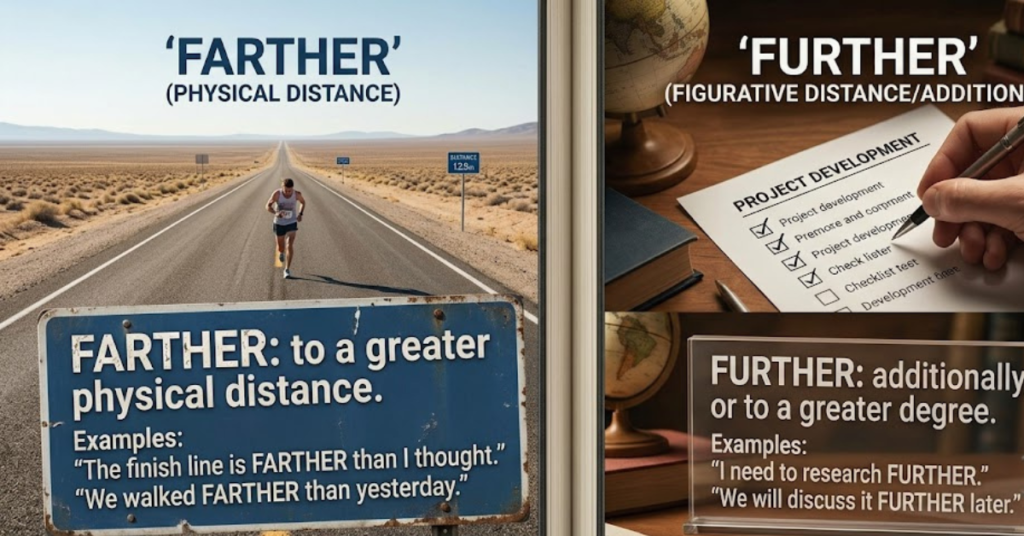

English has plenty of word pairs that seem interchangeable until you stop and think about them. One of the most common examples is farther vs further. These two words look similar, sound close, and are often used in overlapping ways, which makes many writers wonder if there’s actually a difference.
The short answer is yes: there is a traditional distinction, though modern English sometimes blurs the line. Understanding farther vs further can make your writing clearer, more polished, and grammatically accurate.
In this guide, we’ll break down the meanings, grammar rules, pronunciation, examples, and practical tips so you know exactly when to use each word.
Farther vs Further Meaning
At their core, both words relate to the idea of distance or extension.
Traditionally:
- Farther refers to physical distance
- Further refers to figurative distance, degree, time, or additional extent
Simple examples:
- The store is farther than I expected. (physical distance)
- We need to discuss this further. (additional extent)
This is the classic rule taught in grammar guides.
Farther vs Further Difference
The main distinction comes down to whether you are talking about literal measurable distance or something more abstract.
Use farther for physical distance
Think of actual space or measurable movement.
Examples:
- She ran farther than anyone else.
- The hotel is farther down the road.
- Can you throw the ball any farther?
Use further for abstract ideas
Think of progress, degree, discussion, time, or “more/additional.”
Examples:
- We need to investigate this further.
- Nothing could be further from the truth.
- The project was delayed until further notice.
This is the easiest way to remember the difference.
When to Use Farther vs Further
If you’re unsure when to use farther vs further, ask yourself one question:
Am I talking about physical distance?
If yes → use farther
Examples:
- The park is farther from my house.
- We drove farther into the countryside.
If no → use further
Examples:
- I need further explanation.
- She took the research further.
This quick test works most of the time.
Farther vs Further Grammar Rules
Here are the standard grammar guidelines that writers commonly follow.
Rule 1: Farther = measurable distance
Use farther when something can be physically measured.
Examples:
- The second gas station is farther away.
- He jumped farther than his teammate.
Rule 2: Further = metaphorical or abstract extension
Use further when talking about:
- Time
- Degree
- Discussion
- Advancement
- Additional information
Examples:
- We’ll talk further tomorrow.
- For further details, contact support.
Rule 3: Further can also mean “additional”
Farther cannot be used this way.
Correct:
- No further questions.
Incorrect:
- No farther questions.
Farther vs Further Examples in Sentences
Examples make the difference easier to understand.
Farther examples
- The beach is farther than we thought.
- She walked farther than yesterday.
- His house is farther down the street.
Further examples
- We need further research.
- Let’s not go further into that topic.
- She explained the idea further.
Notice that farther relates to physical space, while further often relates to ideas or progression.
Farther vs Further for Time
Many people ask about farther vs further time usage.
For time, further is usually the correct choice because time is considered abstract rather than physical.
Correct:
- The meeting has been postponed until further notice.
- We cannot delay this any further.
Incorrect:
- The meeting has been postponed until farther notice.
Even though time feels measurable, English convention uses further here.
Farther vs Further Usage in Modern English
In modern English, especially casual conversation, people sometimes use further for both physical and figurative meanings.
Examples:
- The town is further down the road.
- The town is farther down the road.
Both may appear in everyday writing, and many style guides accept this.
However:
- Farther is more precise for physical distance
- Further is more flexible overall
That’s why many professional writers still follow the traditional distinction.
Farther vs Further in American English Guidelines
In American English, grammar guides often recommend keeping the traditional difference because it improves clarity.
Preferred usage:
- Physical distance → farther
- Figurative or additional meaning → further
Examples:
- She ran farther.
- We need further discussion.
That said, you may still see further used for distance in informal contexts.
Farther vs Further UK Usage
British English tends to be slightly more flexible.
In UK writing:
- Further is commonly used in many contexts
- Farther still appears for physical distance, but less rigidly in casual usage
Formal writing often still preserves the distinction for clarity.
Farther vs Further Definition
Here are quick dictionary-style definitions.
Farther
Adverb/adjective meaning:
At or to a greater physical distance.
Example:
- The school is farther away.
Further
Adverb/adjective meaning:
To a greater extent, degree, time, or additional amount; sometimes distance as well.
Example:
- We need further information.
Farther vs Further Pronunciation
These words are pronounced very similarly.
Farther
Pronounced:
FAR-thur
Further
Pronounced:
FUR-thur
In some accents, the distinction is subtle, which is one reason people confuse them in writing.
Easy Memory Trick for Farther vs Further
A quick trick can help.
Farther = Far
Both contain far
Think:
Farther = physical distance
Example:
- It’s farther away.
Further = Further discussion
Think:
Further = more, additional, beyond
Example:
- Let’s discuss this further.
This simple memory rule works well.
Quick Quiz: Can You Choose the Right Word?
Try these.
1.
The gas station is _____ than the grocery store.
Answer: Farther
2.
We need _____ explanation.
Answer: Further
3.
The deadline was pushed back until _____ notice.
Answer: Further
4.
She threw the ball _____ than I did.
Answer: Farther
Common Mistakes People Make
Here are some common errors.
Incorrect:
- We need farther information.
Correct:
- We need further information.
Incorrect:
- He ran further than me. (accepted in casual English, but less precise)
Preferred:
- He ran farther than me.
Precision matters, especially in formal writing.
FAQ About Farther vs Further
What is the difference between farther and further?
Farther usually refers to physical distance, while further refers to abstract extension, degree, time, or additional meaning.
Can further mean distance?
Yes, modern English sometimes uses further for distance, but farther is traditionally more precise.
When should I use farther?
Use farther when talking about measurable physical distance.
When should I use further?
Use further for abstract ideas, time, degree, discussions, and additional information.
Is farther vs further a strict grammar rule?
It is a traditional guideline rather than an absolute rule, though many style guides recommend following it.
Which is more common in everyday English?
Further is often more common because it has broader usage.
Is there a pronunciation difference?
Yes, though it is subtle. Farther sounds closer to “far,” while further sounds closer to “fur.”
Conclusion
Understanding farther vs further doesn’t have to be confusing. The traditional rule is simple: use farther for physical distance and further for abstract ideas, time, degree, or additional meaning.
While modern English sometimes uses further more broadly, following the classic distinction can make your writing clearer and more precise. The next time you hesitate, remember this simple trick: if it’s about something far away in space, use farther; if it’s about more, extra, or beyond, use further.