
Have you ever typed “faring vs fairing” and paused, wondering which one is actually correct? You’re not alone. These two words sound identical, yet they mean completely different things. That’s exactly why they often confuse writers, students, and even professionals.
In this guide, we’ll break down faring vs fairing in a clear, practical way. By the end, you’ll not only know the difference but also feel confident using each word in the right context.
What Does “Faring” Mean?
Let’s start with the simpler one.
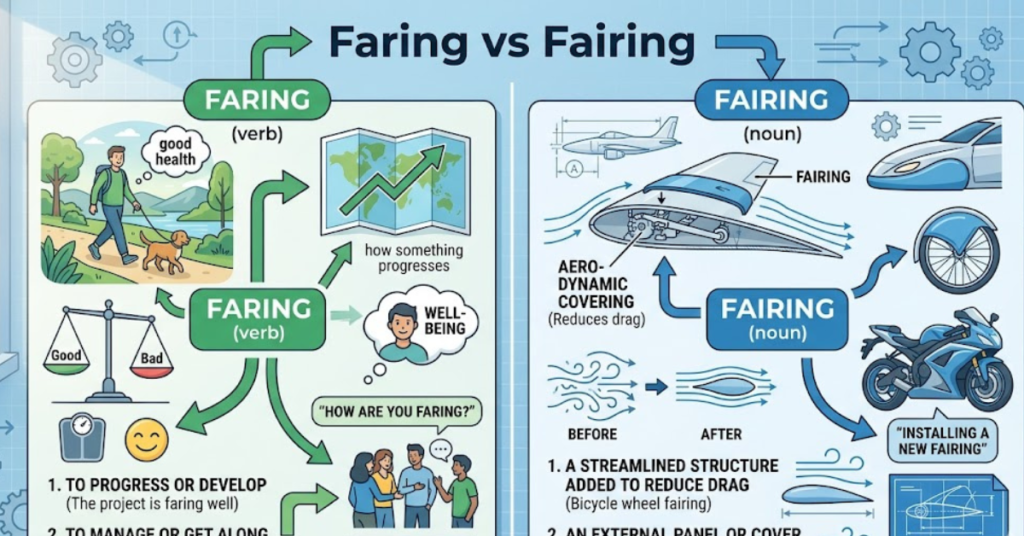
Faring comes from the verb “fare,” which means to get along, perform, or progress in a certain situation. It’s commonly used when asking or describing how someone is doing.
Common Uses of Faring
- Talking about well-being or progress
- Asking about someone’s condition
- Describing outcomes
Examples
- “How are you faring in your new job?”
- “The team is faring well this season.”
- “She wasn’t faring much better after the treatment.”
In short, faring is all about how things are going.
What Does “Fairing” Mean?
Now let’s look at the more technical term.
Fairing refers to a structure designed to improve aerodynamics. You’ll often hear it in engineering, aviation, or automotive contexts.
Where “Fairing” Is Used
- Aircraft design
- Motorcycles and racing vehicles
- Boats and ships
Examples
- “The motorcycle’s fairing reduces wind resistance.”
- “Engineers adjusted the aircraft fairing for better performance.”
- “The boat’s fairing helps it move smoothly through water.”
Simply put, fairing is a physical object, not an action or condition.
Faring vs Fairing: Key Differences
Understanding faring vs fairing becomes easier when you focus on their roles.
Main Distinctions
- Faring
- Related to progress or well-being
- Verb form (action or condition)
- Used in everyday conversation
- Fairing
- Refers to a structure or component
- Noun (a physical object)
- Used in technical or mechanical contexts
Because they sound the same, context is your best clue.
How to Remember the Difference
If you tend to mix them up, a simple memory trick can help.
Easy Mnemonics
- Faring = Feeling (both relate to how things are going)
- Fairing = Frame (both relate to physical structure)
Additionally, if the sentence is about emotions, progress, or performance, “faring” is the correct choice. On the other hand, if it involves machines or design, “fairing” fits.
Common Mistakes to Avoid
Even experienced writers slip up with faring vs fairing. Here are a few common errors and how to fix them.
Mistake 1: Using “Fairing” for Well-Being
Incorrect:
- “How are you fairing these days?”
Correct:
- “How are you faring these days?”
Mistake 2: Using “Faring” in Technical Contexts
Incorrect:
- “The bike’s faring improves speed.”
Correct:
- “The bike’s fairing improves speed.”
Mistake 3: Ignoring Context
Always check whether the sentence is about performance or a physical object. That distinction solves most confusion.
When to Use Faring in Daily Conversation
You’ll hear “faring” more often in casual or conversational English.
Typical Situations
- Asking about someone’s health
- Discussing progress at work or school
- Talking about outcomes
For example:
- “How is your project faring so far?”
It’s natural, simple, and widely understood.
When to Use Fairing in Technical Contexts
“Fairing,” on the other hand, belongs in more specialized discussions.
Common Scenarios
- Engineering and design
- Automotive or motorcycle discussions
- Aviation and marine topics
For instance:
- “The aircraft’s fairing reduces drag during flight.”
Unless you’re discussing machinery, you likely won’t need this word often.
Why “Faring vs Fairing” Confuses So Many People
The confusion comes down to one key reason: pronunciation.
Both words sound exactly the same, making them classic homophones. As a result, people often rely on spelling alone, which can lead to mistakes.
However, once you connect each word to its meaning and context, the difference becomes much easier to remember.
FAQs
What is the difference between faring vs fairing?
“Faring” refers to how someone is doing, while “fairing” is a structural component used in engineering or design.
Which is correct: faring or fairing?
Both are correct, but they are used in different contexts. The right choice depends on the meaning you want to convey.
Is “How are you fairing?” correct?
No, the correct phrase is “How are you faring?” since it refers to well-being or progress.
What does fairing mean in simple terms?
It’s a part of a vehicle or machine designed to improve airflow and reduce resistance.
Why do people confuse faring and fairing?
Because they sound identical, making them easy to mix up when writing.
Conclusion
Understanding faring vs fairing is easier than it first appears. While they may sound the same, their meanings are completely different. One describes how things are going, and the other refers to a physical structure used in design and engineering.
Once you focus on context, the confusion disappears. So next time you write or speak, pause for a moment and ask yourself: are you talking about progress or a part of a machine? That simple check will help you choose the right word every time.