
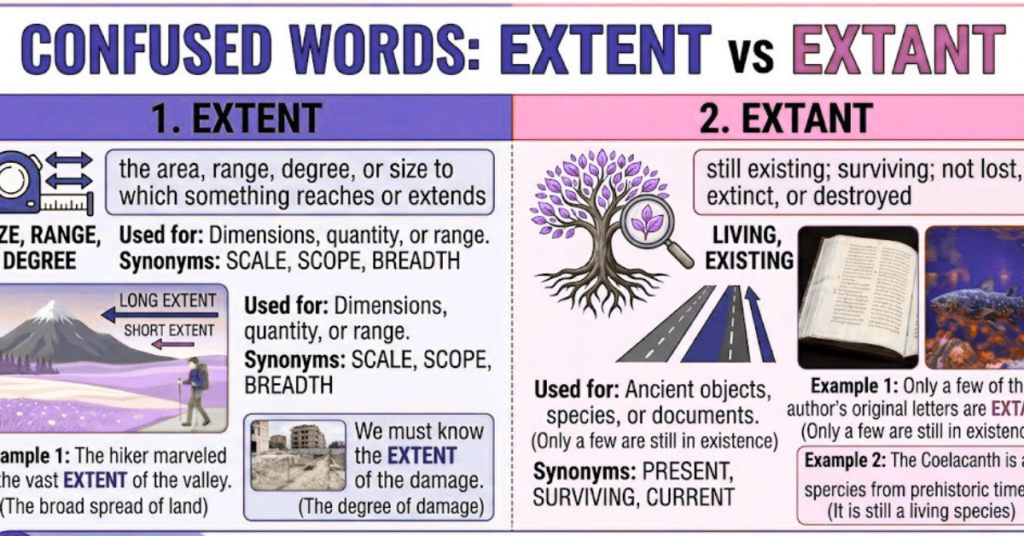

English is full of words that look similar but mean completely different things. A perfect example is extent vs extant. At first glance, they might seem related, but they actually belong to totally different ideas—one describes size or degree, while the other describes existence over time.
Because the words are close in spelling, many writers confuse them in essays, reports, and even professional writing. But once you understand their meanings, the difference becomes very easy to remember.
In this guide, we’ll break down both words clearly, explore their usage, give real examples, and share simple tricks to help you never mix them up again.
What Does “Extent” Mean?
“Extent” is a noun that refers to:
- The size of something
- The range or scope of something
- The degree or level of something
It answers questions like:
- How much?
- How far?
- To what degree?
Examples of Extent
- I was surprised by the extent of the damage.
- The extent of his knowledge is impressive.
- We don’t know the full extent of the problem yet.
- To what extent do you agree with this idea?
In every case, “extent” is about measurement or range.
What Does “Extant” Mean?
“Extant” is an adjective used to describe something that:
- Still exists today
- Has survived over time
- Has not disappeared or become extinct
It is often used in academic, historical, or scientific contexts.
Examples of Extant
- These are the oldest extant manuscripts of the text.
- Few extant examples of ancient architecture remain.
- The species is still extant in remote regions.
- Only a few extant records survive from that period.
Unlike “extent,” this word is about existence rather than measurement.
Extent vs Extant Meaning Explained
The simplest way to understand extent vs extant is this:
- Extent = how much, how far, or how big something is
- Extant = something that still exists today
They are completely unrelated in meaning, even though they look similar.
Why People Confuse Extent and Extant
There are a few common reasons for the confusion:
- Similar spelling (only one letter difference)
- Similar rhythm when spoken quickly
- Less frequent use of “extant” in everyday speech
- Overlapping appearance in academic writing
Because “extent” is much more common in daily language, many people accidentally substitute it for “extant.”
Extent vs Extant Definition Simplified
Here’s a quick breakdown:
Extent
Refers to size, scope, or degree.
Extant
Refers to something that still exists.
This simple distinction is the foundation of the entire extent vs extant definition difference.
When to Use Extent in Sentences
You use “extent” when discussing:
- Size
- Level
- Range
- Quantity
- Intensity
Examples
- The extent of the flood was devastating.
- I didn’t realize the extent of the issue.
- To what extent is this claim true?
- We measured the extent of the forest.
“Extent” often appears in analytical or descriptive writing.
When to Use Extant in Sentences
You use “extant” when discussing:
- Survival
- Historical existence
- Remaining examples
- Living species or documents
Examples
- The only extant copy is stored in a museum.
- These are extant records from the medieval era.
- The language is still extant in small communities.
- Few extant artifacts have been discovered.
This word is more formal and academic.
Extent vs Extant in Academic Writing
In research and scholarly work, both words appear frequently but in very different contexts.
Extent in Academic Use
- To measure impact
- To describe scope of research
- To analyze degree or level
Example:
- The study examined the extent of climate change effects.
Extant in Academic Use
- To describe surviving materials
- To refer to historical evidence
- To classify living species
Example:
- Researchers studied extant fossil records.
Easy Memory Trick to Remember the Difference
A simple trick helps avoid confusion:
Extent = “Extend”
Think of something stretching out in size or degree.
Extant = “Exist”
Think of something still existing today.
This mental association makes the distinction much easier to recall.
Common Mistakes with Extent vs Extant
Mistake 1: Using Extent Instead of Extant
Incorrect:
- Only a few extent manuscripts remain.
Correct:
- Only a few extant manuscripts remain.
Mistake 2: Using Extant Instead of Extent
Incorrect:
- The extant of the damage is unclear.
Correct:
- The extent of the damage is unclear.
Extent in Everyday Language
“Extent” is very common in daily communication.
Examples
- I didn’t realize the extent of the problem.
- The extent of her influence is huge.
- We are unsure of the extent of the delay.
It appears frequently in news, education, and workplace communication.
Extant in Everyday Language
“Extant” is less common in casual speech but appears in:
- History books
- Scientific papers
- Archaeology reports
- Biological studies
Examples
- The species is extant only in this region.
- Extant records confirm the event.
- The building is one of the few extant structures from that era.
Because of its formal tone, it is more specialized.
Quick Comparison of Extent vs Extant
Here’s a simple mental snapshot:
Extent
- Measures size or degree
- Common in everyday English
- Used in analysis and description
Extant
- Refers to existence
- Common in academic writing
- Used in history and science
This is the core distinction in extent vs extant usage.
Why Knowing the Difference Matters
Understanding these words helps you:
- Avoid writing errors
- Improve academic writing
- Enhance vocabulary precision
- Sound more professional
Small word differences can significantly affect clarity and credibility.
FAQs About Extent vs Extant
What is the difference between extent and extant?
“Extent” refers to size or degree, while “extant” refers to something that still exists.
Is extant a common word?
No, it is mainly used in academic, historical, and scientific writing.
Can extent and extant be used interchangeably?
No. They have completely different meanings.
What does extent mean in simple words?
It means how much or how far something is.
What does extant mean in biology?
It refers to species that are still living today.
Why do people confuse extent and extant?
Because they look and sound similar but have different meanings.
Is extant used in everyday English?
Rarely. It is mostly used in formal or academic contexts.
Conclusion
Understanding extent vs extant becomes simple once you separate their meanings clearly. Even though the words look similar, they serve completely different purposes in English.
Remember:
- “Extent” describes size, range, or degree.
- “Extant” describes something that still exists today.
The key to mastering these words is context. If you are talking about measurement or scope, use “extent.” If you are talking about survival or existence, use “extant.”
With a little practice, you’ll be able to use both words confidently and avoid one of the more subtle but common English language mistakes.