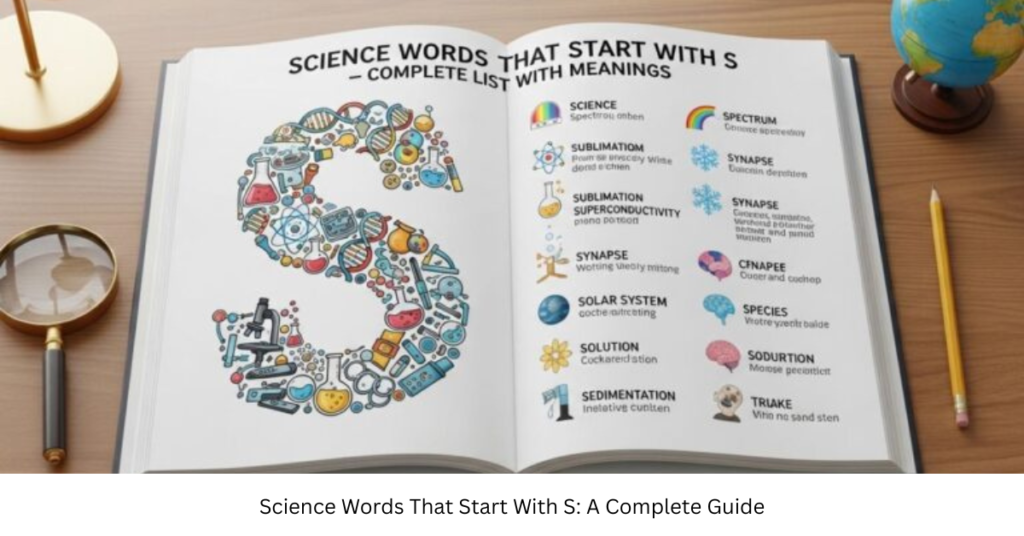

Science is full of fascinating terminology, and some of the most commonly used terms begin with the letter “S.” Whether you’re a student, teacher, or just curious, learning science words that start with s can expand your vocabulary and deepen your understanding of the world around you.
From cells and stars to systems and substances, these terms cover everything from biology to physics. In this guide, we’ll break down essential “S” words in science, explain what they mean, and show how they’re used in real-life contexts.
Why Learn Science Words That Start With S?
Understanding scientific vocabulary isn’t just about memorization—it’s about comprehension. When you recognize key terms, it becomes easier to:
- Understand textbooks and research papers
- Communicate scientific ideas clearly
- Improve academic performance
- Build curiosity about how things work
Let’s dive into some of the most important terms.
Common Science Words That Start With S
1. Biology Terms
Cell Structure Terms
- Structure – The arrangement of parts within a cell or organism
- Symbiosis – A relationship between two organisms living together
- Species – A group of organisms capable of reproducing together
Body and Life Processes
- Stimulus – A change in the environment that causes a reaction
- Secretion – The process of releasing substances from cells
- Synthesis – The creation of complex molecules from simpler ones
2. Chemistry Terms
Matter and Reactions
- Solution – A mixture where one substance dissolves in another
- Solvent – The substance that dissolves another
- Solute – The substance being dissolved
Chemical Processes
- Sublimation – When a solid turns directly into a gas
- Saturation – The point at which no more solute can dissolve
- Stoichiometry – The calculation of reactants and products in reactions
3. Physics Terms
Motion and Forces
- Speed – How fast an object moves
- Scalar – A quantity with magnitude only
- Stress – Force applied to a material
Energy and Space
- Spectrum – The range of different wavelengths of light
- Supernova – A powerful explosion of a star
- Satellite – An object that orbits another object
Advanced Science Words That Start With S
If you want to go beyond the basics, here are some more advanced terms:
- Semipermeable – Allows certain substances to pass through
- Singularity – A point where physical laws break down (often in black holes)
- Superconductivity – Zero electrical resistance in certain materials
- Synergy – When combined effects are greater than individual effects
Real-Life Examples of These Terms
Understanding these words becomes easier when you see them in context:
- When you mix sugar in water, you create a solution
- Plants use synthesis to make food through photosynthesis
- The Sun emits a wide spectrum of light
- A satellite like the Moon orbits Earth
Tips to Remember Science Words
Here are a few simple ways to retain what you learn:
- Use flashcards for quick revision
- Relate words to real-life examples
- Group words by subject (biology, chemistry, physics)
- Practice using them in sentences
FAQs
1. What are some easy science words that start with S?
Some simple examples include speed, solution, species, and structure. These are commonly used in basic science learning.
2. Why are scientific terms important?
They help explain complex ideas clearly and allow scientists worldwide to communicate effectively.
3. Are these words used in everyday life?
Yes, many terms like solution, stress, and system are used both in science and daily conversations.
4. How can I improve my science vocabulary?
Reading science books, watching educational videos, and practicing regularly can help build your vocabulary.
5. Which subject has the most “S” words?
All branches—biology, chemistry, and physics—have a wide range of terms starting with “S.”
Conclusion
Learning science words that start with s is a great way to strengthen your scientific knowledge and communication skills. From basic concepts like speed and solution to advanced ideas like superconductivity and singularity, these terms form the backbone of many scientific discussions.
Keep exploring, keep questioning, and don’t hesitate to dive deeper into the fascinating world of science. The more words you learn, the clearer and more exciting science becomes.