
Some English words sound so similar that even experienced writers occasionally confuse them. One common example is shudder vs shutter. Although the two words differ by just one letter, they have completely different meanings and uses.
One relates to shaking or trembling, while the other refers to closing, covering, or parts of a camera or building. Because they sound alike in fast speech, spelling mistakes happen frequently in emails, articles, social media posts, and even professional writing.
In this guide, we’ll break down the meanings, grammar, pronunciation, examples, and memory tricks that make these commonly confused words much easier to understand.
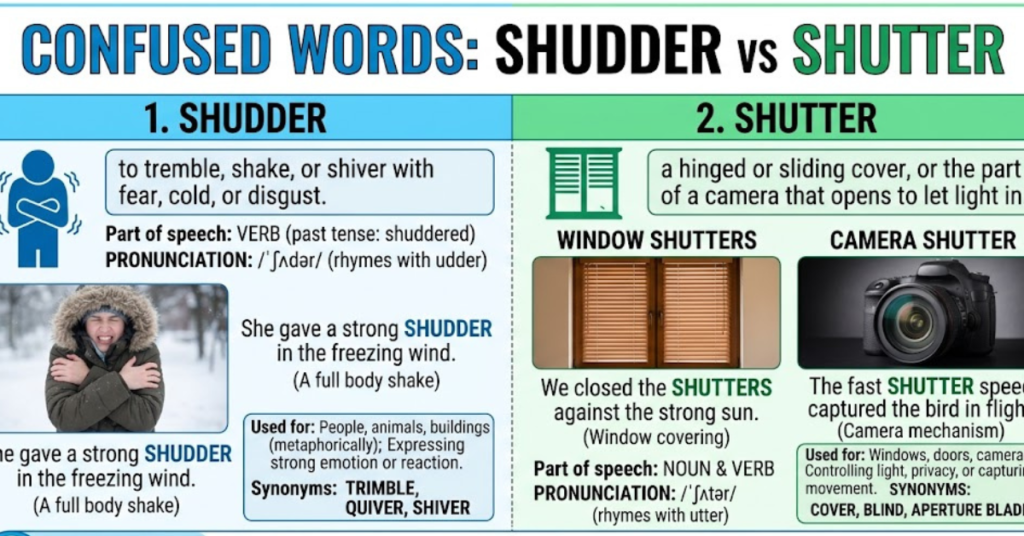
What Does “Shudder” Mean?
“Shudder” is a verb or noun connected to trembling, shaking, or a sudden physical reaction.
People often shudder because of:
- Fear
- Cold weather
- Disgust
- Anxiety
- Shock
Examples of Shudder
- I shuddered when I heard the noise.
- The movie made her shudder with fear.
- A cold wind sent a shudder through the room.
- He shuddered at the memory of the accident.
The word usually describes an emotional or physical reaction.
What Does “Shutter” Mean?
“Shutter” has several meanings, but it usually refers to:
- A movable cover for windows
- A camera mechanism
- Closing a business or operation
Examples of Shutter
- They closed the window shutters before the storm.
- The photographer adjusted the camera shutter speed.
- The company decided to shutter the factory.
- Wooden shutters covered the old house.
Unlike “shudder,” this word relates to objects, mechanics, or closure.
Shudder vs Shutter Meaning Explained
The easiest way to remember the difference is this:
- Shudder = shake or tremble
- Shutter = cover, close, or camera part
One involves emotion or movement.
The other usually involves physical objects or shutting something down.
Why People Confuse Shudder and Shutter
There are several reasons these words get mixed up:
- They sound very similar.
- Only one letter changes.
- Fast typing causes spelling mistakes.
- Autocorrect errors are common.
Because pronunciation overlaps in many accents, context becomes extremely important.
How to Remember the Difference
Simple memory tricks can help you avoid mistakes.
Shudder = Shake
Both words start with “sh.”
Think:
- shudder
- shake
If someone trembles or reacts emotionally, “shudder” is usually correct.
Shutter = Shut
The word “shutter” contains “shut.”
That connection helps remind you that the word often relates to:
- closing
- covering
- blocking
This small trick works surprisingly well.
Shudder in Everyday Writing
“Shudder” appears frequently in emotional or dramatic situations.
Common Uses
- Horror stories
- Emotional writing
- Descriptions of fear
- Reactions to cold or disgust
Example Sentences
- She shuddered at the thought of spiders.
- The loud scream made everyone shudder.
- I still shudder when I remember that moment.
Writers often use the word to create vivid emotional imagery.
Shutter in Everyday Writing
“Shutter” appears in architecture, photography, and business language.
Common Uses
- Window coverings
- Camera equipment
- Business closures
- Mechanical systems
Example Sentences
- The storm damaged the shutters.
- Increase the shutter speed for clearer photos.
- The store will shutter next month.
The meaning depends heavily on context.
Shutter in Photography
One of the most common modern uses of “shutter” appears in photography.
A camera shutter controls:
- How long light enters the camera
- Exposure timing
- Motion blur
- Brightness
Common Photography Terms
- shutter speed
- shutter button
- shutter lag
Photographers frequently adjust shutter settings to improve image quality.
Shutter as a Verb
“Shutter” can also function as a verb meaning to close something permanently or securely.
Examples
- The company shuttered several locations.
- Officials shuttered the building after the storm.
- The café shuttered during renovations.
Business news often uses the word this way.
Shudder as a Noun
“Shudder” can also act as a noun.
Examples
- A shudder ran through the crowd.
- The memory sent a shudder down her spine.
- He felt a sudden shudder of fear.
In noun form, it still relates to trembling or emotional reaction.
Common Mistakes to Avoid
Here are some frequent errors.
Incorrect:
- I shuttered when I saw the snake.
Correct:
- I shuddered when I saw the snake.
Because the sentence describes fear and trembling.
Incorrect:
- They painted the house shudders blue.
Correct:
- They painted the house shutters blue.
Because the sentence refers to window coverings.
Pronunciation Differences
The pronunciation is very similar:
Shudder
Usually pronounced:
- SHUH-der
Shutter
Usually pronounced:
- SHUH-ter
The middle consonant changes slightly, but many accents make them sound nearly identical in fast speech.
That’s why spelling confusion happens so often.
Shudder vs Shutter in Creative Writing
Writers often use both words in descriptive storytelling.
Example
- She shuddered as the old shutters slammed shut in the wind.
This kind of sentence highlights how different the meanings really are despite similar pronunciation.
Why Correct Usage Matters
Using the wrong word can completely change sentence meaning.
For example:
- “The windows shuddered” sounds unusual unless the windows physically trembled.
- “The company shuddered operations” is incorrect because businesses “shutter” operations.
Correct spelling improves:
- Professionalism
- Clarity
- Reader understanding
- Writing accuracy
Quick Comparison Tips
Here’s a fast way to choose the correct word.
Use “Shudder” When Talking About:
- Fear
- Trembling
- Emotional reactions
- Shaking
Use “Shutter” When Talking About:
- Windows
- Cameras
- Closing businesses
- Mechanical coverings
This simple distinction solves most confusion immediately.
Practice Exercises
Try these quick examples.
Fill in the Blank
- The horror movie made me _____.
- The photographer adjusted the _____ speed.
- The old wooden _____ rattled in the storm.
- I _____ at the sound behind me.
Answers
- shudder
- shutter
- shutters
- shuddered
Practice helps reinforce the difference naturally.
FAQs About Shudder vs Shutter
What is the difference between shudder and shutter?
“Shudder” means to tremble or shake, while “shutter” usually refers to coverings, camera parts, or closing something.
Is shudder related to fear?
Yes. People often shudder because of fear, disgust, cold, or shock.
What does shutter mean in photography?
A shutter controls how long light enters a camera.
Can shutter be used as a verb?
Yes. It can mean to close or permanently shut down something.
Why do people confuse shudder and shutter?
The words sound very similar and differ by only one letter.
What are window shutters?
They are movable coverings attached to windows for protection or decoration.
Can shudder be a noun?
Yes. It can describe a trembling sensation or reaction.
Conclusion
Understanding shudder vs shutter becomes much easier once you focus on meaning and context instead of pronunciation alone. Even though the words sound similar, they describe completely different ideas.
Remember:
- “Shudder” relates to trembling, fear, or emotional reactions.
- “Shutter” relates to coverings, cameras, or shutting something down.
The best way to master these words is through regular reading and writing practice. Pay attention to sentence meaning, and over time the distinction will become completely natural. Small spelling differences can have a big impact, and learning them helps make your communication clearer, more polished, and more professional.