
Prefixes may look small, but they completely change the meaning of words. Two of the most common and confusing prefixes in English are “dis-” and “mis-.” If you’ve ever wondered why “disagree” and “misunderstand” mean very different things, understanding dis and mis prefixes is the key.
These prefixes appear in hundreds of everyday English words. They help create opposites, describe mistakes, or express negative ideas. Once you learn how they work, you’ll improve your vocabulary, spelling, reading comprehension, and writing skills much faster.
In this guide, we’ll break down the meanings of both prefixes, explain how they differ, and provide plenty of easy examples you can use in daily communication.
What Is a Prefix?
Before diving deeper, let’s quickly define what a prefix is.
A prefix is:
- A group of letters added to the beginning of a word
- Used to change the word’s meaning
Examples:
- happy → unhappy
- possible → impossible
- agree → disagree
Prefixes are one of the easiest ways to expand vocabulary in English.
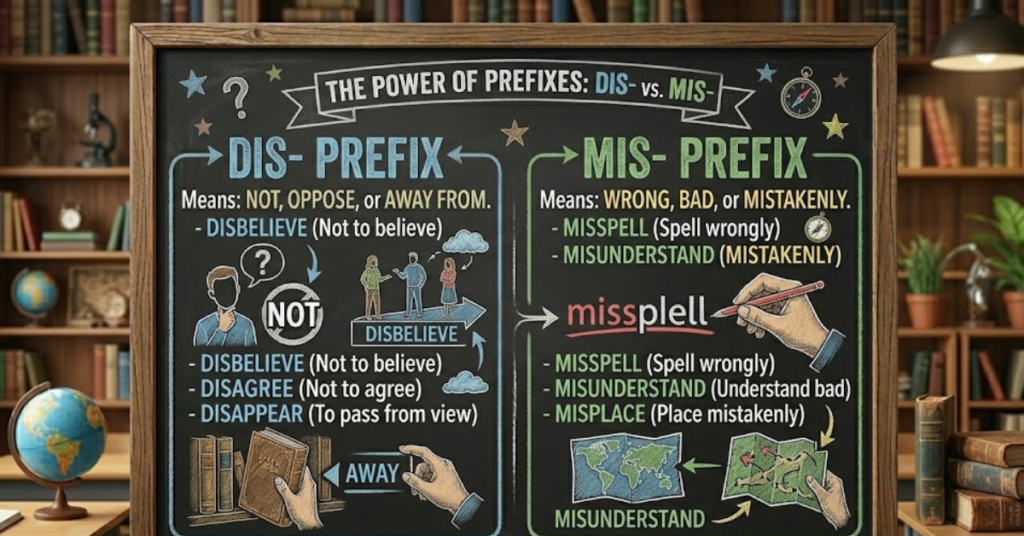
What Does the Prefix “Dis-” Mean?
The prefix “dis-” usually means:
- Not
- Opposite of
- Remove
- Reverse
- Lack of
It often creates a negative or opposite meaning.
Common Words with “Dis-”
- Disagree
- Disappear
- Disconnect
- Dislike
- Dishonest
- Disrespect
Examples in Sentences
- I disagree with that decision.
- The magician made the rabbit disappear.
- Please disconnect the charger.
- She dislikes loud music.
In each case, the prefix changes the original word into something negative or opposite.
What Does the Prefix “Mis-” Mean?
The prefix “mis-” usually means:
- Wrongly
- Incorrectly
- Badly
- Mistakenly
It often describes errors or improper actions.
Common Words with “Mis-”
- Misunderstand
- Misplace
- Misbehave
- Misspell
- Misinform
- Misjudge
Examples in Sentences
- I misunderstood the instructions.
- She misplaced her keys.
- The student misspelled the word.
- Don’t misjudge people too quickly.
Unlike “dis-,” this prefix usually focuses on mistakes rather than opposites.
Dis and Mis Prefixes: Main Difference
The biggest difference is simple:
- “Dis-” usually creates opposites or negatives.
- “Mis-” usually describes errors or incorrect actions.
Quick Comparison
Dislike
Means not liking something.
Mislike
Not a standard English word because “mis-” doesn’t fit the meaning.
Misunderstand
Means to understand incorrectly.
Disunderstand
Not a real English word because “dis-” doesn’t match the intended meaning.
Understanding this distinction makes word formation much easier.
Why Learning Prefixes Matters
Learning prefixes helps improve:
- Vocabulary skills
- Reading speed
- Spelling accuracy
- Writing clarity
- Word recognition
Instead of memorizing every word individually, you start recognizing patterns.
For example:
- disconnect
- disapprove
- disobey
All share a negative or opposite meaning because of the “dis-” prefix.
Common Words Using the Prefix “Dis-”
Here are some frequently used words that begin with “dis-.”
Disapprove
To have a negative opinion.
Example:
- My parents disapprove of smoking.
Disobey
To refuse to follow rules.
Example:
- The child disobeyed the teacher.
Discomfort
A feeling of uneasiness.
Example:
- He felt discomfort after the long trip.
Disorder
A lack of organization.
Example:
- The room was in complete disorder.
These words show how “dis-” often creates negative meanings.
Common Words Using the Prefix “Mis-”
Now let’s look at popular “mis-” words.
Misread
To read incorrectly.
Example:
- I misread the schedule.
Mislead
To guide someone incorrectly.
Example:
- The advertisement misled customers.
Miscalculate
To calculate wrongly.
Example:
- We miscalculated the budget.
Miscommunication
Poor or incorrect communication.
Example:
- The issue happened because of miscommunication.
Notice how these words focus on mistakes or incorrect actions.
Easy Tricks to Remember the Difference
Simple memory tricks can help you instantly identify the correct prefix.
“Dis-” = Opposite
Think:
- disconnect
- disagree
- disappear
The meaning usually reverses or negates the original word.
“Mis-” = Mistake
Think:
- mistake
- misunderstand
- misplace
The action happens incorrectly.
These mental shortcuts make vocabulary learning much easier.
How Prefixes Change Word Meaning
Prefixes completely transform base words.
Agree → Disagree
Meaning changes from agreement to opposition.
Understand → Misunderstand
Meaning changes from understanding correctly to understanding incorrectly.
Even though only a few letters change, the entire meaning shifts.
Common Mistakes Students Make
Many English learners confuse these prefixes because both can sound negative.
Incorrect Thinking
Some learners assume “dis-” and “mis-” mean the same thing.
But they do not.
Example:
- Disinformation = intentionally false information
- Misinformation = incorrect information, often spread accidentally
This subtle difference matters in real communication.
Dis and Mis Prefixes in Everyday English
You probably use these prefixes daily without noticing.
Everyday “Dis-” Words
- disappointed
- disconnected
- disorganized
- disrespectful
Everyday “Mis-” Words
- misunderstand
- mishear
- misprint
- misjudge
Because these words appear so often, understanding the prefixes improves overall English fluency.
How Teachers Use Prefix Lessons
Teachers often introduce prefixes to help students:
- Decode unfamiliar words
- Improve reading comprehension
- Build stronger vocabulary habits
Once students recognize prefix patterns, they can often guess the meaning of unfamiliar words more accurately.
For example:
- If you know “mis-” relates to mistakes, you can infer that “misinterpret” means interpreting something incorrectly.
Fun Prefix Practice Exercises
Try these simple activities.
Choose the Correct Prefix
- _____behave
- _____connect
- _____spell
- _____agree
Answers
- misbehave
- disconnect
- misspell
- disagree
Practice helps reinforce understanding naturally.
Prefixes and Word Building Skills
Prefixes are one of the foundations of English word formation.
When you understand them, you gain the ability to:
- Recognize unfamiliar vocabulary
- Improve grammar comprehension
- Expand speaking and writing skills faster
This is why prefixes remain such an important part of language learning.
Commonly Confused Prefix Pairs
Besides “dis-” and “mis-,” learners often confuse:
- un- vs dis-
- in- vs im-
- mis- vs mal-
Studying prefixes together helps develop a stronger understanding of word structure overall.
FAQs About Dis and Mis Prefixes
What do dis and mis prefixes mean?
“Dis-” usually means opposite or negative, while “mis-” usually means incorrect or mistaken.
What is the difference between dis and mis?
“Dis-” creates opposites or reversals. “Mis-” describes wrong or improper actions.
Is “mis-” always negative?
Not always strongly negative, but it usually indicates an error or mistake.
Can “dis-” and “mis-” be used interchangeably?
No. Each prefix changes word meaning differently.
What are examples of dis words?
Examples include:
- disagree
- disappear
- disconnect
- dishonest
What are examples of mis words?
Examples include:
- misunderstand
- misplace
- misspell
- misjudge
Why are prefixes important in English?
Prefixes help readers understand word meaning, improve vocabulary, and recognize patterns in language.
Conclusion
Understanding dis and mis prefixes can dramatically improve your English vocabulary and comprehension skills. Although both prefixes often create negative meanings, they work differently.
Remember:
- “Dis-” usually creates opposites or reversals.
- “Mis-” usually describes mistakes or incorrect actions.
Once you recognize these patterns, unfamiliar words become much easier to understand. Whether you’re learning English, improving grammar, or expanding vocabulary, mastering prefixes is a powerful step toward stronger communication skills.
The best way to build confidence is through regular reading, writing, and practice. Over time, these prefixes will become second nature, helping you understand and use English more naturally every day.