
Few grammar topics confuse English speakers as much as “if I was” and “if I were.” You’ve probably heard both in conversations, songs, movies, and even professional writing. So which one is actually correct?
The truth is that both phrases can be correct depending on the situation. Understanding if I was vs if I were comes down to grammar, meaning, and whether you’re talking about something real or imaginary. Once you learn the rule behind it, choosing the right phrase becomes much easier.
In this guide, we’ll break down the grammar in simple language, explain the key differences, and show plenty of examples you can use in everyday communication.
Understanding If I Was vs If I Were
At first glance, the two phrases seem almost identical. Both use the verb “to be” in the past tense, but they are used differently in English grammar.
Here’s the simplest explanation:
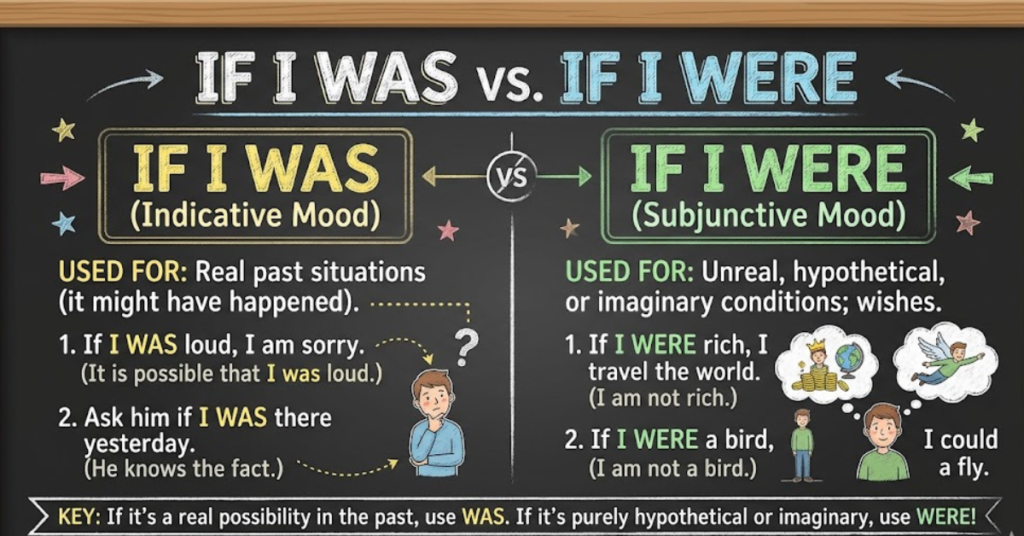
- If I was is often used for real or possible situations.
- If I were is generally used for imaginary, hypothetical, or unreal situations.
This distinction is the foundation of proper if i was vs if i were grammar.
Why This Grammar Rule Confuses People
Part of the confusion comes from everyday speech. Many native English speakers say “if I was” in casual conversation, even when traditional grammar suggests “if I were.”
Another reason is that English grammar has evolved over time. Some formal rules are less strict in modern speech, which makes the distinction feel blurry.
Still, understanding the difference helps improve:
- Writing clarity
- Academic grammar
- Professional communication
- Confidence in spoken English
The Grammar Behind “If I Were”
“If I were” uses the subjunctive mood. That sounds complicated, but the idea is actually simple.
The subjunctive mood describes:
- Imaginary situations
- Wishes
- Hypothetical ideas
- Things contrary to fact
Examples of “If I Were”
- If I were rich, I would travel the world.
- If I were you, I’d apologize.
- If I were taller, I could reach the shelf.
- She acts as if she were the manager.
In all these examples, the situation is not currently true. The speaker is imagining a different reality.
This is the traditional rule taught in formal English grammar.
When “If I Was” Is Correct
“If I was” is used when referring to something that may actually have happened or could realistically be true.
Examples of “If I Was”
- If I was rude yesterday, I’m sorry.
- If I was at the meeting, I don’t remember it.
- If I was unclear, let me explain again.
In these examples, the speaker is talking about a real possibility rather than an imaginary scenario.
That’s the key part of understanding the if i was vs if i were difference.
Real vs Imaginary Situations
A useful trick is to ask yourself one question:
“Is this situation real or imaginary?”
Use “If I Were” for Unreal Situations
- If I were a millionaire…
- If I were invisible…
- If I were the president…
These situations are hypothetical.
Use “If I Was” for Possible Reality
- If I was late, I apologize.
- If I was included in the email, I missed it.
- If I was too harsh, I regret it.
These situations may actually have happened.
Common Examples People Hear Every Day
Some phrases are so common that they’ve become fixed expressions.
Popular “If I Were” Expressions
- If I were you
- If I were in your shoes
- If I were to guess
These are considered grammatically standard.
Casual “If I Was” Expressions
- If I was wrong
- If I was there
- If I was too loud
These are widely accepted in everyday conversation.
Is “If I Was” Grammatically Wrong?
Not always. This is where many people get confused.
Traditional grammar strongly prefers “if I were” for hypothetical situations. However, modern English speakers frequently use “if I was” informally.
In casual speech:
- “If I was you” is common.
- “If I were you” is still considered more grammatically correct.
So context matters:
- Formal writing → usually prefer “if I were”
- Informal conversation → both may appear
Formal vs Informal English Usage
Understanding tone can help you decide which phrase fits best.
In Formal Writing
Use “if I were” for hypothetical situations.
Example:
- If I were responsible for the project, I would change the strategy.
In Informal Conversation
People often use either version.
Example:
- If I was you, I’d leave early.
Even though many people say this casually, grammar experts still favor “if I were you.”
What Grammar Experts Say
Traditional grammar guides and style manuals usually recommend:
- “If I were” for hypothetical statements
- “If I was” for factual or possible past situations
Discussions about merriam-webster if i was vs if i were often point out that modern usage has become more flexible, especially in spoken English.
Still, professional and academic writing tends to follow the traditional rule.
Easy Memory Trick
Here’s a simple shortcut:
“Were” = Wish or Imaginary
Both words start with “W.”
Examples:
- If I were famous…
- If I were younger…
“Was” = Something That Might Be True
Examples:
- If I was mistaken…
- If I was busy…
This small trick helps many learners remember the correct choice instantly.
Common Mistakes to Avoid
Incorrect:
- If I was a bird, I would fly south.
Better:
- If I were a bird, I would fly south.
Because being a bird is imaginary.
Incorrect:
- If I were late yesterday, I apologize.
Better:
- If I was late yesterday, I apologize.
Because the speaker is discussing a real possibility.
Everyday Sentences for Practice
Practice makes grammar feel natural. Try reading these aloud.
Sentences with “If I Were”
- If I were smarter, I’d solve the puzzle.
- If I were the coach, I’d change the lineup.
- If I were free tomorrow, I’d join you.
Sentences with “If I Was”
- If I was impatient earlier, I’m sorry.
- If I was included in the message, I didn’t see it.
- If I was too direct, I didn’t mean to offend you.
These examples help reinforce grammar if i was vs if i were in real-life contexts.
Why Songs and Movies Often Ignore the Rule
You may hear phrases like:
- “If I was your boyfriend…”
- “If I was a rich man…”
Artists often choose wording based on:
- Rhythm
- Rhyme
- Natural speech patterns
- Emotional tone
That’s why popular culture doesn’t always follow formal grammar rules perfectly.
Tips for Remembering the Difference
Here are some practical tips:
- Use “were” for imaginary situations.
- Use “was” for possible past events.
- In professional writing, lean toward traditional grammar.
- Listen to sentence meaning, not just sound.
- Practice with real examples regularly.
The more you read and write, the easier this distinction becomes.
FAQs About If I Was vs If I Were
Which is correct: if I was or if I were?
Both can be correct depending on context. “If I were” is used for hypothetical situations, while “if I was” refers to possible real situations.
Why do people say “if I was” instead of “if I were”?
Many native speakers use informal grammar in conversation. Over time, “if I was” became common in casual speech.
Is “if I were you” grammatically correct?
Yes. It is the traditional and grammatically preferred form because the situation is hypothetical.
Can I use “if I was” in formal writing?
Yes, but only when referring to something that may actually have happened.
What is the subjunctive mood?
The subjunctive mood is a grammatical form used for wishes, hypotheticals, and unreal situations.
Is “if I was” wrong in modern English?
Not necessarily. It’s widely used in casual speech, although formal grammar rules still prefer “if I were” for imaginary situations.
Why is this grammar rule important?
Understanding the difference improves clarity, professionalism, and confidence in English communication.
Conclusion
Learning the difference between if I was vs if I were may seem tricky at first, but the rule becomes much clearer once you focus on meaning instead of memorization.
Use “if I were” for imaginary or hypothetical situations, and use “if I was” when discussing something that may actually be true. While modern English allows flexibility in casual conversation, traditional grammar still matters in formal writing and professional communication.
The best way to master this grammar point is through practice. Pay attention to context, read carefully, and notice how experienced writers use these phrases in real situations. Over time, choosing the correct form will feel completely natural.