
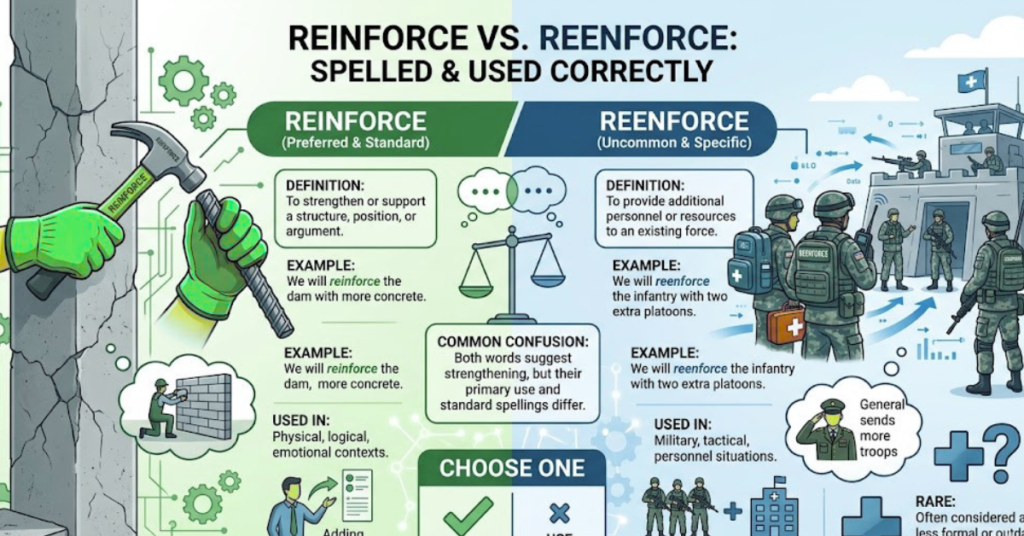

Spelling mistakes can sneak into even the most polished writing, and “reinforce vs reenforce” is a classic example. At first glance, both words seem acceptable, but only one is truly standard in modern English.
If you’ve ever paused while typing, unsure which version to use, you’re in the right place. This guide will break down the meaning, correct spelling, and real-world usage so you can write with confidence every time.
What Does “Reinforce” Mean?
Let’s start with the correct and widely accepted form.
Reinforce means to strengthen, support, or make something more effective. It’s commonly used in both literal and figurative contexts.
Common Uses of Reinforce
- Strengthening physical structures
- Supporting ideas or arguments
- Encouraging behaviors or habits
Examples
- “The builders reinforced the wall with steel beams.”
- “Positive feedback helps reinforce good behavior.”
- “The data reinforces the main argument.”
In everyday English, this is the spelling you should rely on.
What About “Reenforce”?
Now, let’s address the confusing alternative.
Reenforce is an older or nonstandard spelling of “reinforce.” While it may appear in historical texts or outdated usage, it is rarely used in modern writing.
Key Points About Reenforce
- Considered obsolete or incorrect in most contexts
- Rarely used in formal or professional writing
- May appear in older literature or regional variations
In simple terms, you’re almost always better off avoiding it.
Reinforce vs Reenforce: Which Is Correct?
When comparing reinforce vs reenforce, the answer is clear:
- Reinforce is correct and standard
- Reenforce is outdated and generally avoided
Why “Reinforce” Wins
- It follows modern spelling conventions
- It’s recognized in dictionaries and style guides
- It’s universally accepted in both casual and formal writing
If clarity and correctness matter, “reinforce” is the safer choice every time.
Reinforce vs Reenforce UK Usage
You might wonder if British English treats these words differently.
In the case of reinforce vs reenforce UK, the answer remains the same. British English also prefers reinforce as the correct spelling.
UK Usage Insights
- “Reinforce” is standard in British dictionaries
- “Reenforce” is rarely used and considered outdated
- Both academic and professional writing favor “reinforce”
So whether you’re writing in American or British English, the rule doesn’t change.
Why Do People Confuse Reinforce and Reenforce?
The confusion often comes from how the word is formed.
At a glance, “reenforce” looks logical because it combines:
- “re-” (again)
- “enforce” (to apply or strengthen)
However, English doesn’t always follow strict logic in spelling. Over time, “reinforce” became the accepted form, while “reenforce” faded out.
How to Remember the Correct Spelling
If you tend to mix up reinforce vs reenforce, a simple trick can help.
Easy Memory Tips
- Think of “rein” like reins used to control a horse
- “Reinforce” means to control or strengthen something
- Avoid adding extra vowels unless you’re sure
Additionally, seeing the word in common usage will reinforce the correct spelling in your memory.
Common Mistakes to Avoid
Even though the difference is straightforward, mistakes still happen.
Mistake 1: Using “Reenforce” in Formal Writing
Incorrect:
- “We need to reenforce the structure.”
Correct:
- “We need to reinforce the structure.”
Mistake 2: Assuming Both Spellings Are Equal
Some people believe both forms are interchangeable. In reality, only one is widely accepted today.
Mistake 3: Overthinking the Prefix
English spelling isn’t always predictable. Stick with the standard form instead of trying to “fix” it logically.
When to Use “Reinforce” in Everyday Writing
“Reinforce” is a versatile word that fits many situations.
Common Scenarios
- Construction and engineering
- “They reinforced the bridge for safety.”
- Education and learning
- “Practice helps reinforce new skills.”
- Communication and arguments
- “The evidence reinforces the claim.”
Because of its flexibility, it’s a valuable word in both casual and professional contexts.
FAQs
What is the difference between reinforce vs reenforce?
“Reinforce” is the correct modern spelling, while “reenforce” is outdated and rarely used.
Is reenforce ever correct?
It may appear in older texts, but it’s not considered standard in modern English.
Which spelling should I use in the UK?
In reinforce vs reenforce UK, “reinforce” is the correct and preferred spelling.
Why is reenforce incorrect today?
Language evolves over time, and “reinforce” became the accepted standard while “reenforce” fell out of use.
How can I remember the correct spelling?
Associate “reinforce” with “rein” (as in guiding or strengthening), and avoid adding extra letters.
Conclusion
Understanding reinforce vs reenforce doesn’t have to be complicated. While both spellings may look similar, only “reinforce” is correct in modern English. The alternative form is outdated and best avoided in both casual and professional writing.
By focusing on standard usage and remembering a simple spelling trick, you can avoid common mistakes and write more confidently. Keep practicing, and over time, the correct form will feel natural every time you use it.