
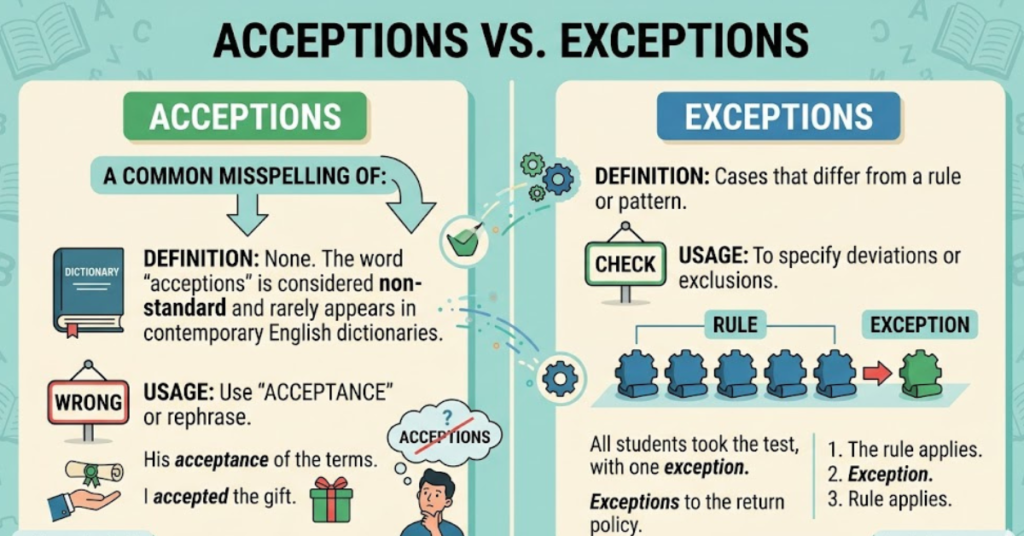

Some words look so similar that they easily trip people up—and acceptions vs exceptions is a perfect example. At first glance, they seem interchangeable, but in reality, they have very different meanings and uses.
If you’ve ever paused mid-sentence wondering which one to use, this guide will clear things up. We’ll break down each term, explain the differences, and show how to use them correctly in everyday writing.
What Does “Acceptations” Mean?
Let’s start with the less common term.
Acceptations Meaning
“Acceptations” is the plural form of “acceptation,” which refers to the different meanings or interpretations of a word. It’s mostly used in formal or linguistic contexts.
Simple Explanation
- It relates to definitions of a word
- It’s often used in dictionaries or academic writing
- It’s rarely used in everyday conversation
Example
- “The word has several acceptations depending on context.”
Because it’s uncommon, many people don’t encounter this term often.
What Does “Exceptions” Mean?
Now let’s look at the more familiar word.
Exceptions Meaning
“Exceptions” refers to things that do not follow a general rule or pattern.
Simple Explanation
- It highlights something different or excluded
- It’s widely used in both casual and formal English
- It often appears in rules, lists, or conditions
Examples
- “Everyone passed the test, with a few exceptions.”
- “This rule applies to all cases except a few exceptions.”
This is the word most people are actually looking for in everyday situations.
Acceptations vs Exceptions: The Core Difference
Understanding the difference between these two words is key to using them correctly.
Main Differences
- “Acceptations” deals with meanings of words
- “Exceptions” deals with breaking rules or patterns
- One is rare and technical, the other is common and practical
In simple terms, one belongs to language study, while the other belongs to everyday communication.
When Should You Use “Acceptations”?
Although uncommon, “acceptations” still has its place.
Use It When:
- Discussing word meanings or definitions
- Writing in academic or linguistic contexts
- Analyzing language or literature
Example in Context
- “Different acceptations of the term appear in historical texts.”
If you’re not discussing language directly, you probably won’t need this word.
When Should You Use “Exceptions”?
“Exceptions” is far more versatile and widely used.
Use It When:
- Talking about rules with special cases
- Describing something unusual or excluded
- Explaining differences in patterns
Example in Context
- “There are no exceptions to this rule.”
In most cases, this is the word you’ll want.
Common Mistakes to Avoid
Because these words look similar, confusion is common. However, a few simple tips can help you avoid errors.
Avoid These Mistakes
- Using “acceptations” when you mean “exceptions”
- Assuming both words are interchangeable
- Using “acceptations” in casual writing
Quick Tip
If you’re talking about rules or situations, use “exceptions.” If you’re talking about meanings, consider “acceptations.”
Easy Way to Remember the Difference
A simple memory trick can make things easier.
Think of It This Way
- “Acceptations” → Accepting meanings
- “Exceptions” → Except from rules
This small distinction can help you choose the right word instantly.
Real-Life Examples for Better Understanding
Let’s compare both words in context.
Acceptations Example
- “The term has multiple acceptations in different cultures.”
Exceptions Example
- “All employees must attend the meeting, with no exceptions.”
Seeing them side by side makes the difference much clearer.
Why This Difference Matters
At first, this might seem like a minor detail. However, using the wrong word can change the meaning of your sentence completely.
Benefits of Using the Right Word
- Improves clarity in communication
- Makes your writing more professional
- Helps avoid misunderstandings
Even small corrections can make a big impact on how your message is received.
FAQs
What is the difference between acceptations vs exceptions?
“Acceptations” refers to meanings of a word, while “exceptions” refers to cases that don’t follow a rule.
Is “acceptations” commonly used?
No, it’s mostly used in academic or linguistic contexts and is rare in everyday language.
Which word should I use in daily writing?
In most cases, you should use “exceptions.”
Can I use both words interchangeably?
No, they have different meanings and should not be swapped.
Why do people confuse these words?
They look similar and sound alike, which makes them easy to mix up.
Conclusion
Understanding acceptions vs exceptions comes down to recognizing their distinct roles. One is a technical term about meanings, while the other is a common word used in everyday situations.
If you remember that “exceptions” relates to rules and “acceptations” relates to meanings, you’ll avoid one of the most common language mix-ups. Keep practicing with real examples, and soon the difference will feel completely natural.