

If you ever pause while typing an email to search for the Affect and Effect Difference, you are definitely not alone. These two words sound almost identical, so millions of writers mix them up every single day. Mixing them up is actually one of the most common spelling and grammar slip-ups in the English language. Fortunately, telling them apart is very simple once you learn a few basic rules. Once you understand how they work, you will never get confused again.
Learning the affect and effect difference will boost your writing confidence fast. Whether you are drafting a school essay, sending an email to your boss, or posting on social media, getting your words right makes a great impression. You do not need a degree in English grammar to master these two words. You just need a simple mental picture and a couple of fun memory tricks. In this guide, we will break down both words using clear examples, easy rules, and helpful guides.
Understanding the Affect and Effect Difference Made Simple
When you first look at the affect and effect difference, it can seem tricky because both words sound almost identical when spoken out loud. In English, words that sound the same are called homophones. Because they sound so close, our brains tend to blur them together when we write quickly. The main key to telling them apart lies in their parts of speech. One word is usually an action, while the other word is usually a thing or result.
To keep things clear in your mind, think about cause and result. An action happens first, and then a result follows that action. One word acts as the starting action that changes something else. The second word is the final outcome that you can see or feel afterward. Once you connect action to the first word and result to the second word, the overall pattern becomes clear immediately.
Why Knowing the Affect and Effect Difference Matters
Many people worry about making embarrassing grammar mistakes at work or school. Understanding the affect and effect difference keeps your writing clean, sharp, and polished. When your writing is accurate, readers can focus on your great ideas instead of your spelling choices. Clear communication builds trust with your readers, teachers, and clients. It shows that you pay attention to details and take pride in your work.
Using the wrong word can also change the entire meaning of your sentence. In professional fields like medicine, law, or business, a tiny mix-up can confuse your reader completely. For example, saying a medicine had a strong outcome is very different from saying a medicine altered your body. Taking a few minutes to learn these two words will save you time and prevent simple misunderstandings in your daily messages.
What Does “Affect” Mean? (The Action Verb)
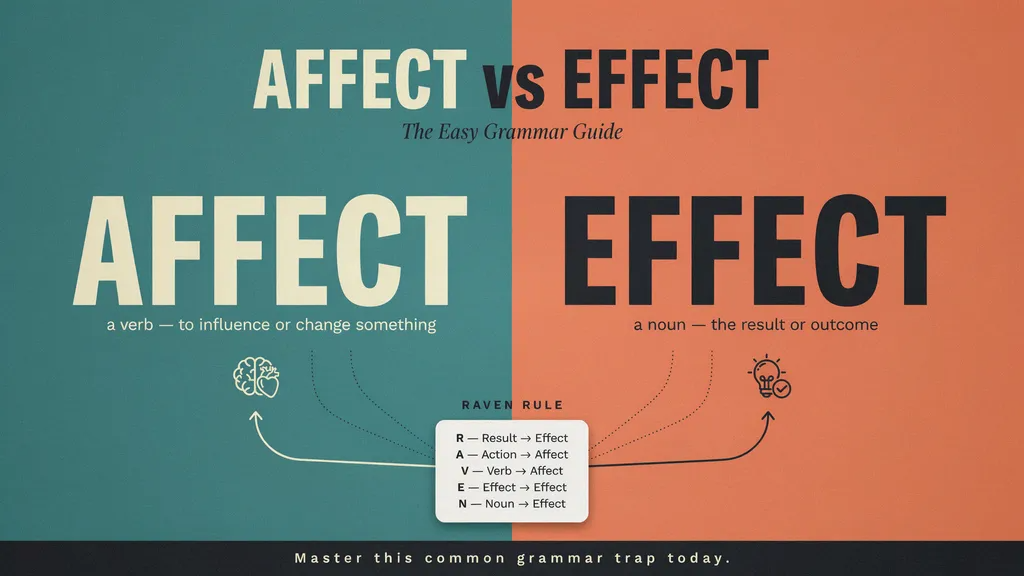
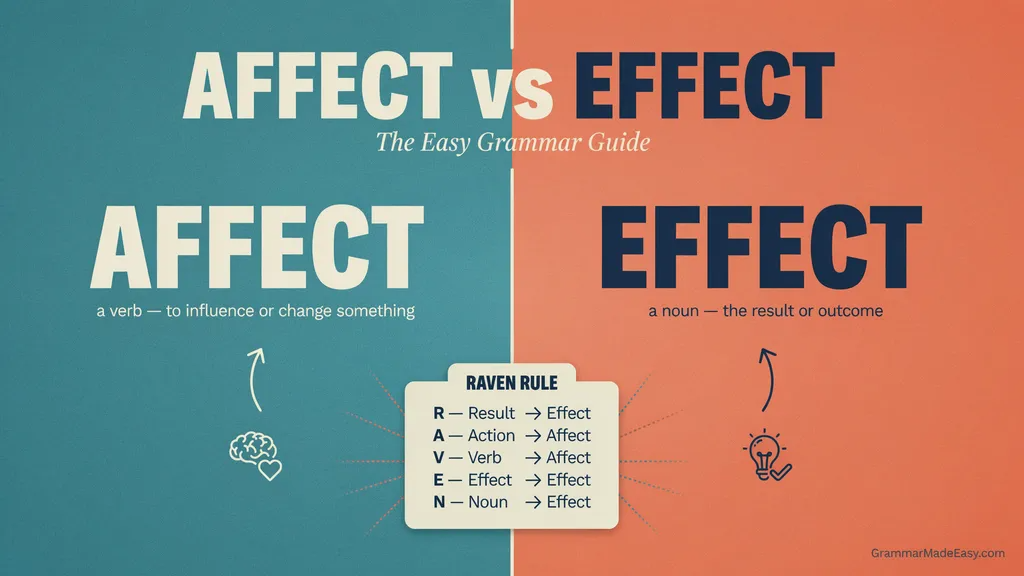
To master the affect and effect difference, start with the word affect. In almost every sentence you write, affect is an action verb. A verb is a word that describes an action, an occurrence, or a process. When you affect something, you produce a change in it or influence it in some way. Think of the letter A at the start of affect as standing for Action. If you are doing something that alters a situation, you want affect.
Here are a few quick examples to help you visualize how this verb works in real life:
- Cold weather can affect your health by giving you a sore throat.
- Loud music can affect your ability to study for a test.
- Rain can affect your weekend plans at the park.
Notice how in every single case, the word describes an action that creates a change in something else.
What Does “Effect” Mean? (The End Result)
Next, let us look at the other side of the affect and effect difference. The word effect is almost always a noun. A noun is a word that names a person, place, thing, or idea. An effect is the actual result or outcome of an action. Think of the letter E at the start of effect as standing for End Result. When you talk about the final outcome that happened, you want to use effect.
You can easily spot this noun in sentences because it often follows words like a, an, or the. For example, you might say that the new law had a positive effect on traffic. The warm sunshine had a soothing effect on my mood. The lack of sleep was an unwanted effect of staying up late. In all of these sentences, the word represents a concrete outcome or thing.
The Famous RAVEN Trick for Remembering the Difference
Grammar experts love quick memory tricks to make writing easier. A famous tool to remember the affect and effect difference is the word RAVEN. RAVEN is an acronym, which means each letter stands for a word in a helpful phrase. Remembering this single bird name can save you whenever you feel stuck on which word to pick in your writing.
Here is what the letters in RAVEN stand for:
- R = Remember
- A = Affect is a
- V = Verb
- E = Effect is a
- N = Noun
If you ever hesitate while writing a paragraph, just spell out RAVEN in your head. Ask yourself if you need a verb or a noun. If you need an action verb, choose affect. If you need a result noun, choose effect.
Side-by-Side Comparison of Affect vs Effect
Here is a detailed reference guide explaining the affect and effect difference in clear detail. Comparing the two terms side by side helps reinforce their primary meanings, typical grammatical roles, and handy memory clues.
| Feature | Affect | Effect |
| Primary Part of Speech | Verb (Action) | Noun (Thing / Result) |
| Simple Definition | To influence or cause a change | The result or outcome of a change |
| First Letter Memory Trick | A = Action | E = End Result |
| Common Signal Words | Will, can, may, directly | A, an, the, cause and, side |
| Synonym Swap | Alter, influence, change | Outcome, result, impact |
| Example Sentence | The noise will affect my sleep. | The noise had a bad effect on my sleep. |
Rare Exceptions You Might See in Advanced Writing
To fully understand the affect and effect difference, you should know about two rare exceptions. While affect is usually a verb and effect is usually a noun, their roles occasionally flip in special situations. You will not encounter these exceptions very often in casual conversation, but knowing them will make you a true word master.
First, effect can sometimes act as a verb meaning to bring about or cause something to happen. You often see this in phrases like “to effect change” in politics or business. Second, affect can sometimes act as a noun in psychology. Psychologists use affect to describe a person’s visible emotional response or facial expression. However, ninety-nine percent of the time, stick to the standard verb and noun roles.

Clear Sentence Examples to Test Your Knowledge
Looking at real sentences is the best way to solidify the affect and effect difference in your mind. Seeing both words used correctly in context makes the rules stick much better than reading definitions alone. Let us take a look at how both words interact inside everyday sentences.
Consider this sentence: “The heavy rain will affect the highway, but the main effect will be slow traffic.” Notice how both words function together nicely in one thought. The rain performs the action of altering the highway (affect). The outcome of that action is slow traffic (effect). Practice reading sentences like this out loud to train your ears and brain.
Everyday Writing Mistakes and How to Avoid Them
One of the most frequent errors related to the affect and effect difference involves mixing up cause and result in complex thoughts. People often try to use effect as an action word because it sounds strong. For instance, writing “The news effected my mood” is incorrect because you need an action verb there. You should write “The news affected my mood” instead.
Another common mistake is forgetting the little words that signal a noun. Words like the, an, or a almost always point to effect. If you see the word “the” right before your blank space, you almost certainly need effect. For example, “The effect of the coffee was immediate.” Keeping an eye out for these small clue words prevents quick writing slips.
How Mastering the Difference Helps Your Career
Professional writing requires sharp attention to detail. Knowing the affect and effect difference shows your boss, colleagues, and clients that you communicate clearly and accurately. Clear emails reduce confusion and keep projects running smoothly. When your messages are error-free, your professional credibility rises immediately.
Furthermore, strong grammar skills give you an edge in competitive job markets. Resume screeners and hiring managers notice good language habits right away. Demonstrating that you can express complex ideas without basic grammar errors makes your cover letters and reports stand out. It proves that you take your professional communication seriously.
Quick Memory Hacks for Fast Everyday Writing
When you are typing quickly, you need an easy shortcut to recall the affect and effect difference on the fly. Besides the RAVEN rule, you can use the alphabetical order trick. In the alphabet, the letter A comes before the letter E. Similarly, an Action (Affect) must happen before you get a Result or Effect.
Another trick is to substitute the word in question with a synonym. If you can replace the mystery word with “alter” or “change,” you need affect because both start with A. If you can replace the mystery word with “result” or “outcome,” you need effect. This simple swap test takes just two seconds and guarantees you pick the right word every time.
Frequently Asked Questions
1. How can I easily remember the affect and effect difference?
The easiest way is to use the RAVEN rule. Remember that Affect is a Verb (Action) and Effect is a Noun (End result). You can also match the letter A in affect to Action, and the letter E in effect to End result.
2. Can affect ever be used as a noun?
Yes, but it is rare. In psychology, affect is used as a noun to describe how someone displays emotions on their face or through body language. In everyday writing, affect is almost always an action verb.
3. Is it “side affect” or “side effect”?
The correct phrase is “side effect.” A side effect is a result or outcome produced by a medicine or treatment. Since it describes a noun or result, you must use effect.
4. Why is the affect and effect difference so confusing for native speakers?
Native speakers find these words confusing because they sound nearly identical in spoken English. Since people hear them used interchangeably in speech, they often guess when writing them down.
5. What is a quick trick to check my sentence?
Try replacing the word with “change.” If the sentence still makes sense using the word “change,” use affect. If the sentence needs the word “result” to make sense, use effect.
6. Can effect ever be used as a verb?
Yes, effect can be a verb when it means to bring about or accomplish something. You will often see it used in business phrases like “to effect change.”
Conclusion
Mastering the affect and effect difference does not have to feel overwhelming or complicated. By focusing on the basic rule—Affect is an Action verb and Effect is an End result—you can eliminate spelling doubt forever. Using tools like the RAVEN acronym and the quick synonym swap test will keep your writing clear and error-free every single time.
Now that you know the rules, take a moment to review your recent emails or essays. Try applying the RAVEN trick today, and share these simple tips with a friend or classmate who wants to improve their writing too!