
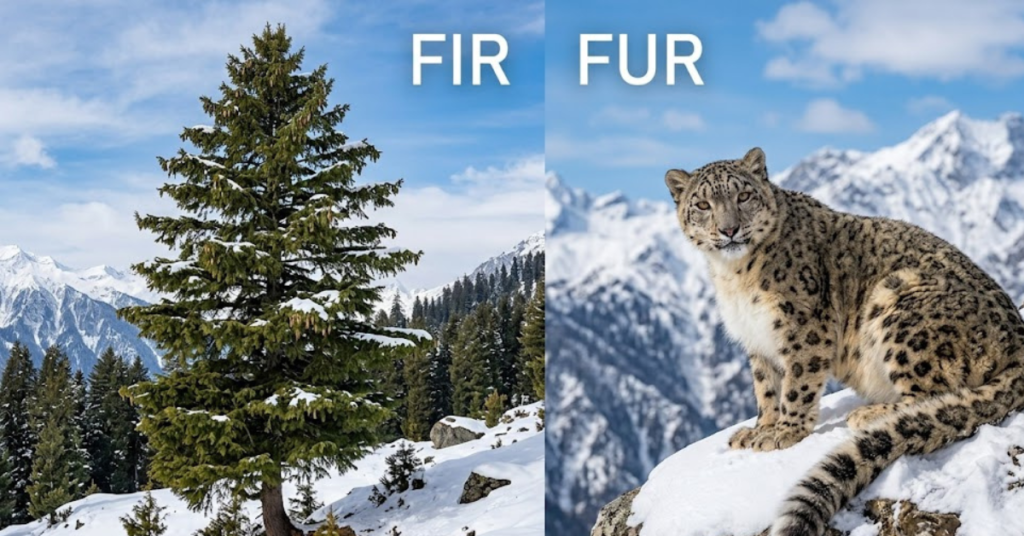

English has many words that sound similar but mean completely different things. One common source of confusion is fir vs fur. Although these two words differ by only one letter, they refer to entirely different things. One is a type of tree, while the other describes the soft hair covering certain animals.
If you’ve ever wondered when to use fir and when to use fur, you’re not alone. This guide explains their meanings, origins, examples, and practical usage so you can use both words confidently in writing and conversation.
Why Fir and Fur Are Often Confused
The confusion usually comes from their similar spelling and pronunciation. When spoken quickly, the two words can sound alike, especially in certain accents.
However, their meanings are completely unrelated:
- Fir refers to a type of evergreen tree.
- Fur refers to the thick, soft coat of hair on animals.
Understanding this distinction makes choosing the correct word much easier.
What Does Fir Mean?
The word fir refers to a group of evergreen conifer trees belonging to the genus Abies.
Fir Definition
A fir is:
- An evergreen tree
- A conifer with needle-like leaves
- A tree commonly used for timber and holiday decorations
Examples of Fir in Sentences
- The forest was filled with tall fir trees.
- Many families decorate a fir tree during the holiday season.
- The cabin was built using fir wood.
Fir trees are valued for their beauty, durability, and economic importance.
Characteristics of Fir Trees
Fir trees are found in many regions of the world, particularly in cooler climates.
Key Features
- Needle-shaped leaves
- Cone-bearing branches
- Evergreen foliage
- Tall, straight trunks
- Distinctive fragrance
Because they remain green throughout the year, fir trees are often associated with winter landscapes and festive traditions.
What Does Fur Mean?
The word fur refers to the soft hair that covers the skin of many mammals.
Fur Definition
Fur is:
- The coat of hair on an animal
- A protective layer that provides warmth
- A feature found on animals such as cats, dogs, rabbits, and bears
Examples of Fur in Sentences
- The cat’s fur was soft and shiny.
- Polar bears have thick fur to survive cold temperatures.
- She brushed her dog’s fur every morning.
In each example, fur refers to animal hair rather than a plant or tree.
The Purpose of Fur in Nature
Fur serves several important biological functions.
Benefits of Fur
- Provides insulation from cold weather
- Protects the skin
- Helps animals regulate body temperature
- Offers camouflage in some environments
- Assists with sensory perception in certain species
Different animals have different types of fur depending on their habitats and survival needs.
Fir vs Fur: Side-by-Side Comparison
The easiest way to understand the difference is through direct comparison.
Fir
Meaning:
- Evergreen tree
- Type of conifer
Example:
- The mountains were covered with fir trees.
Fur
Meaning:
- Animal hair
- Protective coat on mammals
Example:
- The rabbit’s fur felt incredibly soft.
One relates to plants and forests, while the other relates to animals.
Pronunciation of Fir and Fur
In many English dialects, fir and fur are pronounced almost identically.
Fir
Pronunciation:
- Fur
Fur
Pronunciation:
- Fur
Because they often sound the same, context becomes essential for understanding which word is intended.
This makes them examples of near-perfect homophones in many accents.
Common Examples in Everyday Language
Using Fir Correctly
- Fir forests cover large areas of mountainous regions.
- The carpenter used fir lumber for the project.
- We admired the giant fir trees during our hike.
Using Fur Correctly
- The puppy’s fur was fluffy and warm.
- She found fur on the couch after the cat took a nap.
- Thick fur helps animals survive harsh winters.
These examples highlight how different the meanings are despite similar pronunciation.
Memory Tricks to Remember the Difference
Simple associations can help prevent mistakes.
Remember Fir = Forest
Both words begin with the letter “F.”
Think:
- Fir
- Forest
Since fir trees grow in forests, the connection is easy to remember.
Remember Fur = Furry Animals
Think of:
- Fur
- Furry
- Animal coats
This instantly connects the word to animals rather than trees.
Common Mistakes to Avoid
Because the words sound alike, spelling mistakes are common.
Incorrect
- The bear’s fir kept it warm during winter.
Correct
- The bear’s fur kept it warm during winter.
Why?
Because animals have fur, not trees.
Incorrect
- We walked through a forest of tall fur trees.
Correct
- We walked through a forest of tall fir trees.
Why?
Because fir refers to a type of tree.
Origin of the Words
Learning the origins can provide additional context.
Origin of Fir
The word fir comes from Old Norse and Germanic languages referring to evergreen conifer trees.
Its meaning has remained relatively unchanged for centuries.
Origin of Fur
The word fur originates from Old French and medieval Germanic languages.
Historically, it referred to animal pelts and the soft hair covering mammals.
Although their spellings are similar today, the words developed from different linguistic roots.
Why Context Matters
When reading or writing, context usually makes the correct choice obvious.
Ask yourself:
Are You Talking About Trees?
Use fir.
Examples:
- Fir forest
- Fir wood
- Fir tree
Are You Talking About Animals?
Use fur.
Examples:
- Dog fur
- Thick fur
- Soft fur
This simple rule solves most cases immediately.
Related Vocabulary
Words Associated with Fir
- Pine
- Spruce
- Conifer
- Evergreen
- Forest
Words Associated with Fur
- Hair
- Coat
- Pelt
- Mammal
- Furry
These related terms reinforce the distinction between the two words.
Frequently Asked Questions
What is the difference between fir and fur?
Fir is a type of evergreen tree, while fur is the soft hair covering many animals.
Is fir a tree or a plant?
A fir is a coniferous evergreen tree belonging to the genus Abies.
What animals have fur?
Many mammals have fur, including cats, dogs, rabbits, foxes, bears, and squirrels.
Are fir and fur pronounced the same?
In many English accents, they are pronounced identically or nearly identically.
Why do people confuse fir and fur?
The words have similar spellings and often share the same pronunciation, making them easy to mix up.
How can I remember the difference?
Associate fir with forests and trees, and fur with furry animals.
Conclusion
Understanding fir vs fur is straightforward once you know their meanings. Fir refers to an evergreen tree commonly found in forests and mountain regions, while fur refers to the soft coat of hair that covers many animals. Although the words are often pronounced the same way, their meanings belong to completely different categories.
Whenever you’re unsure, remember this simple rule: trees are fir, and animals have fur. Keeping that distinction in mind will help you avoid common spelling mistakes and communicate more clearly in both writing and speech.