
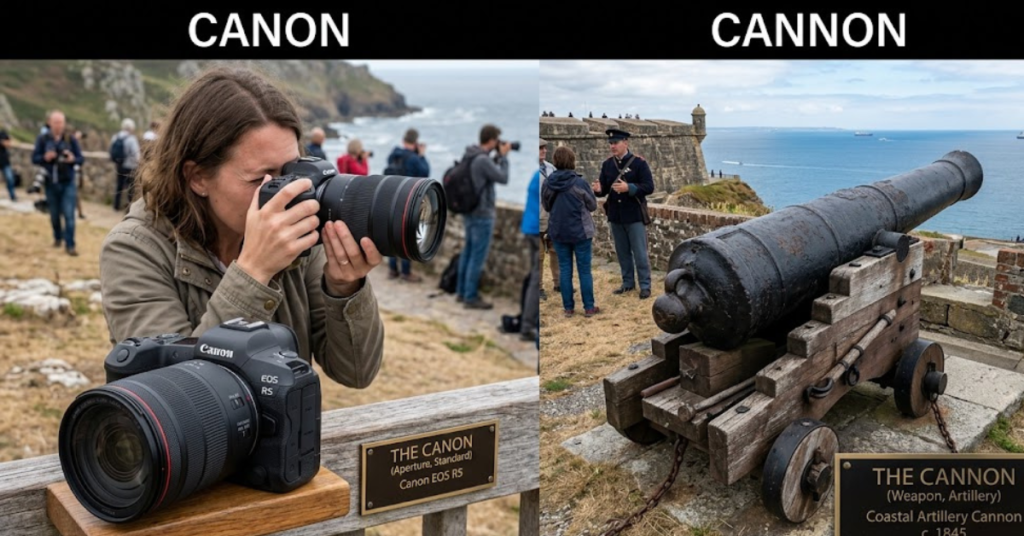

Few word pairs create as much confusion as canon vs cannon. They sound exactly the same when spoken, but their meanings couldn’t be more different. One relates to accepted rules, official stories, and religious laws, while the other refers to a powerful weapon.
Because these words are homophones—words that sound alike but have different meanings and spellings—many writers accidentally use the wrong one. Whether you’re discussing literature, religion, gaming, fandoms, or military history, understanding the distinction between canon vs cannon is essential.
This guide explains the canon vs cannon meaning, pronunciation, definitions, examples, and common mistakes so you can use each word correctly and confidently.
Canon vs Cannon: What’s the Difference?
The primary difference is simple:
- Canon refers to an accepted rule, official work, or authoritative collection.
- Cannon refers to a large firearm or artillery weapon.
Although they sound identical, they belong to completely different categories of language.
Quick Example
Correct:
That event is canon in the story.
Correct:
The army fired a cannon during the battle.
Incorrect:
That event is cannon in the story.
Incorrect:
The army fired a canon during the battle.
The key is understanding the context.
Canon vs Cannon Meaning
Let’s break down each word individually.
What Does Canon Mean?
The word canon generally refers to something officially accepted as authentic, authoritative, or part of an established body of work.
Common meanings include:
- Religious laws or principles
- Official literary works
- Accepted storylines in fiction
- Recognized standards or rules
Examples:
- Biblical canon
- Literary canon
- Canon law
- Canon in a fictional universe
What Does Cannon Mean?
A cannon is a large weapon designed to fire heavy projectiles.
Examples include:
- Naval cannons
- Military cannons
- Historical battlefield cannons
- Decorative ceremonial cannons
Example sentence:
The fortress protected itself with several cannons.
Canon vs Cannon Pronunciation
One reason people confuse these words is that they share the same pronunciation.
Both words are typically pronounced as:
KAN-uhn
Because there is no audible difference, writers must rely on spelling and context to determine which word is correct.
This makes canon vs cannon pronunciation a common source of confusion.
Canon Definition and Usage
The word canon has several meanings depending on the subject being discussed.
Religious Canon
In religion, canon refers to officially recognized texts or laws.
Examples:
- The biblical canon
- Church canon law
- Canonical scriptures
Literary Canon
In literature, canon refers to works considered important or authoritative.
Examples:
- Shakespeare’s canon
- The Western literary canon
Fictional Canon
In entertainment and fandom culture, canon refers to events officially recognized as part of a story.
Example:
The novel is considered canon within the series.
Cannon Definition and Usage
The word cannon has a much more specific meaning.
A cannon is:
- A large artillery weapon
- A military firearm
- A historical siege weapon
Examples:
- The soldiers loaded the cannon.
- The museum displayed a Civil War cannon.
- The pirate ship carried several cannons.
Unlike canon, cannon almost always relates to weaponry.
Canon vs Cannon in Fandom
One of the most searched topics involving this word pair is canon vs cannon fandom.
In fandom communities, canon is extremely important.
Canon in Fandom
Canon includes:
- Official storylines
- Confirmed character relationships
- Events approved by creators
- Published material recognized as authentic
Example:
That character’s backstory is canon.
Non-Canon Content
Fans often create:
- Fan fiction
- Alternative endings
- Alternate universes
These may not be considered canon.
Example:
The fan theory is interesting, but it isn’t canon.
Because the words sound alike, newcomers sometimes mistakenly write “cannon” instead of “canon.”
Non Canon vs Cannon
A common mistake online involves the phrase non canon vs cannon.
Non-Canon
Non-canon means:
- Not officially part of a story
- Unrecognized by creators
- Existing outside official continuity
Examples:
- Fan fiction
- Alternate timelines
- Unofficial adaptations
Cannon
Cannon still means a weapon.
Therefore:
Correct:
The story is non-canon.
Incorrect:
The story is non-cannon.
The second version accidentally refers to a weapon rather than a storyline.
Church Canon vs Cannon Bloodborne
The search phrase church canon vs cannon bloodborne highlights an interesting example from gaming.
In the video game Bloodborne, there is an actual weapon called the Church Cannon.
Here:
- Church = religious reference
- Cannon = weapon
Some players mistakenly write “Church Canon” because they associate the word with religious terminology.
However, the in-game item is correctly spelled “Church Cannon” because it is literally a weapon.
This example perfectly illustrates why understanding canon vs cannon difference matters.
Canon in Movies, TV Shows, and Books
The modern use of canon has expanded dramatically due to popular culture.
When discussing stories, canon refers to material officially recognized by the creators.
Examples
A television series may have:
- Canon episodes
- Canon characters
- Canon events
A movie franchise may establish:
- Canon timelines
- Canon backstories
- Canon relationships
Fans frequently debate whether certain events are canon or non-canon.
Common Examples of Canon vs Cannon
Understanding real-world examples helps reinforce the distinction.
Canon Examples
- The novel is canon within the franchise.
- The church follows a specific canon law.
- Scholars study the literary canon.
- That scene is considered canon.
Cannon Examples
- The army fired a cannon.
- The fortress contained several cannons.
- The museum displayed a historic cannon.
- The ship carried powerful cannons.
Notice that canon relates to authority or official status, while cannon refers to weaponry.
Easy Memory Tricks
If you struggle to remember the difference, these tricks can help.
Canon Has One “N”
Think of:
- Narrative
- Novel
- Official story
These concepts connect to canon.
Cannon Has Two “N”s
Think of the extra “n” as extra firepower.
- Cannon = weapon
- Bigger spelling = bigger object
Story vs Weapon
Ask yourself:
- Am I discussing a story, rule, or official version? Use canon.
- Am I discussing artillery or firearms? Use cannon.
Why the Confusion Exists
Several factors contribute to the confusion.
Identical Pronunciation
Canon and cannon sound exactly alike.
Internet Discussions
Fandom communities use the word canon frequently, increasing opportunities for spelling mistakes.
Autocorrect Errors
Some devices mistakenly replace one word with the other.
Lack of Context
Without context, it can be difficult to determine which spelling is intended.
Why Correct Usage Matters
Choosing the right word improves:
- Writing accuracy
- Professional communication
- Academic credibility
- Reader understanding
- Search engine optimization
Using “cannon” instead of “canon” in a literary discussion can completely change the meaning of a sentence.
Frequently Asked Questions
What is the difference between canon and cannon?
Canon refers to official rules, accepted works, or recognized storylines. Cannon refers to a large artillery weapon.
What does canon mean?
Canon generally means something officially accepted or recognized, such as religious texts, literary works, or story continuity.
What does cannon mean?
A cannon is a large firearm designed to launch projectiles.
Are canon and cannon pronounced the same?
Yes. They are homophones and are pronounced the same way.
What does canon mean in fandom?
In fandom culture, canon refers to story elements officially recognized by the creators.
What is non-canon?
Non-canon refers to material that is not officially part of a story’s continuity.
Is the Church Cannon in Bloodborne spelled with canon or cannon?
It is correctly spelled “Church Cannon” because it is a weapon.
What is church canon?
Church canon generally refers to religious laws, rules, or officially accepted religious texts.
Conclusion
Understanding canon vs cannon is easier once you recognize that the two words belong to completely different worlds. Canon refers to official stories, accepted works, religious laws, and recognized authority, while cannon refers to a large weapon used throughout military history.
Although their pronunciation is identical, their meanings are distinct. Whether you’re discussing church law, literary works, fandom continuity, gaming references, or historical artillery, choosing the correct spelling ensures your writing remains accurate and professional.
The next time you encounter canon vs cannon, remember a simple rule: if it’s about stories, rules, or official content, use canon. If it’s about a weapon, use cannon. That one distinction will help you avoid one of English’s most common spelling mix-ups.