
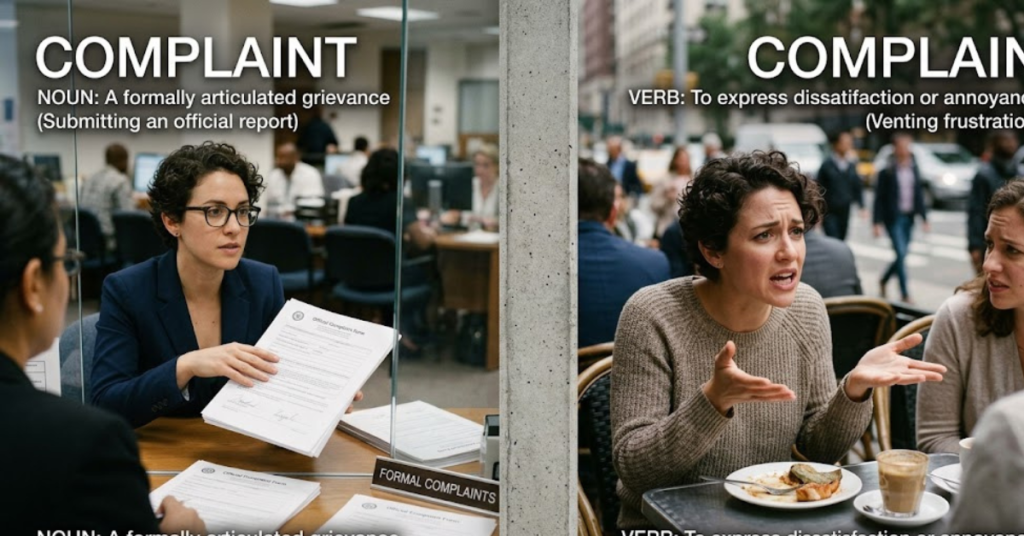

If you’ve ever been unsure whether to use complaint vs complain, you’re definitely not the only one. These two words look similar, sound related, and even share the same root—but they play completely different roles in English grammar.
The focus keyword complaint vs complain often confuses learners because one is a noun and the other is a verb. In this guide, we’ll break it down in a simple, conversational way so you can confidently use both words in writing, speaking, emails, and exams without hesitation.
What Does “Complain” Mean?
To understand complaint vs complain meaning, we first need to look at the verb complain.
Complain means to express dissatisfaction or annoyance about something.
It is an action word (verb), so it describes what someone does.
Examples of “complain”:
- She often complains about the weather.
- They complained about the noise last night.
- He is complaining about the service at the restaurant.
In simple terms, when someone is speaking up about a problem, they are complaining.
What Does “Complaint” Mean?
Now let’s look at the noun form in complaint vs complain meaning.
A complaint is the actual statement or expression of dissatisfaction.
It is a thing, not an action.
Examples of “complaint”:
- She filed a complaint with customer service.
- The company received several complaints about delays.
- His main complaint was poor communication.
So, a complaint is the result of complaining—it’s what gets written, reported, or formally submitted.
Complaint or Complain: Key Difference
The main difference in complaint vs complain is simple grammar structure:
1. Complain (Verb)
- Shows action
- Something you do
- Used with actions like “is complaining,” “complained,” “complain about”
2. Complaint (Noun)
- Shows a thing or idea
- Something you make or submit
- Often used in formal or written contexts
Quick comparison:
- I complain about bad service.
- I filed a complaint about bad service.
Once you see the pattern, complaint vs complain becomes much easier to understand.
Complaint vs Complain Examples in Real Life
To fully understand complaint vs complain examples, let’s look at everyday situations.
In daily conversation:
- I will complain if the food is cold.
- My complaint is that the food is cold.
At work:
- Employees often complain about workload.
- The HR department received a formal complaint about workload issues.
Customer service:
- Customers complain when they are unhappy.
- A customer submitted a complaint through email.
These examples show how both words are used in different contexts but are closely connected.
Common Mistakes with Complaint vs Complain
Many learners mix up complaint vs complain because of similar spelling. Here are common errors:
- Using “complain” as a noun (incorrect)
- Writing “I have a complain” instead of “I have a complaint”
- Confusing verb and noun forms in formal writing
Correct usage reminder:
- I have a complaint (wrong if used as verb form)
- I have a complaint
- I will complain
Understanding this difference helps improve grammar accuracy quickly.
How to Remember the Difference Easily
If complaint vs complain still feels confusing, here’s a simple trick:
- Complain = action (verb) → ends in “-ain” like “pain” (something you express)
- Complaint = thing (noun) → ends in “-t” like “object” (something you submit)
Another way to think:
- You complain (do the action)
- You make a complaint (create a thing)
This mental shortcut makes usage much easier in real situations.
When to Use Complaint vs Complain in Writing
In formal writing, choosing the correct form is important:
Use “complain” when:
- Describing actions
- Writing about behavior
- Using verbs in sentences
Use “complaint” when:
- Writing emails, reports, or forms
- Referring to customer service issues
- Talking about formal issues or grievances
In professional communication, complaint vs complain errors can affect clarity, so choosing the right form matters.
Complaint or Complain Meaning in Simple Words
To summarize complaint or complain meaning:
- Complain = to express unhappiness
- Complaint = the expression or report of unhappiness
They are connected, but not interchangeable.
FAQs
1. What is the difference between complaint or complain?
“Complain” is a verb (action), while “complaint” is a noun (thing or statement).
2. Can I say “I have a complain”?
No, the correct form is “I have a complaint.”
3. What is complaint or complain meaning in simple English?
Complain means to express dissatisfaction; complaint is the expression itself.
4. What are some complaint or complain examples?
- I complain about noise.
- I filed a complaint about noise.
5. Is complain always negative?
Yes, it is usually used to express dissatisfaction or problems.
6. Can complaint be used in formal writing?
Yes, complaint is commonly used in legal, business, and customer service contexts.
Conclusion
Understanding complaint vs complain is actually quite simple once you break it down. One is an action (complain), and the other is the result of that action (complaint). This small difference plays a big role in writing clear and correct English.
The next time you’re unsure, just remember: you complain when something bothers you, and you make a complaint when you report it. Mastering this difference will instantly improve your grammar, writing clarity, and confidence in everyday communication.