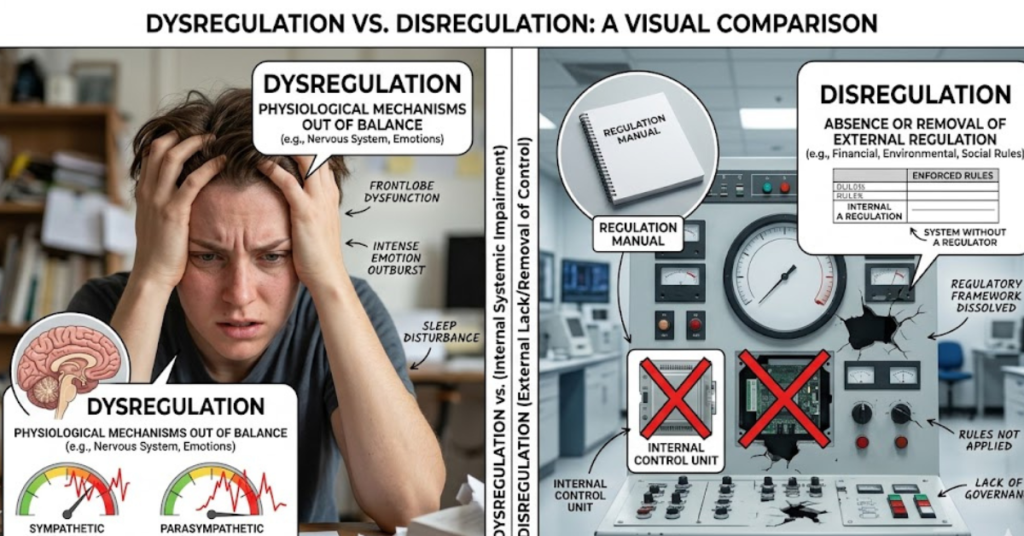

The confusion around dysregulation vs disregulation is more common than you might think. Both words look similar, sound almost identical, and are often used interchangeably online. But in reality, only one of them is widely accepted in psychology and medical language.
If you’ve ever wondered which term is correct, what they mean, or why people keep mixing them up, you’re in the right place. Understanding dysregulation vs disregulation matters especially in mental health discussions, where precision in language helps avoid misunderstanding and miscommunication.
In this guide, we’ll break down the correct usage, meanings, examples, and real-world context so you can confidently use the right term.
Dysregulation vs Disregulation: Which Is Correct?
The correct and widely accepted term is “dysregulation.”
“Disregulation” is often used informally, but it is generally considered incorrect in clinical, psychological, and academic contexts.
So when comparing dysregulation vs disregulation, the clear answer is:
- Correct: dysregulation
- Incorrect or non-standard: disregulation
What Does Dysregulation Mean?
Dysregulation refers to a difficulty in controlling or regulating emotional, behavioral, or physiological responses.
In simple terms, it means the body or mind is not managing reactions in a balanced way.
Emotional Dysregulation Explained
Emotional dysregulation happens when a person:
- reacts very strongly to small triggers
- struggles to calm down after stress
- experiences intense mood shifts
- has difficulty managing frustration or anger
This term is commonly used in psychology and psychiatry.
Examples of Dysregulation
- A child having a meltdown after a minor disappointment
- An adult struggling to calm down after an argument
- Sudden emotional shifts that feel overwhelming
Dysregulation is often discussed in conditions like anxiety, ADHD, PTSD, and mood disorders.
Why People Say “Disregulation”
The confusion usually comes from language patterns and spelling assumptions.
Here’s why the mistake happens:
1. Prefix Confusion
People assume “dis-” is the correct prefix because it often means “not” or “opposite of.”
2. Similar Sounding Words
When spoken quickly, dysregulation and disregulation sound very similar.
3. Informal Usage Online
Social media and non-clinical writing sometimes use “disregulation,” making it appear correct when it is not standard.
Dysregulation Meaning in Psychology
In psychology, dysregulation refers to a disruption in how the nervous system manages responses.
This can include:
- emotional responses (anger, sadness, anxiety)
- behavioral responses (impulsivity, aggression)
- physical responses (heart rate, stress reactions)
It is often linked to:
- trauma-related conditions
- neurodevelopmental disorders
- emotional processing difficulties
Common Types of Dysregulation
Understanding the different forms helps clarify the concept further.
Emotional Dysregulation
Difficulty managing emotions appropriately.
Behavioral Dysregulation
Impulsive or uncontrolled actions.
Physiological Dysregulation
Body-based responses like rapid heartbeat, sweating, or stress overload.
Each type reflects challenges in self-regulation systems.
Dysregulation vs Disregulation in Everyday Use
Even though “disregulation” appears online, professionals avoid it.
Correct Usage Examples
- Emotional dysregulation can affect daily functioning
- Therapy often helps manage emotional dysregulation
- Children may experience dysregulation under stress
Incorrect Usage Examples
- Emotional disregulation affects behavior
- He is experiencing disregulation issues
In formal writing, only “dysregulation” is accepted.
Why Dysregulation Is the Preferred Term
There are a few reasons why “dysregulation” is the standard:
1. Medical and Psychological Standards
It is used in:
- clinical psychology
- psychiatry
- neuroscience research
2. Etymology
“Dys-” comes from Greek, meaning:
- difficult
- impaired
- abnormal functioning
So “dysregulation” literally means “impaired regulation.”
3. Consistency in Research
Using one standard term avoids confusion in diagnosis and treatment.
Common Conditions Associated With Dysregulation
Dysregulation is not a diagnosis itself but a symptom or feature of several conditions.
ADHD
Difficulty controlling attention, impulses, and emotions.
PTSD
Heightened emotional responses to triggers.
Anxiety Disorders
Overactive stress responses.
Mood Disorders
Intense emotional highs and lows.
How to Recognize Dysregulation
Some common signs include:
- difficulty calming down after stress
- intense emotional reactions
- impulsive decision-making
- feeling overwhelmed easily
- trouble switching between emotional states
These signs vary from person to person.
Simple Way to Remember the Difference
A helpful memory trick:
- “Dysregulation” = correct clinical term
- “Disregulation” = common mistake
Think of “dys-” as the scientific prefix used in medical language.
Why This Confusion Matters
You might wonder why spelling matters so much, but in mental health language, accuracy is important because:
- it affects clarity in communication
- it ensures proper understanding in clinical settings
- it helps avoid misinformation online
- it supports better mental health awareness
Using correct terminology improves both learning and communication.
Dysregulation vs Disregulation in Online Content
On social media, both terms are often used incorrectly. However, credible psychology sources consistently use “dysregulation.”
If you’re writing or researching mental health topics, using the correct term strengthens:
- trustworthiness
- professionalism
- reader understanding
FAQs
What is the correct term: dysregulation or disregulation?
The correct term is dysregulation.
Is disregulation a real word?
It is sometimes used informally but is not considered correct in clinical or academic contexts.
What does dysregulation mean?
It refers to difficulty controlling emotional, behavioral, or physiological responses.
Why do people say disregulation?
It is usually a spelling or pronunciation confusion influenced by the prefix “dis-.”
Is emotional dysregulation a disorder?
No, it is a symptom or feature seen in various mental health conditions.
What causes dysregulation?
It can be linked to trauma, neurological differences, stress, or mental health conditions.
How is dysregulation treated?
It is often managed through therapy, coping strategies, emotional regulation skills, and sometimes medication depending on the condition.
Conclusion
When comparing dysregulation vs disregulation, the correct and widely accepted term is clearly “dysregulation.” It is a scientifically recognized concept used in psychology to describe difficulties in managing emotions, behaviors, and physiological responses.
While “disregulation” appears in casual writing, it is not standard and can lead to confusion in professional or academic settings. Understanding the correct term helps improve communication, especially in mental health discussions where accuracy matters.
Now that you understand the difference, you can confidently use the correct terminology and better interpret psychological content when you come across it.