
If you’ve ever typed “curtesy vs courtesy” and paused, wondering which one is right, you’re not alone. This is a surprisingly common spelling confusion in English, especially in emails, messages, and formal writing.
Here’s the simple truth: the correct word is “courtesy.” The word “curtesy” is usually a mistake or confusion with another old legal term. Let’s clear everything up so you never mix them again.
Curtesy vs Courtesy: Which Is Correct?
The correct spelling is:
- Courtesy (correct)
- Curtesy (incorrect in general usage)
So when comparing curtesy vs courtesy, the answer is always “courtesy.”
Simple Rule
curtesy vs courtesy = “courtesy” is the correct modern English word
The spelling “curtesy” is not used in everyday English and is often mistaken due to pronunciation or typing errors.
What Does Courtesy Mean?
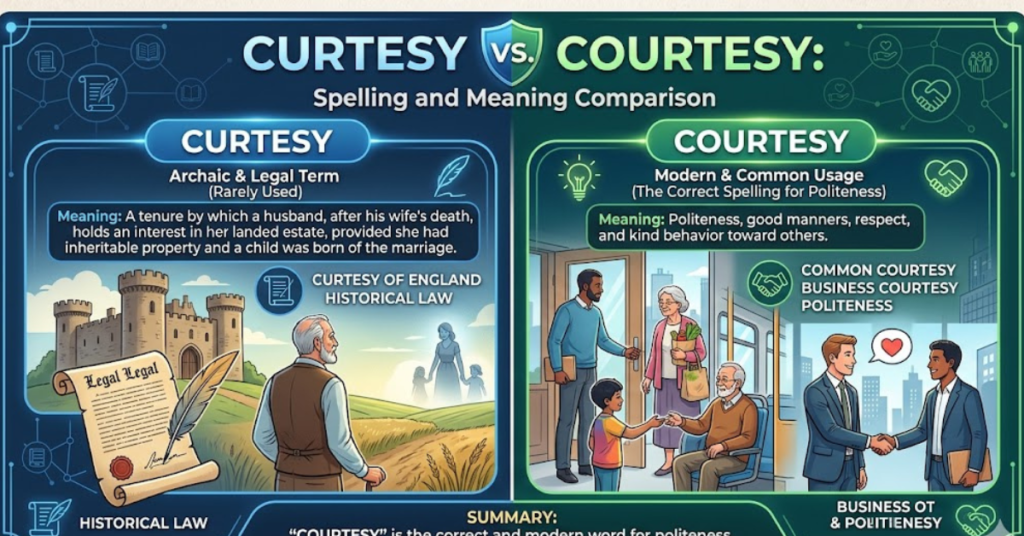
The word “courtesy” refers to polite behavior, respect, and good manners.
Simple Meaning
Courtesy = polite and respectful behavior toward others
Examples of Courtesy
- Saying “please” and “thank you”
- Holding the door open for someone
- Respecting others in conversation
So when people search curtesy vs courtesy meaning, they are usually trying to understand polite behavior in English.
Why “Curtesy” Is Wrong in Modern English
The word “curtesy” is not commonly used in everyday English. It is often:
- a spelling mistake
- a misunderstanding of pronunciation
- confused with an old legal term
Important Note
There is a rare legal term “curtesy” in historical law (related to inheritance rights), but it is not used in modern communication or general English writing.
So in normal usage, “curtesy” is incorrect.
Courtesy Meaning in Everyday Life
Courtesy plays an important role in communication and social behavior.
Real-Life Examples
- Giving up your seat for someone
- Greeting people politely
- Being respectful in conversations
Why Courtesy Matters
- Builds good relationships
- Improves communication
- Shows respect and kindness
So courtesy is not just a word—it reflects behavior.
Common Curtesy vs Courtesy Mistakes
Many people mistakenly write “curtesy” because:
1. Pronunciation Confusion
The word sounds like it could be spelled with a “u.”
2. Typing Errors
Fast typing leads to missing letters.
3. Lack of Exposure
People may not see the correct spelling often.
4. Similar Sounding Words
English has many similar-sounding words that create confusion.
How to Use “Courtesy” in Sentences
Using “courtesy” correctly is simple once you understand the meaning.
Correct Examples
- He showed great courtesy to the guests.
- Please extend courtesy to all visitors.
- It is common courtesy to say thank you.
Incorrect Example
- He showed great curtesy
So in curtesy vs courtesy usage, only “courtesy” fits correctly.
Courtesy in Professional Communication
Courtesy is especially important in formal and workplace settings.
Examples in Professional Use
- Customer service courtesy
- Workplace courtesy
- Email courtesy phrases
Example Sentences
- We appreciate your courtesy in handling the issue.
- Thank you for your courtesy and cooperation.
Simple Trick to Remember Courtesy
Here’s an easy memory tip:
Memory Trick
- Courtesy = “courteous behavior”
- Think of “court” (like royal manners = polite behavior)
This helps you remember the correct spelling quickly.
Curtesy vs Courtesy in Modern English
In today’s English usage:
- Courtesy = standard and correct word
- Curtesy = outdated or incorrect in general use
So when writing emails, essays, or messages, always use “courtesy.”
Common Situations Where Courtesy Is Used
Courtesy appears in many everyday contexts:
Social Situations
- polite greetings
- respectful communication
Workplace
- professional behavior
- customer service
Travel & Public Life
- transport etiquette
- public manners
Quick Summary
Let’s simplify everything:
- Courtesy = correct spelling and meaning (politeness)
- Curtesy = incorrect in modern English usage
- Meaning = polite and respectful behavior
So when you see curtesy vs courtesy, the correct choice is always “courtesy.”
FAQs
Is it curtesy vs courtesy?
The correct spelling is “courtesy.” “Curtesy” is generally incorrect in modern English.
What does courtesy mean?
It means polite and respectful behavior toward others.
Why do people write curtesy?
Because of pronunciation confusion or typing mistakes.
Is curtesy ever correct?
Only in rare historical legal contexts, not in everyday English.
How do you use courtesy in a sentence?
Example: He showed great courtesy to the guests.
What is the difference between curtesy and courtesy?
“Courtesy” means politeness, while “curtesy” is an outdated or incorrect form.
What is the correct spelling of curtesy vs courtesy?
The correct spelling is “courtesy.”
Conclusion
Understanding curtesy vs courtesy is simple once you know the rule: the correct and standard word is “courtesy,” which means politeness and respectful behavior. The form “curtesy” is either a mistake or a rare historical term not used in modern English.
Whether in daily conversation, professional emails, or academic writing, using “courtesy” correctly helps you communicate more clearly and professionally. Once you remember the link between courtesy and courteous behavior, the spelling becomes easy to retain and apply confidently.