
If you’ve ever been unsure whether to write “programme vs program,” you’re definitely not alone. This is one of the most common spelling differences in English, especially when switching between British and American writing styles.
At first glance, both words look correct—and in a way, they are. The difference isn’t about meaning, but about region and style. Understanding when to use each one helps you write more confidently, whether you’re in school, business, or content writing.
Let’s break it down clearly so it finally makes sense.
Programme vs Program Meaning
The simplest way to understand programme vs program meaning is this:
- Both words refer to a planned series of activities or instructions
- They can also refer to software in computing contexts
Simple Definition
Programme / Program = a planned set of activities or instructions
Examples of Meaning
- A TV programme (show)
- A training program (learning plan)
- A computer program (software)
So the meaning stays the same. The only difference is spelling.
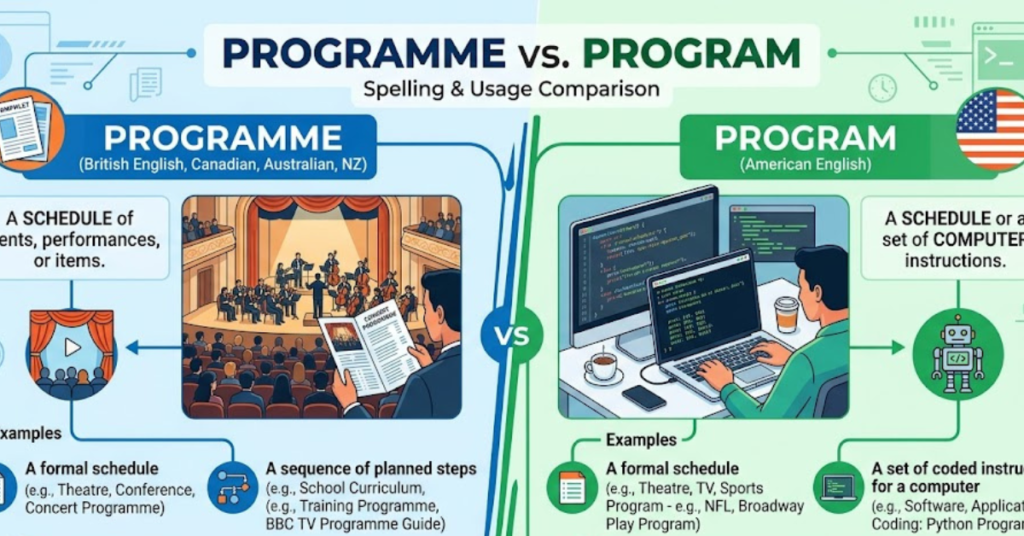
Programme vs Program Difference
The key difference lies in regional English usage.
British English
- Uses “programme” for general use
- Example: TV programme, education programme
American English
- Uses “program” for all contexts
- Example: TV program, education program
So the main programme vs program difference is purely spelling preference based on geography.
British English Spelling: Programme vs Program
In British English, “programme” is the traditional spelling for most uses.
Used in the UK, Ireland, and some Commonwealth countries:
- United Kingdom
- South Africa (in many formal contexts)
- Parts of academic writing
Example Usage in UK English
- The school programme starts next week.
- We watched a television programme.
So when discussing british english spelling programme vs program, “programme” is the standard choice.
American English Spelling: Program
In American English, “program” is used universally.
Used in:
- United States
- Most global tech and software writing
Example Usage
- The computer program is running.
- The event program is well organized.
So in uk english spelling programme vs program, Americans simplify everything to “program.”
Programme vs Program UK, NZ, Australia, and South Africa
Different English-speaking regions follow slightly different rules.
United Kingdom
- Programme (general use)
- Program (mostly computing/software)
New Zealand English (programme vs program NZ)
- Programme is common in general writing
- Program is used in tech contexts
Australia (programme vs program Australia)
- Similar to UK usage
- Programme is preferred in formal writing
South Africa (programme vs program South Africa)
- Often follows British English
- Programme is commonly used
So programme vs program new zealand and other regions depend on context, but British influence is strong in most cases.
Programme vs Program in College and Education
In academic settings, the word often refers to structured learning.
Examples
- Degree programme (UK)
- Study program (US)
So when you see programme vs program in college, both refer to courses or academic structures, just spelled differently.
Programme vs Program for Event
Events also use both spellings depending on region.
British English
- Event programme = schedule of activities
American English
- Event program = same meaning
Example
- The wedding programme listed all speeches.
So programme vs program for event follows the same regional rule.
Programme vs Program Examples
Here are real-world examples to make it clearer:
British English (Programme)
- TV programme
- Training programme
- Cultural programme
American English (Program)
- TV program
- Training program
- Computer program
So programme vs program examples show that meaning never changes—only spelling does.
Programme or Program Meaning in Hindi
To simplify for Hindi speakers:
- Programme / Program = योजना या कार्यक्रम
Example:
- टीवी कार्यक्रम
- प्रशिक्षण कार्यक्रम
- कंप्यूटर प्रोग्राम
So programme or program meaning in hindi stays the same regardless of spelling.
Spelling of Programme or Program Explained Simply
Let’s make it very easy:
- Programme = British spelling
- Program = American spelling
This is the core rule behind programme or program spelling difference.
Define Programme or Program
Simple Definition
Programme / Program = a planned series of actions, events, or instructions designed to achieve a goal
Common Confusion Explained
People often get confused because:
- Both words sound identical
- Both are grammatically correct
- Context does not always change meaning
But once you know the region, the choice becomes easy.
Quick Summary
Here’s the simplest breakdown:
- Programme = British English spelling
- Program = American English spelling
- Meaning = same in both cases
- Difference = regional spelling style
So programme or program is not about correctness—it’s about location and style guide.
FAQs
What is the difference between programme or program?
The difference is spelling: “programme” is British English, “program” is American English.
Which is correct, programme or program?
Both are correct depending on the region.
What is programme or program meaning?
Both refer to a planned set of activities, events, or instructions.
When should I use programme?
Use “programme” in British English writing, especially in the UK and Commonwealth countries.
When should I use program?
Use “program” in American English and most tech-related contexts.
Is programme used in Australia and New Zealand?
Yes, “programme” is commonly used in formal writing in both countries.
Is there a difference in meaning?
No, the meaning is exactly the same.
Conclusion
Understanding programme vs program is actually simple once you know the rule: both words mean the same thing, but the spelling changes depending on whether you are using British or American English.
“Programme” is preferred in the UK, New Zealand, Australia, and South Africa, while “program” is standard in the United States and in computing worldwide.
Once you remember this regional difference, you can confidently choose the correct spelling in any situation—whether you’re writing essays, emails, or professional content.