
English grammar can be surprisingly flexible, especially when it comes to comparisons. One question that often confuses learners and native speakers alike is cleverer vs more clever. Are both correct? Does one sound more natural? And why do people use both forms if they mean the same thing?
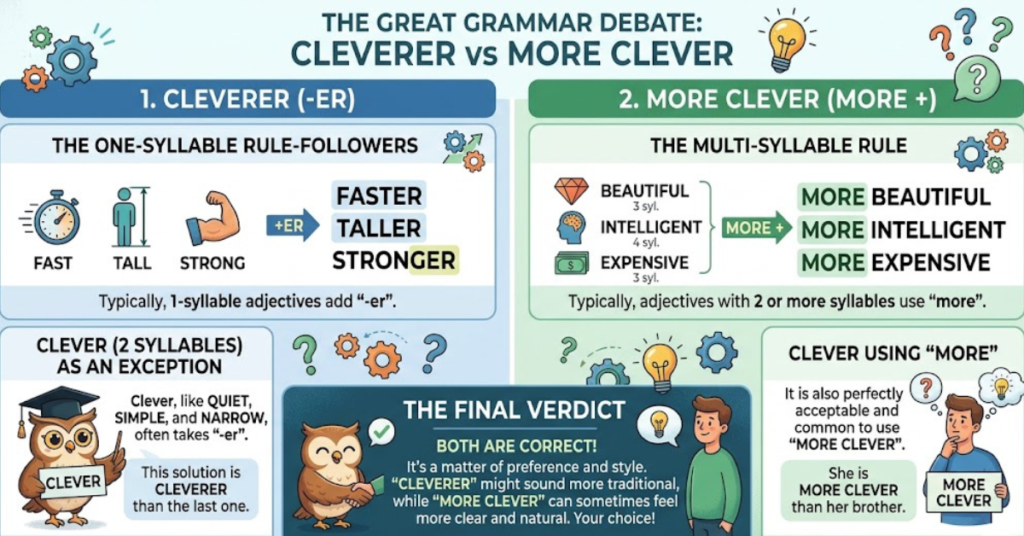
The short answer is simple: both “cleverer” and “more clever” are grammatically correct. However, style, tone, and regional preferences can influence which version sounds better in a sentence.
In this guide, we’ll explore the grammar rules behind comparative adjectives, explain the subtle differences between these forms, and show practical examples that make usage much easier to understand.
What Do “Cleverer” and “More Clever” Mean?
Both phrases compare intelligence, creativity, or quick thinking.
Examples:
- She is cleverer than her brother.
- She is more clever than her brother.
The meaning stays the same in both sentences. The difference mainly involves style and sentence flow.
Understanding Comparative Adjectives
To understand this topic properly, it helps to know how comparative adjectives work.
Comparative adjectives compare two people, things, or ideas.
Common Examples
- tall → taller
- fast → faster
- smart → smarter
- clever → cleverer
Sometimes English also uses “more” before the adjective:
- more beautiful
- more interesting
- more careful
The confusion happens because “clever” can work both ways.
Is Cleverer Grammatically Correct?
Yes, absolutely.
“Cleverer” follows the standard rule for many short adjectives:
- Add “-er” to create the comparative form.
Examples
- He became cleverer over time.
- The younger student sounded cleverer than expected.
- This solution is cleverer than the first one.
Grammar experts widely accept this form.
Is More Clever Also Correct?
Yes. “More clever” is also grammatically correct.
English allows some two-syllable adjectives, including “clever,” to use either comparative structure.
Examples
- She seemed more clever than arrogant.
- The second strategy feels more clever.
- His response was more clever than funny.
Both forms work naturally in modern English.
Cleverer vs More Clever: Main Difference
The biggest difference comes down to style and rhythm rather than grammar.
Cleverer
- Shorter
- More traditional
- Often sounds more direct
More Clever
- Slightly more conversational
- Sometimes sounds smoother in longer sentences
- Common in modern speech
Neither form is wrong.
Why English Allows Both Forms
English grammar is not always rigid. Certain adjectives can take either form because of historical usage and pronunciation patterns.
Words like:
- clever
- simple
- gentle
- quiet
can sometimes use:
- the “-er” ending
- or “more”
This flexibility developed naturally over centuries of language evolution.
Which Form Sounds More Natural?
Usage often depends on context and personal preference.
“Cleverer” Often Sounds:
- More concise
- More formal
- Slightly traditional
“More Clever” Often Sounds:
- Softer
- More conversational
- Easier in longer phrases
For example:
- “That was a cleverer move.”
sounds compact and direct.
Meanwhile:
- “That approach seemed more clever than practical.”
flows more smoothly because of sentence rhythm.
British English vs American English Preferences
Regional habits sometimes influence word choice.
British English
British speakers may use “cleverer” more comfortably in everyday speech and writing.
American English
American speakers sometimes lean toward “more clever,” especially in casual conversation.
However, both forms are widely understood in both regions.
When Writers Prefer Cleverer
Writers often choose “cleverer” when they want:
- Brevity
- Stronger rhythm
- Traditional grammar flow
Examples
- The sequel was cleverer than the original.
- Her answer sounded cleverer than his.
The shorter structure can make writing feel sharper and cleaner.
When Writers Prefer More Clever
Writers may prefer “more clever” when:
- The sentence already feels crowded
- Pronunciation becomes awkward
- A conversational tone fits better
Examples
- The advertisement looked more clever than persuasive.
- His joke was more clever than offensive.
In some sentences, the longer structure simply sounds smoother.
Can You Use Both in Formal Writing?
Yes. Most grammar guides accept both forms.
Still, consistency matters.
Good Practice
Choose one style and use it consistently throughout a piece of writing whenever possible.
Switching repeatedly between “cleverer” and “more clever” can feel uneven to readers.
Common Grammar Rule for Comparatives
Here’s the general guideline:
Short Adjectives
Usually take “-er”
- taller
- smaller
- faster
Long Adjectives
Usually use “more”
- more beautiful
- more complicated
- more important
Flexible Adjectives
Some two-syllable adjectives can use both forms.
“Clever” belongs to this category.
Examples of Cleverer in Sentences
Here are some natural examples.
- The newer design is cleverer and more efficient.
- She gave the cleverer argument during the debate.
- His second book was even cleverer than the first.
- That solution seems cleverer than expected.
These sentences sound concise and polished.
Examples of More Clever in Sentences
Now let’s look at the alternative structure.
- The campaign felt more clever than sincere.
- Her explanation sounded more clever than realistic.
- The ad was more clever than informative.
- He tried to appear more clever than everyone else.
This version often feels slightly more conversational.
Common Mistakes to Avoid
Mistake 1: Thinking One Form Is Wrong
Both are grammatically acceptable.
Mistake 2: Using Double Comparatives
Incorrect:
- more cleverer
Correct:
- cleverer
or - more clever
Never use both comparative forms together.
Mistake 3: Overthinking Natural Flow
Sometimes the best choice is simply the one that sounds smoother in context.
Easy Memory Trick
Here’s a simple rule to remember:
Short and Sharp Sentence?
Use “cleverer.”
Longer or More Conversational Sentence?
“More clever” may sound smoother.
This approach works well in everyday writing.
Why This Grammar Topic Matters
Understanding comparative adjectives improves:
- Writing fluency
- Sentence rhythm
- Professional communication
- Grammar confidence
It also helps you sound more natural when speaking or writing English.
Small grammar choices can subtly affect tone and readability.
How Native Speakers Actually Use These Forms
In real conversation, native speakers use both versions freely.
Some people naturally prefer:
- “cleverer”
Others instinctively choose:
- “more clever”
The choice often depends more on habit and rhythm than strict grammar rules.
FAQs About Cleverer vs More Clever
Is cleverer a real word?
Yes. “Cleverer” is a correct comparative form of “clever.”
Is more clever grammatically correct?
Yes. English allows both “cleverer” and “more clever.”
Which is more common: cleverer or more clever?
Both are common, although preferences vary by speaker, region, and sentence style.
Can I use cleverer in formal writing?
Yes. It is fully acceptable in formal and academic English.
Why does “more clever” sound better sometimes?
Longer sentence structures sometimes flow more naturally with “more clever.”
Is “more cleverer” correct?
No. That is a double comparative and is grammatically incorrect.
Do native speakers use both forms?
Yes. Native speakers regularly use both depending on context and preference.
Conclusion
Understanding cleverer vs more clever is easier once you realize that both forms are grammatically correct. The difference is mostly about style, rhythm, and personal preference rather than strict rules.
“Cleverer” often sounds shorter and more traditional, while “more clever” can feel smoother and more conversational in certain sentences. Neither choice is wrong, and both appear regularly in modern English.
The best approach is to focus on clarity and natural flow. Read your sentence aloud, pay attention to rhythm, and choose the version that sounds most comfortable in context. With practice, selecting the right comparative form will become completely natural.