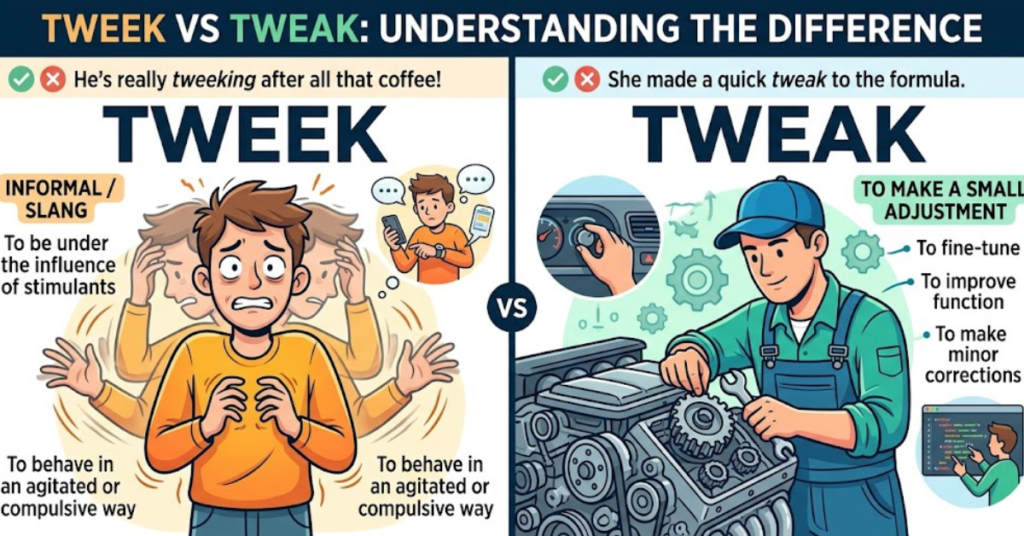

English is full of words that look or sound similar, and that’s exactly why people often get confused about tweek vs tweak. At first glance, the two spellings may seem interchangeable, but only one is considered correct in standard English usage.
If you’ve ever wondered whether “tweek” is a real word or just a common misspelling, you’re not alone. This guide explains the difference clearly, covers proper meanings, shows real-world examples, and helps you avoid one of the most common spelling mistakes in casual and professional writing.
What Does “Tweak” Mean?
“Tweak” is the correct and widely accepted English word.
It generally means:
- To make small adjustments
- To improve something slightly
- To fine-tune details
- To pinch or pull sharply in some contexts
People commonly use “tweak” when talking about improving settings, designs, plans, or performance.
Examples of “Tweak” in Sentences
- I need to tweak the presentation before the meeting.
- She tweaked the recipe to improve the flavor.
- The developer tweaked the website layout.
- Small tweaks can make a big difference.
In most situations, “tweak” refers to minor modifications rather than major changes.
Is “Tweek” a Real Word?
In standard English dictionaries, “tweek” is generally considered a misspelling of “tweak.”
Most people accidentally write “tweek” because:
- It sounds similar when spoken
- English spelling patterns can be confusing
- Words like “week” influence pronunciation assumptions
While you might occasionally see “tweek” online or in informal chats, it is not recognized as the standard spelling in professional writing.
Tweek vs Tweak Meaning Explained
Understanding tweek vs tweak meaning becomes much easier once you know that only “tweak” is officially correct.
Here’s the simple breakdown:
- “Tweak” = correct spelling
- “Tweek” = common misspelling
This confusion is similar to other English spelling mix-ups where pronunciation does not perfectly match spelling rules.
Why People Confuse “Tweek” and “Tweak”
English pronunciation often creates spelling challenges because many words don’t follow predictable phonetic patterns.
People may assume “tweek” is correct because:
- “Twea” is less visually familiar than “wee”
- The pronunciation sounds like “tweek”
- Fast typing causes spelling errors
- Social media and texting encourage informal spelling
Over time, repeated online usage makes the incorrect spelling appear more believable.
Common Contexts Where “Tweak” Is Used
“Tweak” appears in many industries and everyday situations.
Technology
People frequently use “tweak” in tech conversations.
Examples include:
- Tweaking software settings
- Tweaking website performance
- Tweaking gaming graphics
Writing and Editing
Writers often tweak content before publishing.
For example:
- Tweaking headlines
- Tweaking sentence structure
- Tweaking tone and readability
Design and Creativity
Designers use the word when making small visual improvements.
Examples:
- Tweaking colors
- Tweaking layouts
- Tweaking logos
Personal Habits
The word also appears in self-improvement discussions.
Example:
- Tweaking your daily routine for better productivity
Difference Between Minor Changes and Major Changes
One reason “tweak” is useful is because it specifically implies small modifications rather than complete transformations.
A Tweak Usually Means:
- Small adjustments
- Fine-tuning
- Improving details
- Minor corrections
A Major Change Means:
- Full redesign
- Complete replacement
- Significant alteration
- Large-scale modification
This subtle distinction makes “tweak” especially valuable in professional communication.
Pronunciation of “Tweak”
The word “tweak” is pronounced as:
- Tweek
This pronunciation is one of the main reasons spelling confusion exists. Even though it sounds like “tweek,” the correct spelling remains “tweak.”
Synonyms for “Tweak”
If you want alternatives to the word “tweak,” several synonyms work depending on context.
Common Synonyms
- Adjust
- Modify
- Fine-tune
- Improve
- Refine
- Alter slightly
- Edit
- Revise
These words can sometimes sound more formal or specific depending on usage.
Examples of Incorrect and Correct Usage
Seeing side-by-side examples can help reinforce the correct spelling.
Incorrect
- I need to tweek my resume.
- She tweeked the settings.
Correct
- I need to tweak my resume.
- She tweaked the settings.
Using the correct spelling improves clarity and professionalism.
Why Correct Spelling Matters
Spelling mistakes may seem small, but they can affect how your writing is perceived.
Correct spelling helps:
- Improve professionalism
- Build credibility
- Increase readability
- Avoid confusion
- Strengthen communication
This is especially important in emails, resumes, business documents, and academic writing.
How to Remember the Correct Spelling
Simple memory tricks can make the correct spelling easier to recall.
Helpful Tip
Think of the word:
- “Weak” = contains “ea”
- “Tweak” = also contains “ea”
Although not a perfect language rule, this association helps many people remember the correct form.
Another useful strategy is reading more professionally edited content, where you consistently see the proper spelling used.
Is “Tweek” Ever Acceptable?
In standard English writing, “tweek” is generally not considered acceptable.
However, there are rare exceptions:
- Usernames
- Brand names
- Fictional character names
- Intentional stylized spelling
Outside of those situations, “tweak” remains the correct choice.
FAQs
Which is correct: tweek or tweak?
“Tweak” is the correct spelling in standard English.
What does tweak mean?
“Tweak” means to make small adjustments or improvements to something.
Is tweek a dictionary word?
Most standard dictionaries do not recognize “tweek” as a correct English word.
Why do people spell tweak as tweek?
The confusion mainly comes from pronunciation because “tweak” sounds like “tweek” when spoken aloud.
Can I use tweek in informal writing?
You technically can, but it may still appear incorrect to readers.
What are examples of tweaking something?
Examples include tweaking settings, tweaking a design, or tweaking a schedule for better results.
Conclusion
Understanding the difference between tweek vs tweak is actually quite simple once you know the correct spelling. “Tweak” is the proper English word and refers to making small adjustments or improvements, while “tweek” is usually just a spelling mistake caused by pronunciation confusion.
Because “tweak” appears frequently in technology, writing, business, and everyday conversations, learning the correct usage can improve both your communication and professionalism. Small spelling corrections may seem minor, but they often make a stronger impression than people realize.
If you enjoy exploring commonly confused words and language tips, continuing to study these subtle English differences can sharpen your writing skills even further.