
You’ve probably heard someone say, “Apparently, it’s going to rain today,” but what does that really mean? Understanding apparently meaning can help you sound more natural and confident in everyday conversations. This small but powerful word is often used to express uncertainty, assumptions, or secondhand information.
In this guide, we’ll break down what “apparently” means, how to use it correctly, and explore real-life examples so you can apply it effortlessly.
What Is Apparently Meaning?
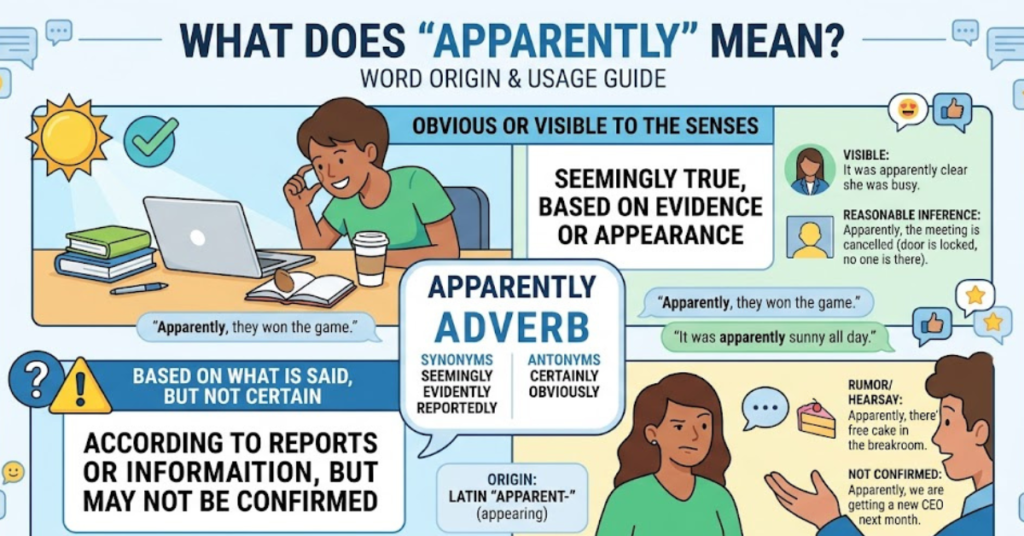
At its core, “apparently” is an adverb used to describe something that seems true based on what you’ve seen, heard, or been told—but you’re not 100% certain.
Simple Definition
- It indicates something appears to be true.
- It often reflects secondhand information.
- It can express mild surprise or doubt.
In Easy Words
“Apparently” means:
- “As far as I know”
- “It seems like”
- “I heard that”
Apparently Meaning in Different Contexts
Understanding how context changes meaning is key to mastering this word.
1. Based on Information
Used when you heard something from someone else.
- Apparently, the meeting has been canceled.
- Apparently, she moved to another city.
2. Based on Observation
Used when something looks a certain way.
- Apparently, he’s upset about something.
- Apparently, the store is closed today.
3. Expressing Surprise
Sometimes it shows mild shock or disbelief.
- Apparently, they finished the project in one day.
- Apparently, he won the competition without practice.
Apparently Meaning in Hindi and Other Languages
Many learners search for translations to understand better.
- Apparently meaning in Hindi: “शायद” or “लगता है”
- In Tamil: “வெளிப்படையாக” or “தெரிகிறது”
- In Malayalam: “തോന്നുന്നത് പോലെ”
While translations vary slightly, the core idea remains the same—something that appears true but isn’t fully confirmed.
How to Use “Apparently” in Sentences
Using “apparently” correctly is easier than you think.
Sentence Placement
You can place it:
- At the beginning
- In the middle
- At the end (less common)
Examples
- Apparently, he forgot the deadline.
- She apparently knows the answer.
- The event was canceled, apparently.
Apparently vs Similar Words
“Apparently” is often confused with similar adverbs.
Common Alternatives
- Obviously: Something clearly true
- Evidently: Based on clear evidence
- Seemingly: Appears true but may not be
Key Difference
“Apparently” suggests uncertainty or secondhand knowledge, while others may imply stronger certainty.
Common Mistakes to Avoid
Even simple words can be misused. Here are a few pitfalls:
- Assuming it means “definitely” (it doesn’t)
- Overusing it in formal writing
- Using it without context or clarity
Quick Tip
If you’re not fully sure about something, “apparently” is your safe choice.
When Should You Use “Apparently”?
This word works best in everyday conversations and informal writing.
Ideal Situations
- Sharing rumors or news
- Making assumptions
- Describing something that seems true
Avoid Using It
- In highly formal or academic writing
- When stating confirmed facts
FAQs
What is apparently meaning in simple words?
It means something seems true based on what you’ve heard or observed, but you’re not completely sure.
Can “apparently” be used in formal writing?
It’s better suited for informal or conversational contexts, though it can be used carefully in formal writing when uncertainty is intended.
Is “apparently” the same as “obviously”?
No. “Obviously” shows certainty, while “apparently” suggests doubt or indirect knowledge.
How do you use “apparently” in a sentence?
You can start a sentence with it or place it before the verb, like: “Apparently, he left early.”
What is apparently meaning in Hindi with example?
It means “शायद” or “लगता है.”
Example: “Apparently, वह घर पर नहीं है।”
Conclusion
Understanding apparently meaning helps you communicate with nuance and clarity. It’s a simple word, but it adds depth by signaling uncertainty, secondhand information, or observation.
Use it when you’re not completely sure but still want to share information. With practice, you’ll find it naturally fitting into your daily conversations and writing.
If you want to improve your English further, explore similar words and practice using them in real-life situations.