
You’ve probably typed “infront” at least once and wondered if it looked right. If you’re unsure about infront or in front, you’re not alone. This is one of those small grammar details that can make a big difference in clear writing.
In this guide, we’ll break down the correct spelling, explain the grammar rules, and show real-life examples so you can use the phrase confidently every time.
Infront or In Front: Which Is Correct?
Let’s clear it up right away.
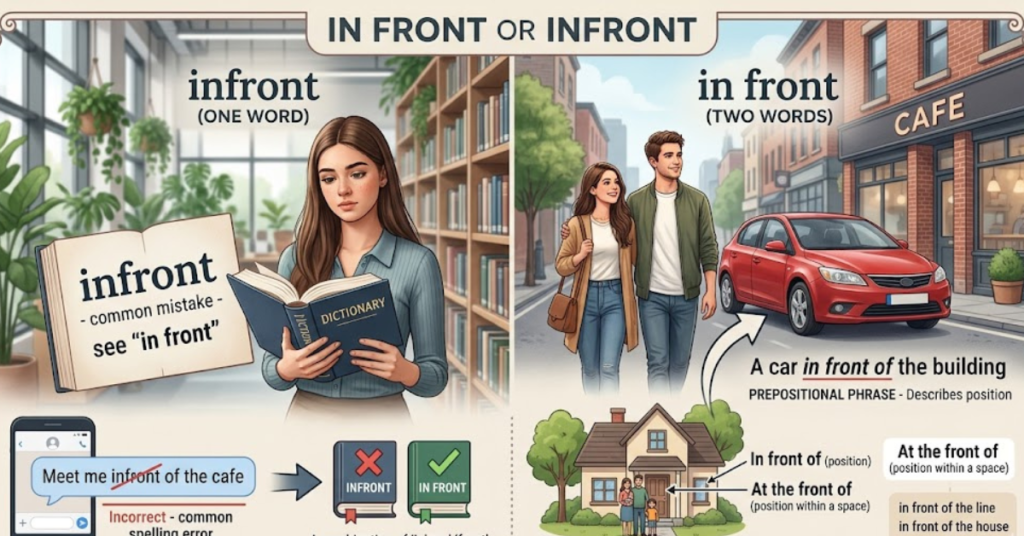
“In front” is correct.
“Infront” is incorrect in standard English.
The correct form is always written as two separate words. While “infront” might appear in casual typing or online posts, it’s not accepted in formal writing or proper grammar.
Understanding the Meaning of “In Front”
To use the phrase correctly, it helps to understand what it actually means.
In Front Meaning
“In front” refers to a position ahead of something or someone. It indicates location or direction.
Simple Explanation
- It describes something positioned before another object
- It’s often used with “of” (in front of)
- It answers the question: Where?
Examples
- “The car is parked in front of the house.”
- “She stood in front of the class.”
These examples clearly show how the phrase works in everyday language.
Infront or In Front Grammar Rules
When it comes to grammar, “in front” is a prepositional phrase.
Key Grammar Points
- “In” is a preposition
- “Front” is a noun
- Together, they form a phrase describing position
Why “Infront” Is Incorrect
English does not combine these two words into one. Unlike words such as “inside” or “into,” this phrase remains separate.
So, if you’re asking, is it infront or in front, the answer is always the two-word version.
In Front of: How to Use It Correctly
You’ll often see the phrase used with “of.”
In Front of Usage
This form connects the position to a specific object or person.
Examples
- “The dog is sitting in front of the door.”
- “He parked his bike in front of the store.”
Quick Tip
Always follow “in front of” with a noun or object for clarity.
Infront or In Front Difference Explained
Understanding the difference is simple once you see it clearly.
Key Differences
- “In front” is correct and widely accepted
- “Infront” is a common mistake
- The correct form is used in both formal and informal writing
Even in casual conversations, using the correct version improves clarity and credibility.
In Front Examples in Daily Use
To make things easier, here are more examples you can relate to.
Everyday Examples
- “He stood in front of me in line.”
- “The teacher is standing in front of the board.”
- “There’s a shop right in front of the building.”
Sentence Practice
- “The car stopped in front of the gate.”
- “She waited in front of the cinema.”
These examples show how natural and common the phrase is.
Infront or In Front UK Usage
If you’re wondering about regional differences, the answer is simple.
UK vs US English
- Both UK and US English use “in front”
- “Infront” is incorrect in both versions
So, no matter where you are, the correct spelling stays the same.
Synonyms and Alternatives for “In Front”
If you want variety in your writing, you can use similar expressions.
In Front Synonym Options
- Ahead of
- Before
- Opposite
- Facing
Example
Instead of “The car is in front of the house,” you could say:
- “The car is parked ahead of the house.”
Using synonyms can make your writing more dynamic.
Common Mistakes to Avoid
Even simple phrases can cause confusion if you’re not careful.
Avoid These Errors
- Writing “infront” as one word
- Forgetting to use “of” when needed
- Using the phrase without a clear reference
Quick Reminder
Always double-check your spelling when writing formal content.
FAQs
Is it infront or in front?
The correct form is “in front.” “Infront” is not considered correct in standard English.
What does in front mean?
It refers to a position ahead of something or someone.
Can I use infront in informal writing?
Even in informal writing, it’s better to use “in front” to avoid mistakes.
How do you use in front of in a sentence?
Example: “The car is parked in front of the house.”
Is in front used the same in UK and US English?
Yes, both use “in front” as the correct form.
Conclusion
When it comes to infront or in front, the answer is clear: “in front” is the only correct option. It’s a simple two-word phrase that plays an important role in everyday communication.
By understanding its meaning, grammar, and proper usage, you can avoid common mistakes and write with more confidence. Keep practicing with real examples, and soon it will feel completely natural to use the correct form every time.